
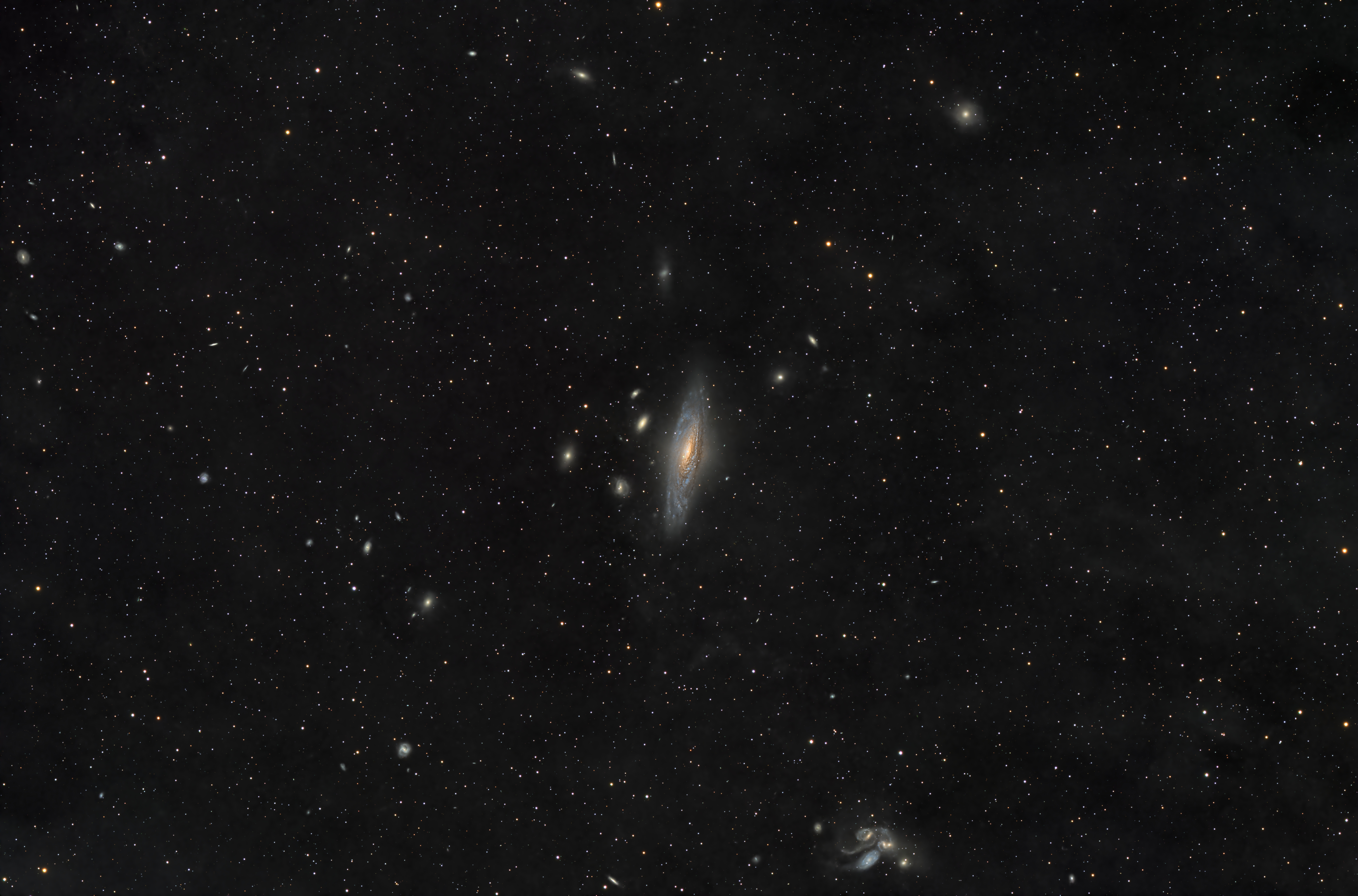
NGC7331 and SN2026aaiv
This started out as a simple shot of the latest supernova in NGC7331, taken after I finished testing a new polar alignment routine in MosaicEngine.
I had a couple of hours before the late movie I was watching was over so I decided to shoot 2 hours of data to catch the supernova. After processing the data,
I was suprised at what the combination of tack sharp optics, a modern one shot colour CMOS camera and the latest generation of processing tools can do.
I acquired the data under bright Bortle 7 urban skies and even in just two hours the IFN around that area of sky is starting to show up.
I've added five more hours to bring out some detail in the galaxy and to make the IFN more visible.
This is the second supernova in two years visible in this galaxy, with the first being SN2025RBS, visible in this image captured during July, 2025. A supernova is one of the ways a star can die.
Large stars are short lived, on a cosmic time scale, burning through their hydrogen fuel relatively quickly in 20 million years or so. When this happens, nuclear fusion stops and the star collapses, compressing the core to
extreme densities. A slight rebound blows the outer layers into space leaving the core behind as a neutron star or a black hole. Supernovae are very bright, often outshining the surrounding galaxy by orders of magnitude. SN2026aaiv
is visible as the bright star just to the lower left of the core of the galaxy.
Use the zoom to view the detail in the main galaxy, the supernova is the brightest star near the core. There are over 30 galaxies in this image with some of the brightest being the Deer Lick Group, just to the left of NGC7331, and Stephan's Quintet
to the right of center at the bottom of the image. Clicked on the "Annotated Image" tab to see a version of the picture showing the location of many of the galaxies visible in the data.
Click on the image repeatedly to zoom in and click and drag to look around the zoomed image. Move your mouse off the image to reset the zoom.
| RA: | 22:37:06 |
| Dec: | +34:25:23 |
| Date: | October 2026 |
| Exposure: | 8 hours of RGB data (24 X 10 minutes) |
| Conditions: | Bortle 7 urban skies, no Moon. |
| Gain: | 100 |
| Camera: | Zwo ASI2600MC Pro |
| Optics: | Prime focus of a SkyWatcher Esprit 120 f/7 APO refractor with a focal length of 840 mm |
| Filter: | none |
| Location: | Bedford, Nova Scotia |
Processed entirely in PixInsight using several plug-ins, Blur Exterminator for deconvolution, Noise Exterminator for noise reduction, GHS for stretching, Seti-Astro
suite for mask generation, and Star Exterminator to produce a starless image. The workflow is as follows:
1. Calibration and stacking done in PixIngsight.
2. Deconvolution using Blur Exterminator.
3. Gradient correction applied to help enhance the darker areas by reducing the overall background brightness using Graxpert.
4. Colour calibration using SPCC in PixInsight.
5. Noise reduction using Noise Exterminator with three iterations and luminance and colour as well as frequency separation.
6. Star Exterminator was used to produce starless and star only images.
7. The galaxy image was duplicated.
8. GHS used to stretch the galaxy and the star images differently. One galaxy image was stretched to the point where galactic detail washed out but the IFN became visible.
9. Local Histogram Equalization was used with a mask to enhance the core of the galaxy.
10. Unsharp mask used to sharpen the galaxy detail using the same mask.
11. TVGDenoise used with a mask to reduce the noise in both galaxy images.
12. Multiscale medium transform used with a mask to clean up the galaxy image with the IFN faintly visible.
13. LMS processing was used to combine the galaxy images and the saturation boosted on the resulting image.br>
14. The new galaxy image was combined with the star only image using pixel math with the expression combine(galaxy,stars,op_screen()).
15. The image was cropped and rotated for this web page.