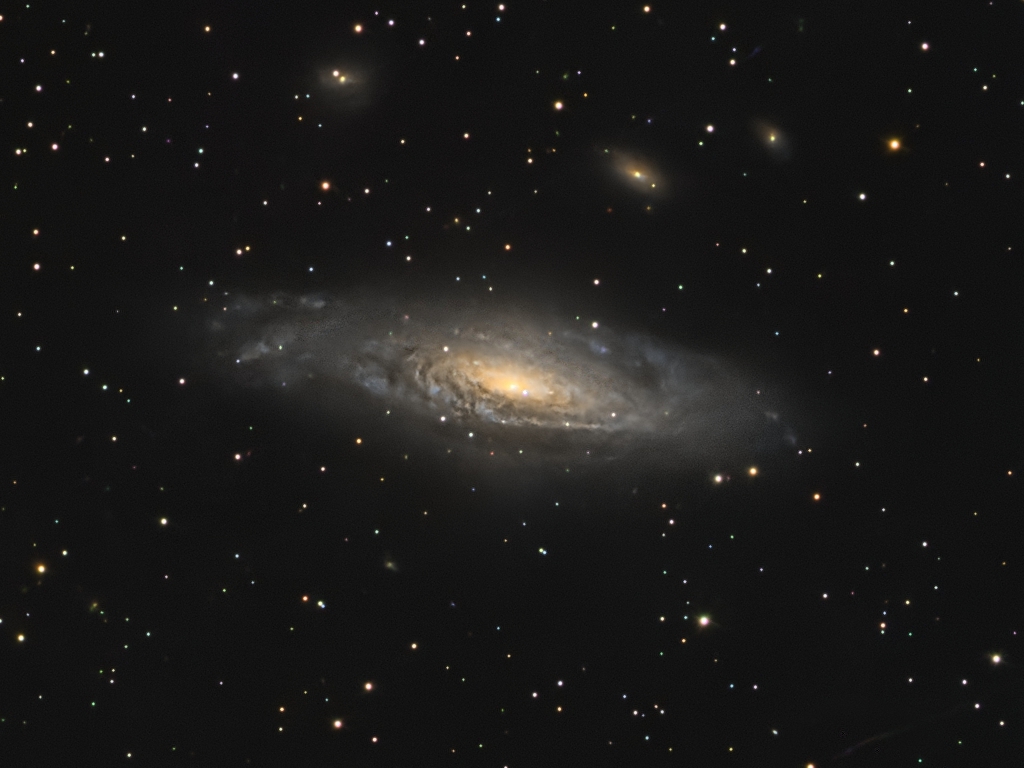

Definately not one of my better astrophotos, but what can you do with our weather. The target (NGC7331) was low
in the east for this shot as I had to start early because cloud was moving in later in the evening. I only managed
an hour on the target, and most of that was through a smokey haze due to summer forest fires.
A supernova is a titanic explosion that happens at the end of a massive star's life. The fusion reaction
that had been sustaining the star throughout its life shuts down leading to a rapid collapse of the star.
The resulting explosion can shine brighter than the millions of stars in the galactic core, as seen in this picture.
What is left over depends on the mass of the core that is left. If the mass is below 2 solar masses then
it will form a neutron star, any more massive and the stellar remnant forms a black hole.
The type Ia supernova was discovered by GOTO (USA) and is located in a
nearby spiral galaxy, NGC7331, about 40 million light-years away.
| RA: | 22:37:06 |
| Dec: | +34:25:07 |
| Date: | 25 July, 2025 |
| Exposure: | 1 hour (6 X 10 minutes) |
| Conditions: | Bortle 4 to 5 skies, very poor seeing with obsucring smoke and high cloud |
| Gain: | 100 |
| Camera: | Zwo ASI2600MC-Pro |
| Optics: | Prime focus of a SkyWatcher Esprit 120 f/7 APO refractor with a focal length of 840 mm |
| Filter: | None |
| Location: | Marion Bridge, Nova Scotia |
Processed entirely in PixInsight using several plug-ins, Blur Exterminator for deconvolution, Noise Exterminator for noise reduction, GHS for stretching, Seti-Astro
suite for gradient removal and StarNet++ to produce a starless image.
1. Calibration and stacking done using the WBPS.
2. Deconvolution using Blur Exterminator.
3. Gradient removal using GraXpert.
4. Spectrophotometric Colour Calibration.
5. Noise reduction using Noise Exterminator with three iterations.
6. StarNet++ was used to produce a starless image and a star only image.
7. GHS was used multiple times to stretch the starless image, with the first stretch using colour mode to enhance the colour in the galaxies.
8. Local Histogram Equalization was used with a mask to enhance the core contrast of the galaxy.
9. Unsharp mask used to sharpen the core detail using the same mask.
10. TVGDenoise used to smooth the background using the inverse of the mask to protect the galaxy core.
11. HistogramTransformation used to set the black point.
12. The image identifer set to g.
13. GHS used to stretch the star only image paying attention to the star profile. No attempt to retain colour. Image luminance extracted.
14. GHS used on a copy of the unstretched star only image in colour mode to stretch the image. Attention was paid to the star colour.
15. Convolution used in three iterations to slightly blur the colour star image to remove odd colour halos made by GHS using an inverted mask made from the star luminance image.
16. Saturation increased using GHS in saturation mode.
17. The LRGB tool was used to combine the star luminance image with the star colour image. This produces a better colour star image than GHS alone. Image ID set to s.
18. Pixel math used to recombine the star image with the galaxy image with s+g-s*g as the combination expression.
19. ICC profile set to sRGB.
20. Image stored then binned by two for web upload and stored as a jpeg.