
| I was experimenting with
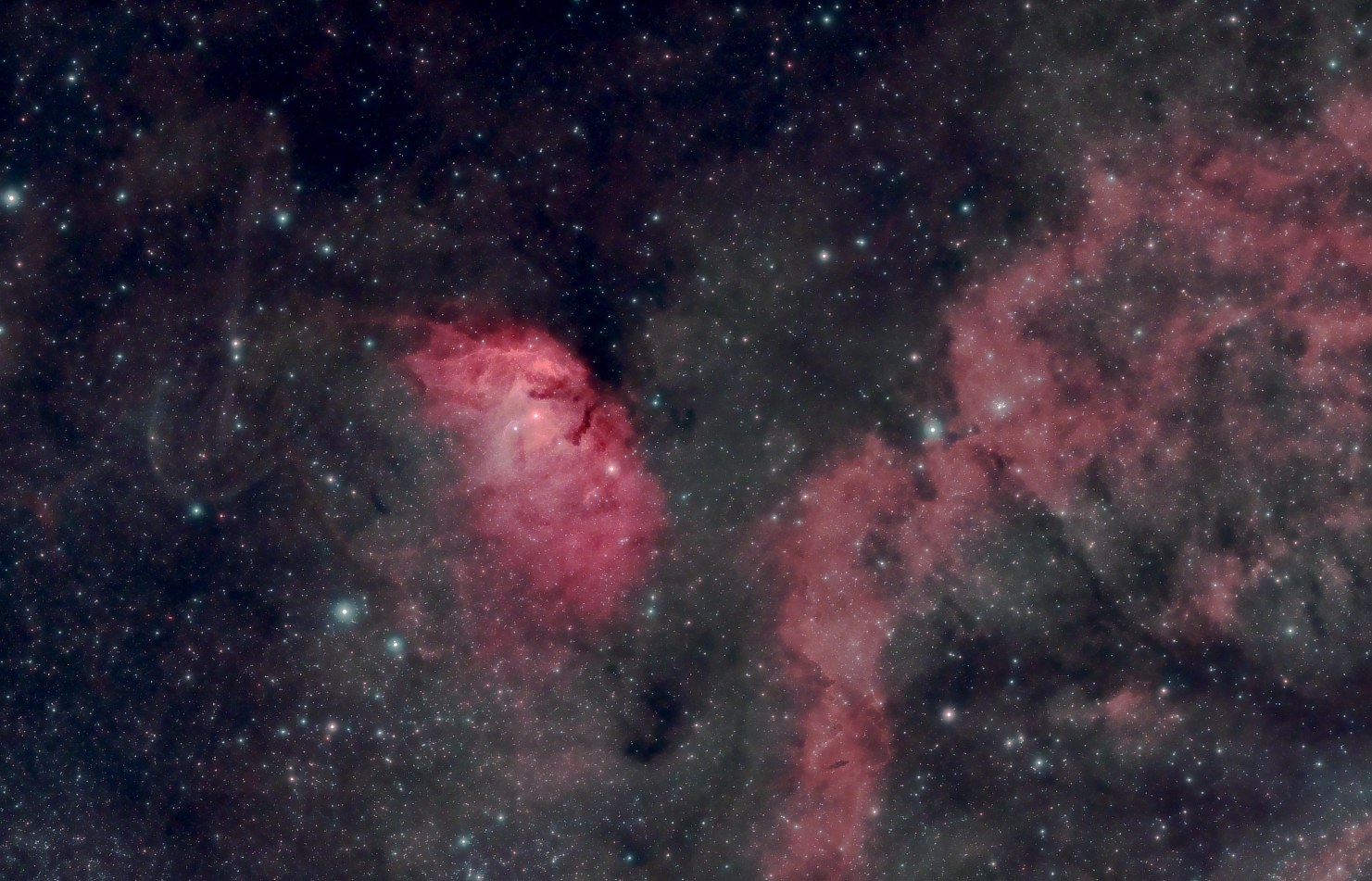
a Tulip Nebula
image I took over the summer (Aug 2021) to see what if any detail I may
have captured from Cygnus-X1. I suppressed the stars a fair amount and
boosted the background contrast significantly. I'd never do this for a
pretty picture, but to reveal everything captured in the data it often
works as well as a negative image. The picture below shows relitavistic
jets and a bow shock as one of the jets slams into the interstellar
medium.
Click on the image below to see an annotated version click
again to return to this page. According to Wikipedia - Cygnus X-1 (abbreviated Cyg X-1) is a galactic X-ray source in the constellation Cygnus and was the first such source widely accepted to be a black hole. It was discovered in 1964 during a rocket flight and is one of the strongest X-ray sources seen from Earth, producing a peak X-ray flux density of 2.3×10⁻²³ Wm−2 Hz−1 (2.3×10³ Jansky). It remains among the most studied astronomical objects in its class. The compact object is now estimated to have a mass about 21.2 times the mass of the Sun and has been shown to be too small to be any known kind of normal star, or other likely object besides a black hole. If so, the radius of its event horizon has 300 km "as upper bound to the linear dimension of the source region" of occasional X-ray bursts lasting only for about 1 ms. Cygnus X-1 belongs to a high-mass X-ray binary system, located about 6,070 light-years from the Sun, that includes a blue supergiant variable star designated HDE 226868 which it orbits at about 0.2 AU, or 20% of the distance from the Earth to the Sun. A stellar wind from the star provides material for an accretion disk around the X-ray source. Matter in the inner disk is heated to millions of degrees, generating the observed X-rays. A pair of jets, arranged perpendicularly to the disk, are carrying part of the energy of the infalling material away into interstellar space. This system may belong to a stellar association called Cygnus OB3, which would mean that Cygnus X-1 is about five million years old and formed from a progenitor star that had more than 40 solar masses. The majority of the star's mass was shed, most likely as a stellar wind. If this star had then exploded as a supernova, the resulting force would most likely have ejected the remnant from the system. Hence the star may have instead collapsed directly into a black hole. Cygnus X-1 was the subject of a friendly scientific wager between physicists Stephen Hawking and Kip Thorne in 1975, with Hawking betting that it was not a black hole. He conceded the bet in 1990 after observational data had strengthened the case that there was indeed a black hole in the system. This hypothesis lacks direct empirical evidence but has generally been accepted from indirect evidence. |
||||||||||||||||||||
 |
||||||||||||||||||||
|