
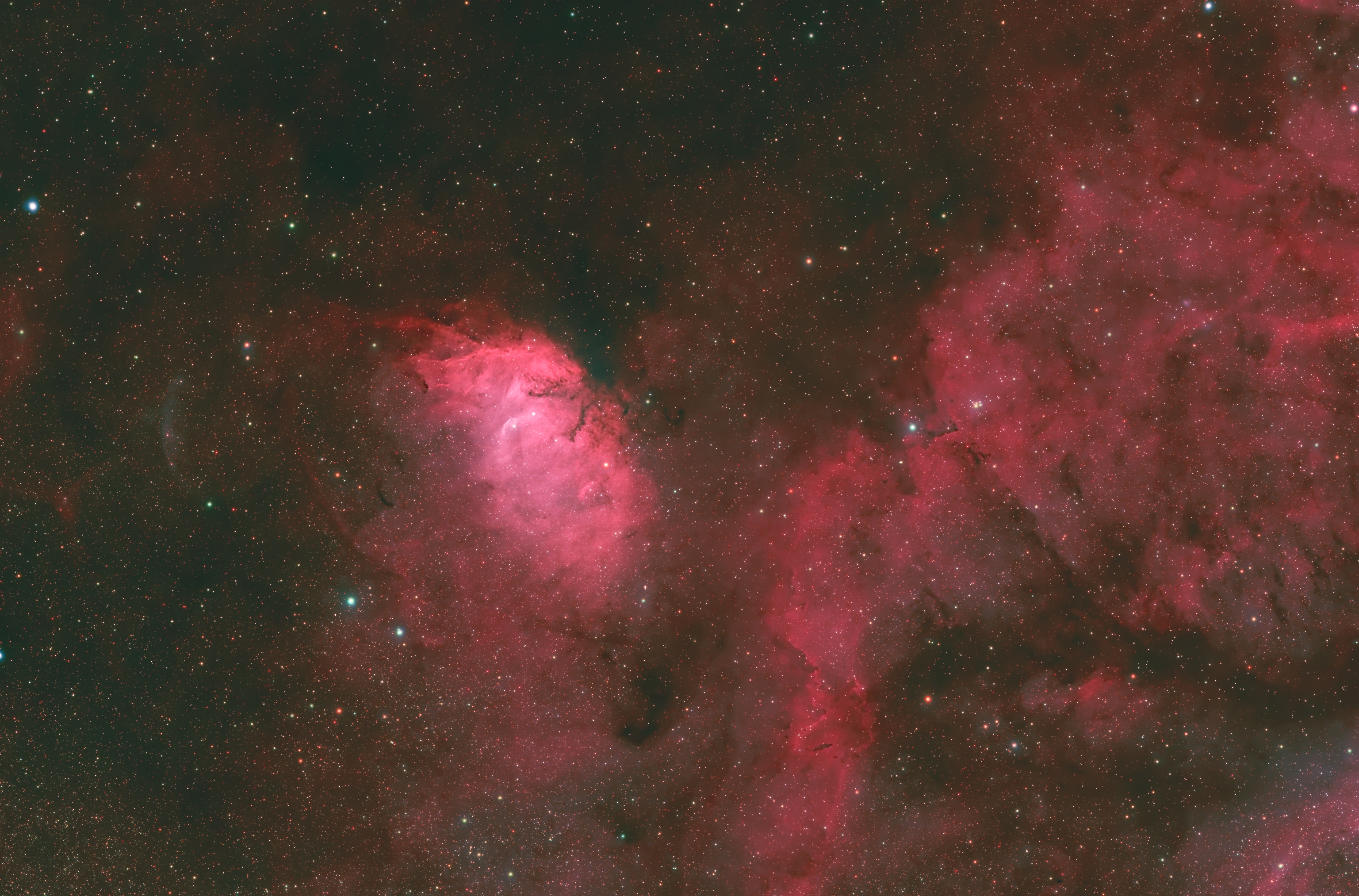
| SH2-101, also known as
the Tulip nebula, is a bright nebula in Cygnus with the brightest part
shaped like a tulip with the petals open toward the lower left corner
in this image. According to Wikipedia
- It was cataloged by astronomer Stewart Sharpless in his 1959 catalog
of nebulae. It lies at a distance of about 6000 light-years (5.7×10^16
km; 3.5×10^16 mi) from Earth. The companion star of the black hole,
Cygnus-X1, is also in the field - the top reddish star of a red and
white pair of stars just to the upper left of the Tulip. The image was taken from rural, dark skies using an Optolong L-eNhance filter to increase the contrast in the nebula. As the exposure was short and the seeing poor, the image has been binned two by two in post processing to reduce it for web display and to increase the SNR. This is my third attempt at processing this data. In both previous attempts I had problems with the image colour becoming monochrome red. In my second attempt I used a mask and reduced the saturation to make a passible image. There is a lot going on in this image with bright emission nebulae several dark nebulae and lots of gas and dust. The bow shock from one of the jets of Cygnus X1, a black hole, is faintly visible as a green-blue semi-circular shape just to the left of the Tulip Nebula. Click on the image below to cycle through the three attempts and once more to see a higher resolution version of this image. Click again to return to this page. |
||||||||||||||||||||
 |
||||||||||||||||||||
|