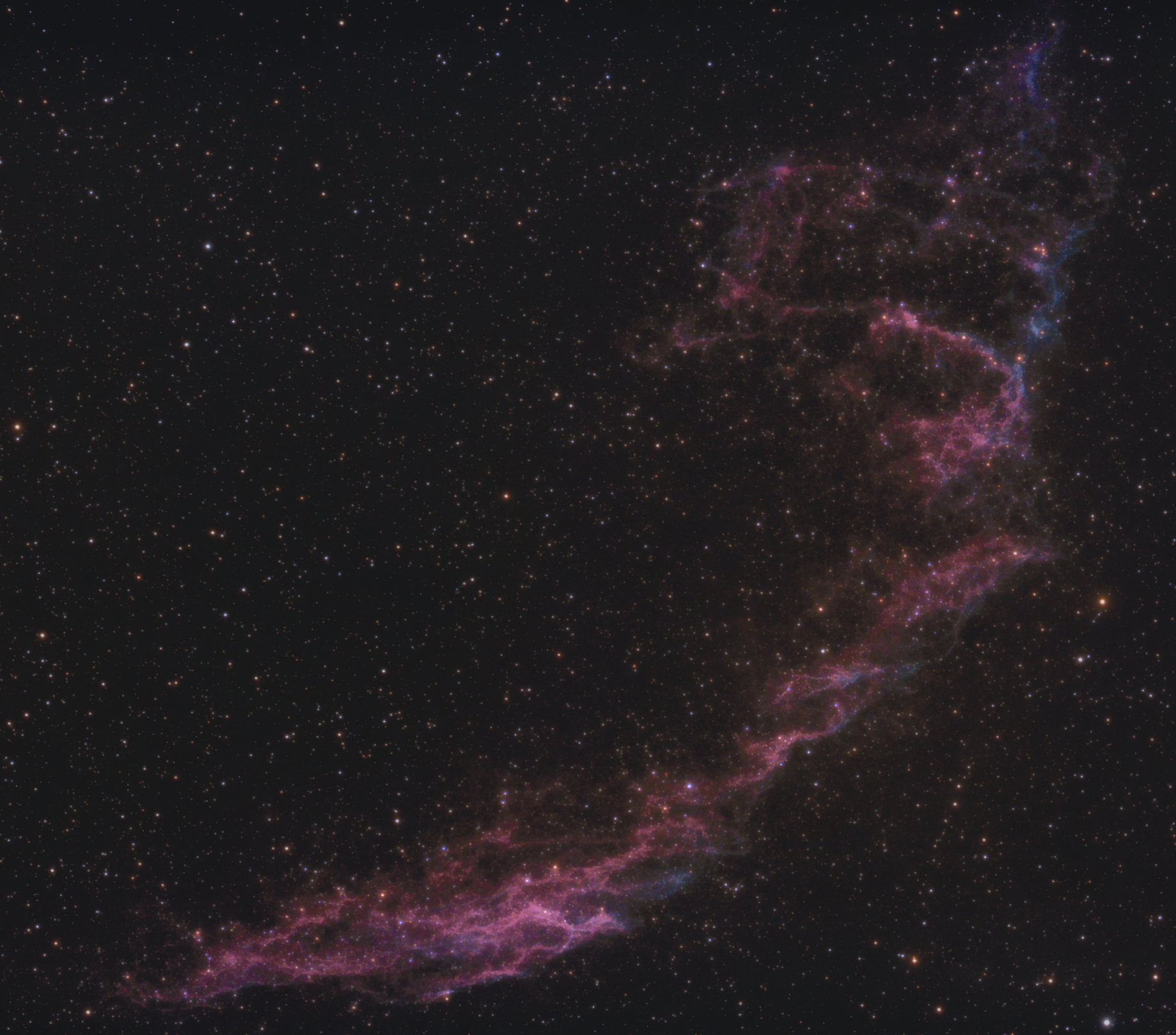
Urban NGC6992

Here is another in a series of urban efforts taken to show that you can capture such images from city skies. NGC6992 has an integrated magnitude of  about 7 and a size of 60 by 8 arc-minutes giving a surface brightness of  about 22.6 magnitudes per arc-second. This image was taken from an urban site with the first quarter Moon high in the sky, giving a sky brightness of 18.3 magnitudes per arc-second. This equates to a Bortle 7 sky, clearly in the red zone and although nowhere a nice as what can be captured under a truly dark sky it does compare well with this version taken from a dark sky Bortle 2 site. The dark sky version has had  more star reduction applied to control the star bloat caused by my reflector's secondary mirror. No filters were used to capture this urban data. The image could use a lot more exposure, but it was a weekday and I had to work the next morning. With more exposure I could back off on the noise reduction keeping some more of the fine detail. I may do this as an experiment later in the month once the Moon moves out of the sky.
Object NGC6992  Object RA 20:57:12 Dec 31:47:31
Date 10 July 2019
Exposure 39 minutes (13 X 180 seconds) 
ISO 800
Camera Canon 60Da DSLR
Optics SkyWatcher Esprit 120  f/7 APO refractor with  a  focal length of 840 mm
Location Bedford, Nova Scotia
Processing This image was processed entirely in Images Plus. Calibration, stacking, statistical filter applied to reduce noise before stretching. Masked stretching and split star processing used to enhance the image. Masked noise reduction using a frequency domain lowpass filter applied to the DSO layer and then it was recombined with the star layer. Image binned 2 by 2. Final sharpening, a slight start reduction and a saturation boost rounded out the processing. Since the 60Da has on sensor dark suppression no darks were used in the calibration.