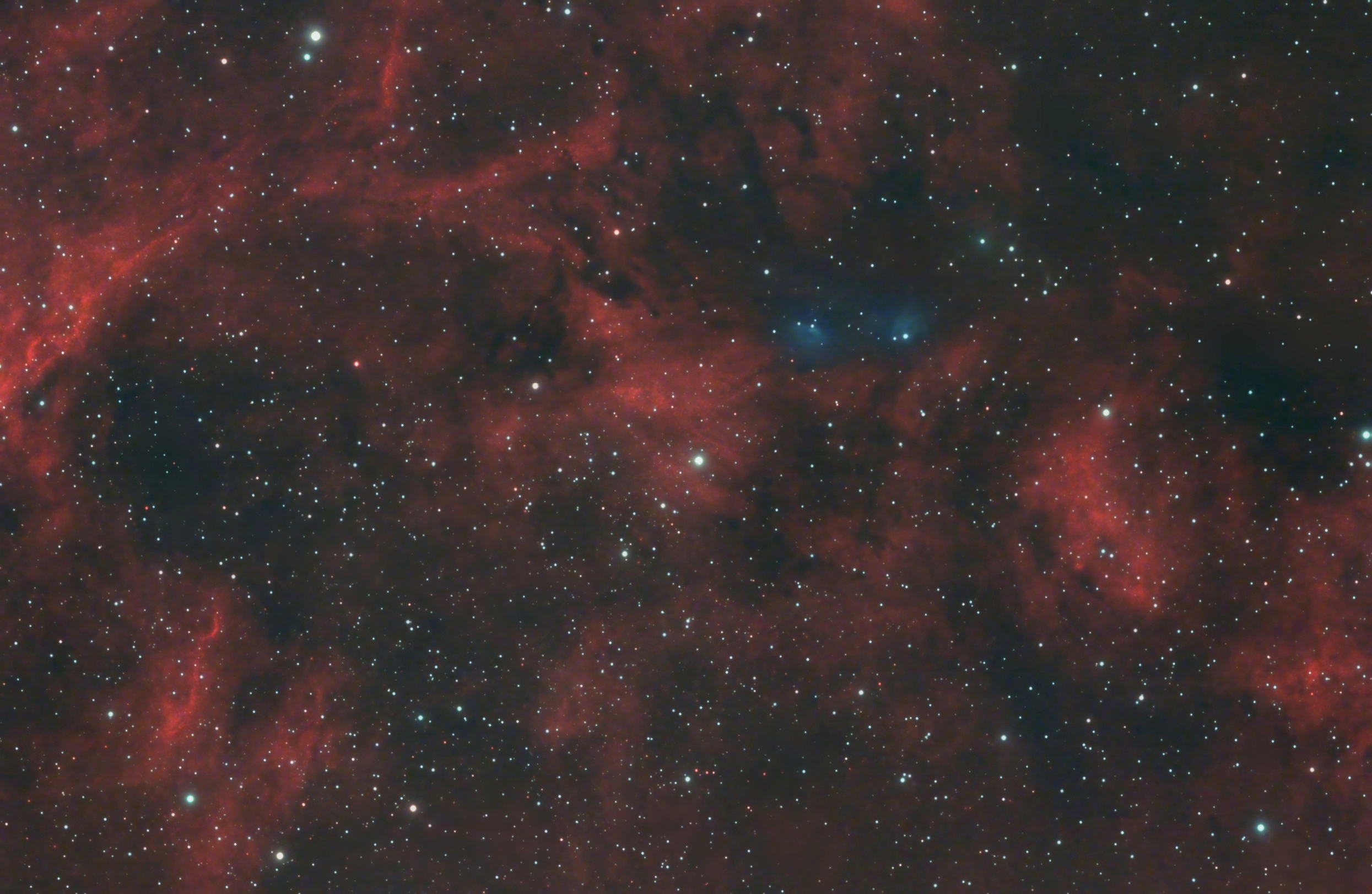
Here is
another urban
image taken from my driveway .
This shot was taken
looking almost straight up with less light pollution than looking to
the south. I've never been a fan of exposing longer than the present
age of the universe to get a good image, but this one was cut short at
two hours as I had to work the next day. I still plan on another couple
of hours to reduce the amount of noise reduction required, but I
thought I'd give the data I had a whirl.
According to Wikipedia
- NGC 6914 is a reflection nebula located at approximately
6,000
light-years away in the constellation of Cygnus, and was discovered by
Édouard Stephan on August 29, 1881.
Click on the
image to see a higher resolution version, then
click again on the image to return to
this page.
|
| Object |
NGC6914, image centered on SAO 49603 RA
20:26:08,
Dec+42:40:20 |
| Date |
20
September, 2020 |
| Exposure |
120 minutes (8 X 15 minutes) |
| Conditions |
Bortle
7 skies, high light pollution levels. |
| ISO |
1600 |
| Camera |
Canon 60Da DSLR |
| Optics |
Prime focus of a SkyWatcher Esprit
120 f/7 APO refractor with a focal length of 840 mm |
| Filter |
Optolong
L-eNhance |
| Location |
Bedford,
Nova Scotia |
| Processing |
This image was captured using Sequence Generator
Pro, telescope control provided by Mosaic Engine and
processed entirely in Images Plus. Arcsinh stretch, crop, and
then the feature mask used to split out the stars. Masked noise
reduction used on the DSO layer several times at different image scales
to target the noise due to the short exposure.
Multi-point flatten used to remove gradient and balance the
background. Multiscale deconvolution used to emphasize the nebula with
a mask to limit the effect. Local sharpening used to
sharpen brighter areas of the nebula layer. The saturation of the star
layer was increased and then combined with the nebula layer. Resulting
image binned by two to reduce the size for download. |
|