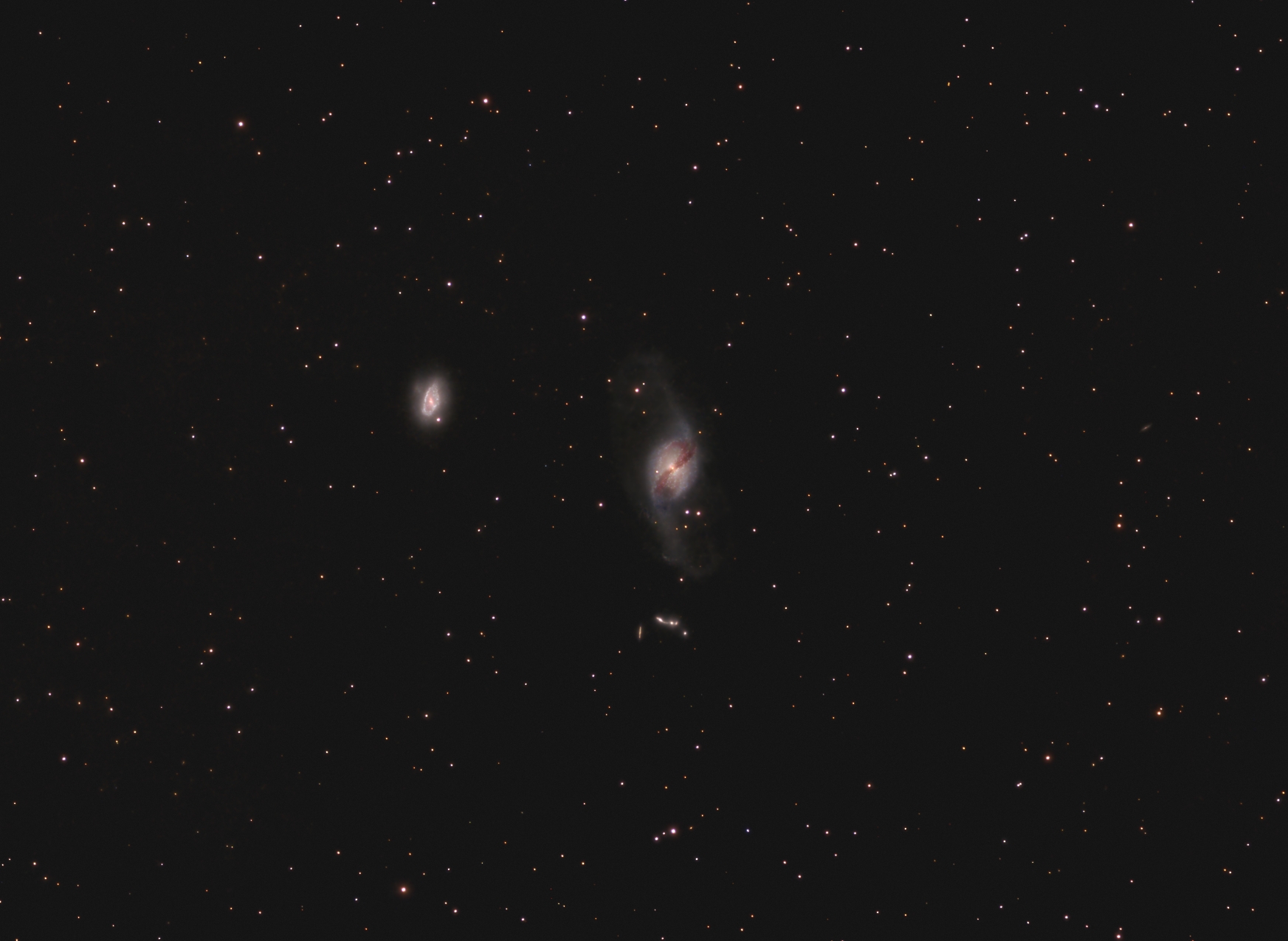
Urban NGC 3718 with Esprit 120 & Canon 60Da

Another in a sequence of urban shots taken from my urban front yard while isolating due to the COVID-19 madness. This is a little over four hours of data and I wasn't expecting much from the shot due to the conditions and the small size of the target (8.2 X 3.5 arcminutes). The conditions were as good as I get in the city and cloud free. The temperature was around 3 degrees Celsius and the light pollution produced a sky background around 18.5 mag/arcsecond^2. The technique used to pull out the very faint arms is the same as was used to image the star streams in my NGC5907 shot. I am pleasantly surprised at how much detail showed up in this image. I'm definitely going to give this one a try from dark skies when I get a chance. Click on the image to zoom in to a 50 percent crop. Click again to return to the wider field. The second 40 subs were captured using Sequence Generator Pro so I could use its auto focus and temperature compensation capabilities along with my new Focus Cube motorized focuser.
Object NGC 3718 RA 11:32:36 Dec  +53:04:00
Date 17 April 2020 and 16 May 2020
ConditionsLarge amounts of light pollution (Borttle 6 - 7)
Exposure 252 minutes (44 X 3 minutes)+(40 X 3 minutes)
ISO 800
Camera Canon 60Da DSLR
Optics SkyWatcher Esprit 120  f/7 APO refractor with  a  focal length of 840 mm
Location

Bedford, Nova Scotia

Processing

This image was processed entirely in Images Plus. All subs were calibrated and stacked in Images Plus. The image was stretched using an arcsinh stretch and then a mask made from the average of the red, green and blue channels. The feature mask was used on this synthetic luminance frame to remove the stars. Several iterations of stretching and blurring were used to make the arms visible. Each time the blurring was applied, the bright detail was protected with a inverted luminance mask. This mask was then used on an arcsinh stretch of the original data followed by a root x^n stretch also using the mask. Next the stars were removed using the feature mask and the noise of the galaxy layer reduced using a masked frequency domain low pass filter. The layer was then sharpened and contrast enhanced using multi-scale decomposition and a layer combine. The saturation of the star layer was boosted and the stars placed back in the image, which was then binned by two. A little touch up with a sharpening brush rounded out the processing.