
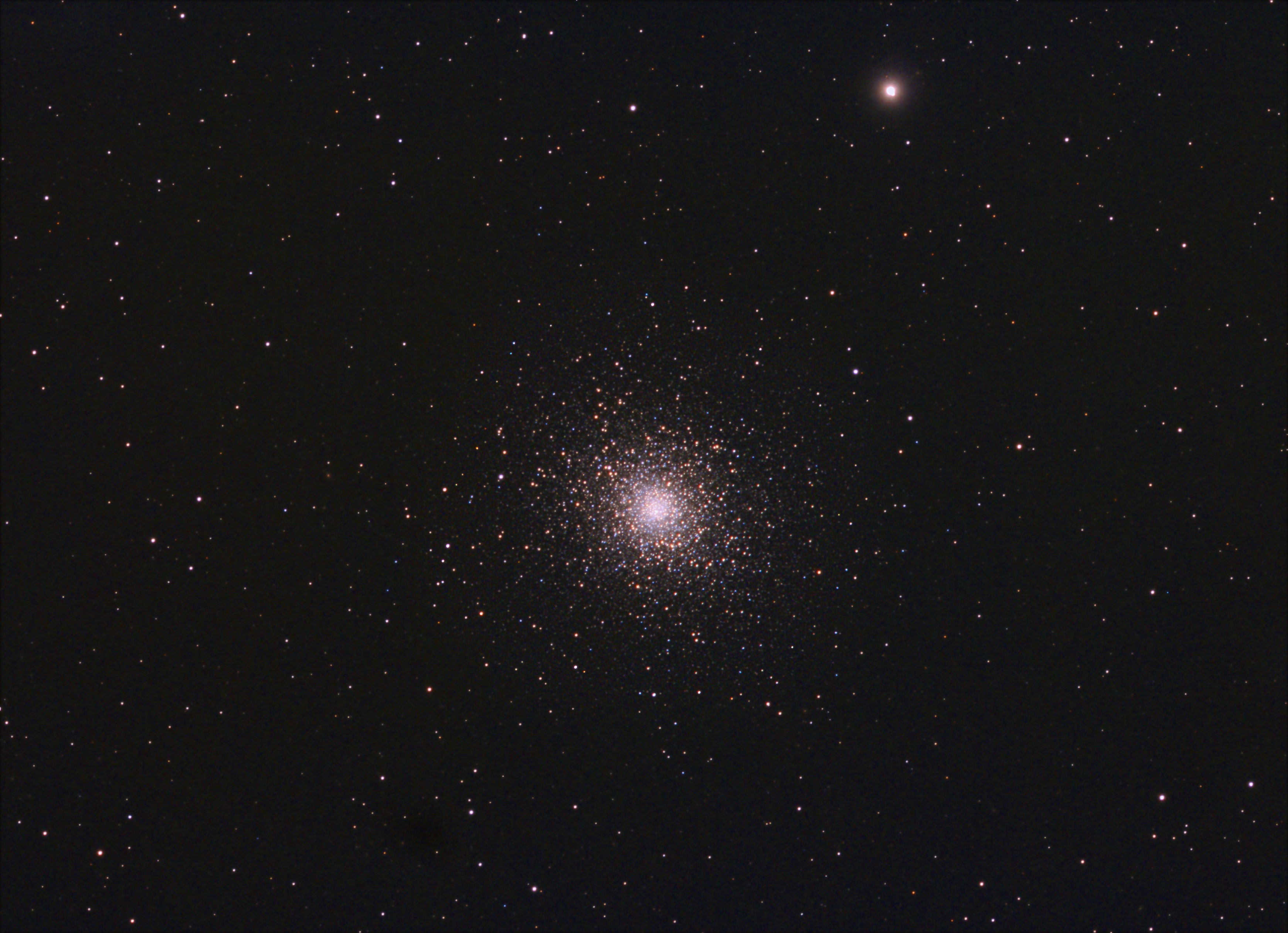
| Here is another urban
image taken from my driveway
during the province wide COVID-19 lock down. This shot was taken
looking straight into the worst of my urban light pollution. According to Wikipedia - M5 is, under extremely good conditions, just visible to the naked eye as a faint "star" near the star 5 Serpentis. Binoculars or small telescopes will identify the object as non-stellar while larger telescopes will show some individual stars, of which the brightest are of apparent magnitude 12.2. M5 was discovered by German astronomer Gottfried Kirch in 1702 when he was observing a comet. Charles Messier also noted it in 1764, but thought it was a nebula without any stars associated with it. William Herschel was the first to resolve individual stars in the cluster in 1791, counting roughly 200. Click on the image to see a higher resolution version, then click again on the image to return to this page. |
||||||||||||||||||
 |
||||||||||||||||||
|