Finally, with another clear night and I was
able to image Sirius again. Having easily resolved Rigel which is close
in separation to Sirius, I knew where the dwarf should be in my image.
In addition, using the differences in magnitudes between the Rigel
components and the Sirius components I calculated that my exposure
should be between 0.1 and 0.3 seconds at ISO 1600. Much shorter than
the 8 seconds used in my previous attempts. The longer exposure caused
Sirius A to over expose and saturate the area where Sirius B should be.
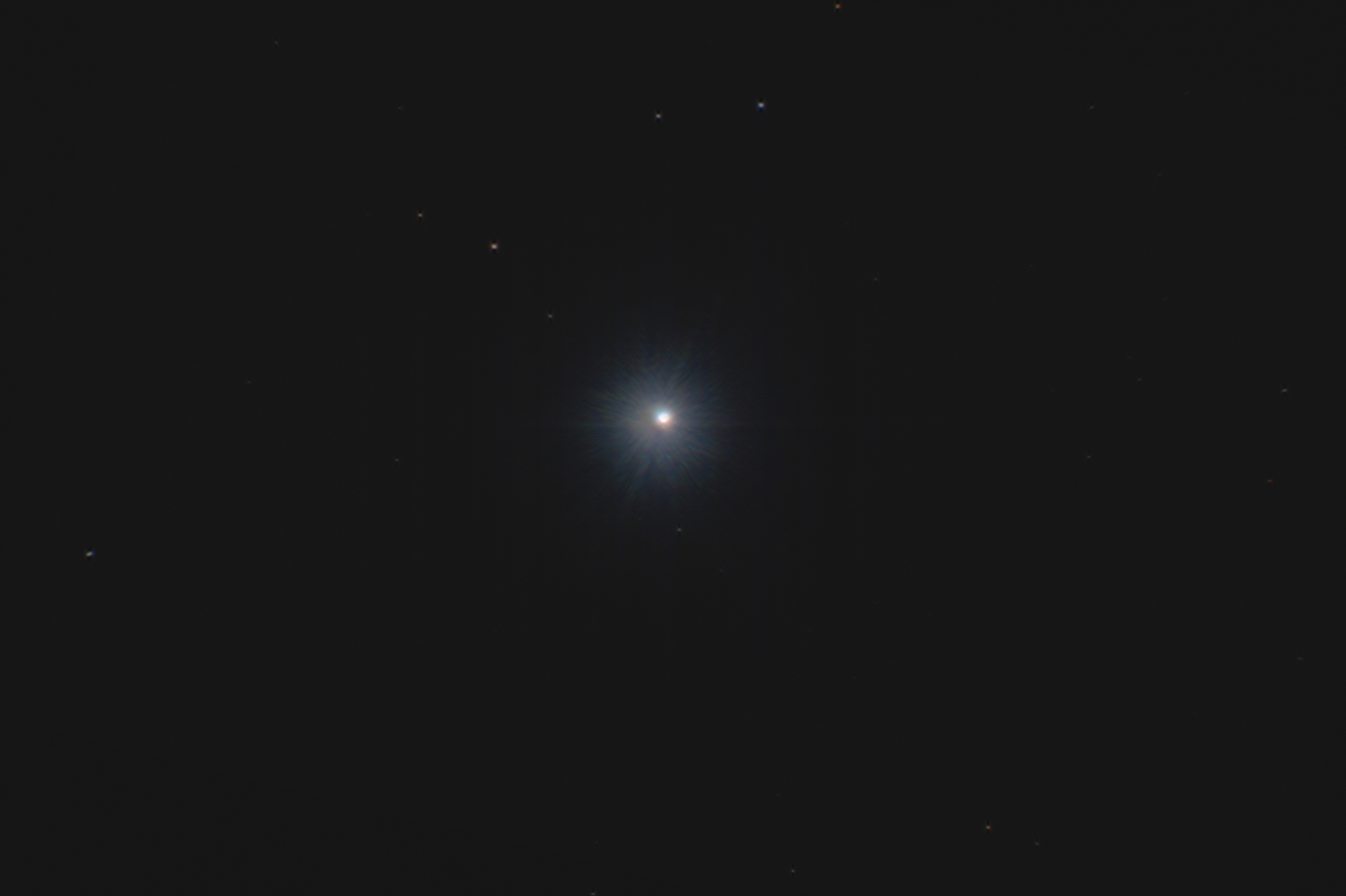
The image below is a combination of a stack of eight second
exposures, to show some field stars and the stack of 0.1 second
exposures, to show Sirius B. The two images were LMS combined using a
mask to blend the two together. Sirius B is just visible at about six
o'clock very close to Sirius A. For more on the story of the hunt for
this challenge object, check out my blog pages here and here. |
|
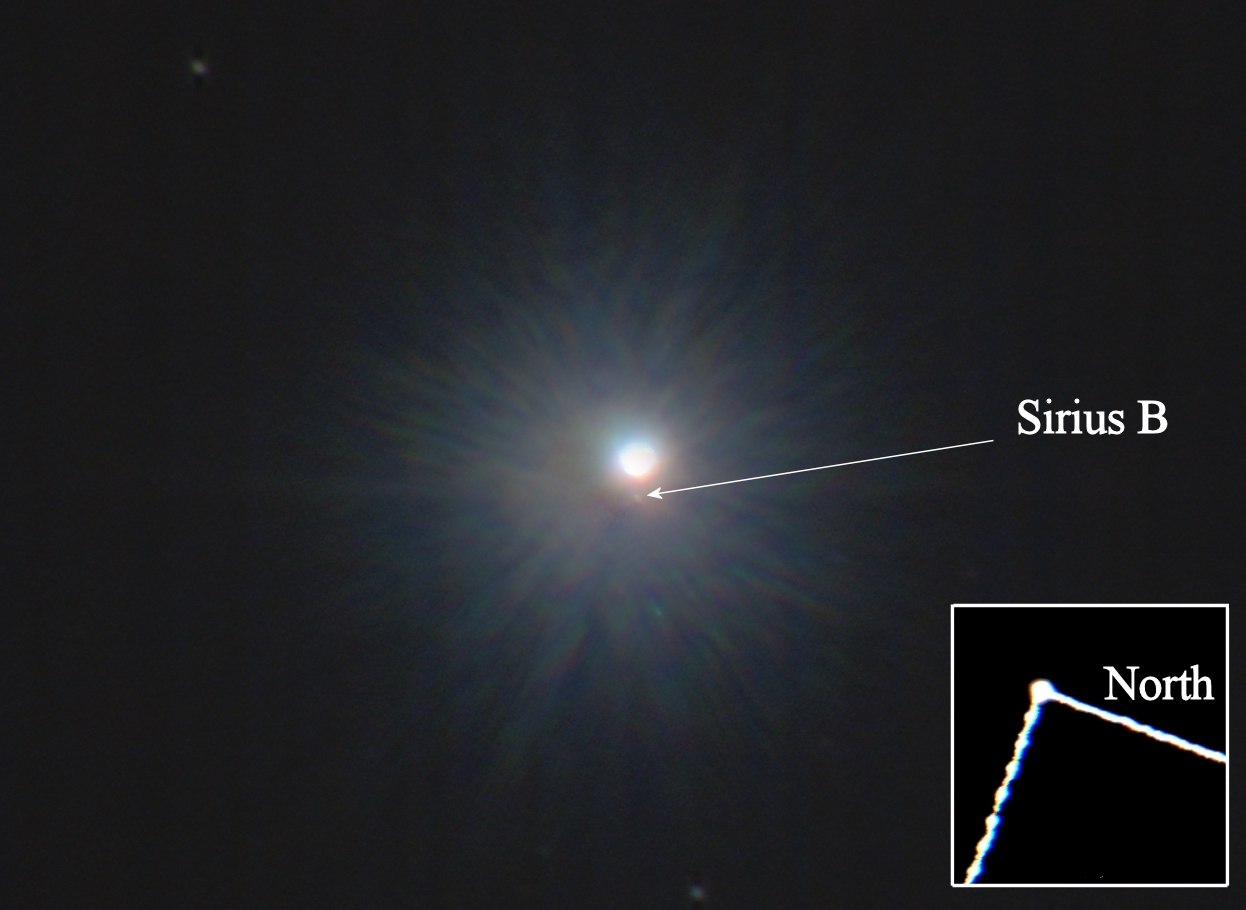
| Zooming in on Sirius,
the crop below clearly shows the dwarf. The axis insert was
produced by pressing the north, south, east and west buttons on the
mount hand control to move Sirius A while exposing a frame. The image
scale is 0.315 arc-seconds per pixel in the file as captured, but is
likely resized by browser display. The separation between the
components as calculated from the image is 11.3 arcsonds with a
position angle (PA) of 72 degrees which is in good agreement with the
RASC Observer's Handbook at 10.94 arc-seconds with a PA of 72 degrees.
This is an error of one pixel at the image scale! |
 |
| Object |
Sirius A & B Object RA
06:45:09 Dec
-16:42:58 |
| Exposure |
Composite of 336 seconds (42 X 8 seconds) and 12.2 seconds (122 X 0.1 seconds) |
| ISO |
100 for the 8 seconds subs and 1600 for the 0.1 second subs |
| Camera |
Canon 60Da DSLR |
| Optics |
SkyWatcher f/7 Esprit 120 with a focal length of
840 mm and a Celestron 2.5 times barlow. Given the projection distance
the barlow increases the focal length by 4.1315 times to 3470.5 mm at
f/28.9. |
| Location |
Bedford, Nova Scotia |
| Processing |
This image was processed entirely in Images Plus.
No calibration frames were used,
min and max excluded average used to stack the sub-frames. ArcsinH
stretch was used and the stretch was varied until the dwarf showed.
Sharpening using RL deconvolution applied then further contrast
enhancement using micro-curves. Vertical lines reduced in the 8 second
stack and LMS combine used to composite the two images so some field
stars could be seen. Final sharpening done with the sharpening and
texture enhancement tool. |
|
