
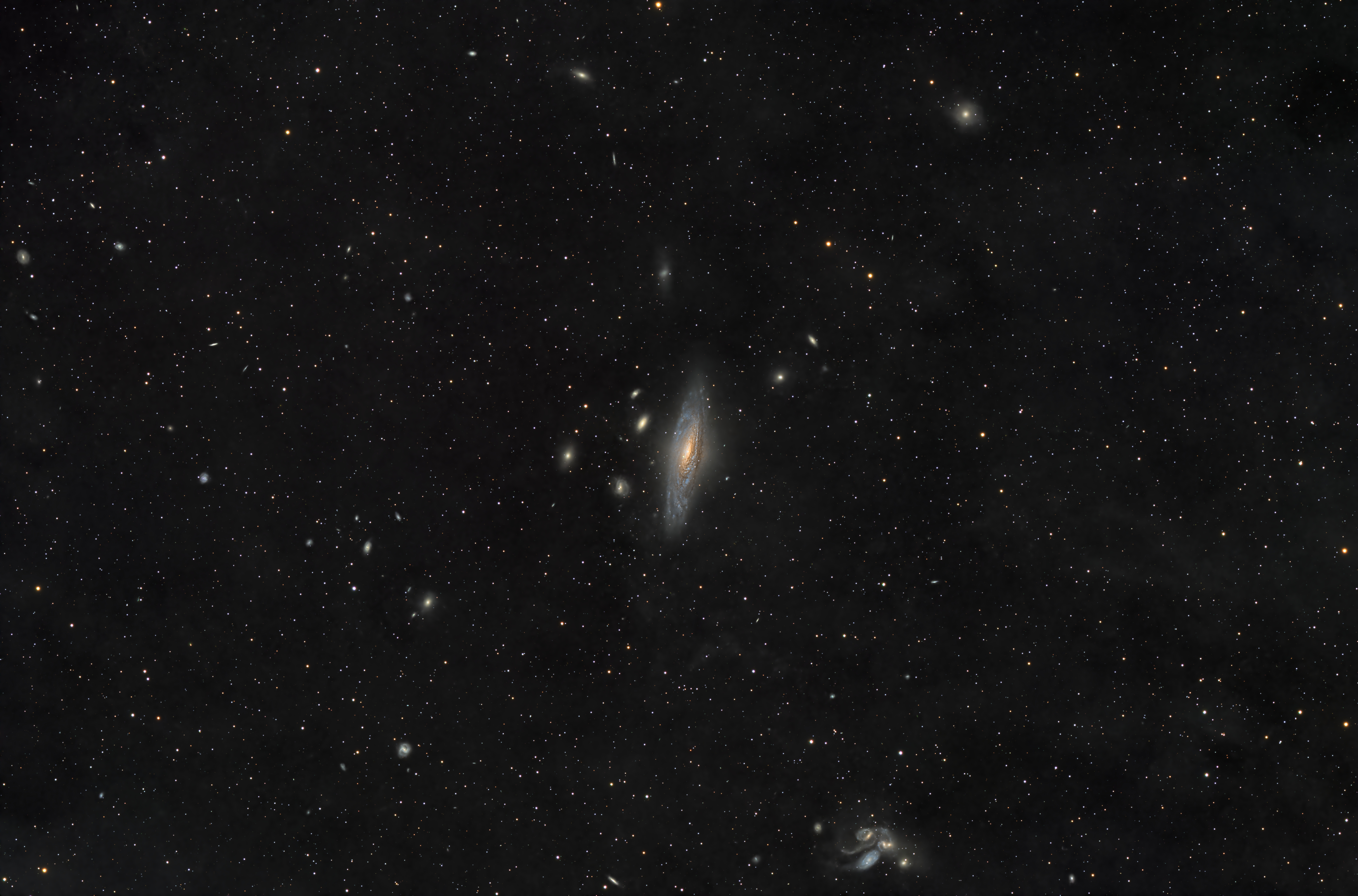
NGC83 and Friends
I am definitely going to have to spend some quality time on this field, once the Moon is gone for the month. The field is centered on NGC83, a 12'th magnitude elliptical galaxy in Andromeda. It is surrounded by a host of other galaxies,
as shown on the annotated image tab, that range in brightness down to 18'th magnitude smudges. The galaxies are not a cluster by themselves, instead they are some of the many field galaxies in this area of the sky and are
likely part of a filiment of the Persius supercluster.
Click on the image repeatedly to zoom in and click and drag to look around the zoomed image. Move your mouse off the image to reset the zoom.
| RA: | 00:21:23 |
| Dec: | +22:26:07 |
| Date: | 24 November 2026 |
| Exposure: | 160 minutes of RGB data (16 X 10 minutes) |
| Conditions: | Bortle 7 urban skies, bright waxing gibbous Moon. |
| Gain: | 100 |
| Camera: | Zwo ASI2600MC Pro |
| Optics: | Prime focus of a SkyWatcher Esprit 120 f/7 APO refractor with a focal length of 840 mm |
| Filter: | none |
| Location: | Bedford, Nova Scotia |
Processed entirely in PixInsight using several plug-ins, Blur Exterminator for deconvolution, Noise Exterminator for noise reduction, GHS for stretching, Seti-Astro
suite for mask generation, and Star Exterminator to produce a starless image. The workflow is as follows:
1. Calibration and stacking done in PixIngsight.
2. Deconvolution using Blur Exterminator.
3. Gradient correction applied using the Gradient Correction tool.
4. Colour calibration using SPCC in PixInsight.
5. Noise reduction using Noise Exterminator with three iterations and luminance and colour as well as frequency separation.
6. Star Exterminator was used to produce starless and star only images.
7. GHS used to stretch the galaxy and the star images differently.
8. Local Histogram Equalization was used with a mask to enhance the galaxies.
9. Unsharp mask used to sharpen the galactic detail using the same mask.
10. Multiscale TVGDenoise used with a mask to reduce the noise in background.
11. The galaxy image was combined with the star only image using pixel math with the expression combine(galaxy,stars,op_screen()).
12. The image was cropped and rotated for this web page.