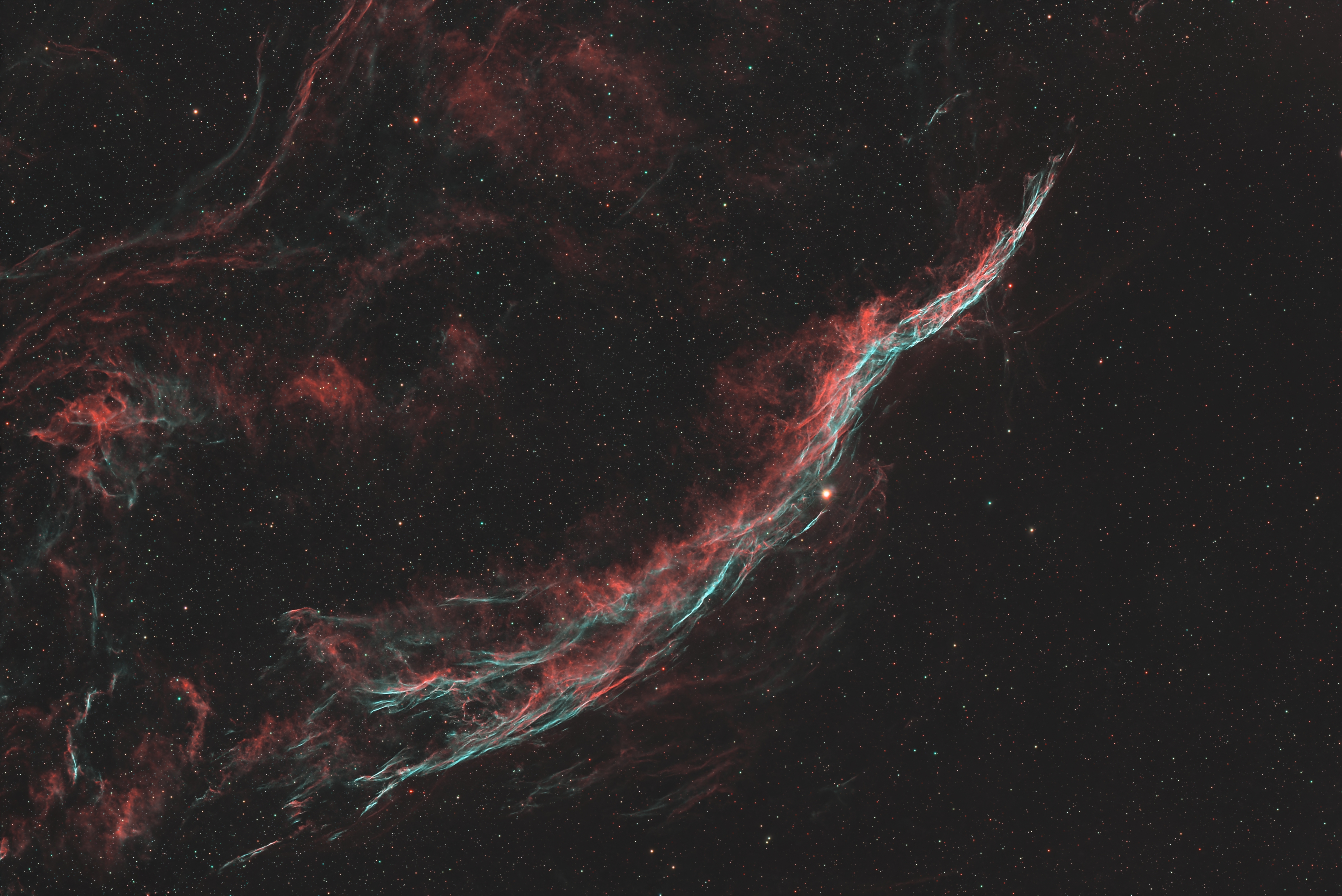

Here is a reprocess of some older data using newer tools and techniques and it is a good example of why you should never throw away
data. This is the second time I've processed this data and you can see my first attempt with older software leaves a little to
be desired. The data was acquired from my urban driveway, and the older webpage shows the lighting conditions under which the image was taken.
NGC6960 is one of the major parts of the Veil supernova remnant. According to Wikipedia - The Veil Nebula is a cloud of heated and ionized gas and dust in the constellation Cygnus.
It constitutes the visible portions of the Cygnus Loop, a supernova remnant, many portions of which have acquired their own individual names and catalogue identifiers.
The source supernova was a star 20 times more massive than the Sun which exploded between 10,000 and 20,000 years ago. At the time of explosion, the supernova would
have appeared brighter than Venus in the sky, and visible in daytime. The remnants have since expanded to cover an area of the sky roughly 3 degrees in diameter
(about 6 times the diameter, and 36 times the area, of the full Moon). While previous distance estimates have ranged from 1200 to 5800 light-years, a recent determination
of 2400 light-years is based on direct astrometric measurements. (The distance estimates affect also the estimates of size and age.)
| RA: | 20:46:36 |
| Dec: | +30:40:30 |
| Date: | 6 November, 2021 |
| Exposure: | 3 hours (12 X 15 minutes) |
| Conditions: | Bortle 7 skies |
| Gain: | 100 |
| Camera: | Zwo ASI2600MC-Pro |
| Optics: | Prime focus of a SkyWatcher Esprit 120 f/7 APO refractor with a focal length of 840 mm |
| Filter: | Optolong L-eNhance |
| Location: | Bedford, Nova Scotia |
Processed entirely in PixInsight using several plug-ins, Blur Exterminator for deconvolution, Noise Exterminator for noise reduction, GHS for stretching, Seti-Astro
suite for gradient removal and StarNet++ to produce a starless image.
1. Calibration and stacking done in PixInsight using the WBPS.
2. Deconvolution using Blur Exterminator.
3. Spectrophotometric Colour Calibration used to calibrate the colour of the image and remove the green cast.
4. Gradient removal using Seti-Astro's Automatic DBE.
5. Noise reduction using Noise Exterminator with three iterations.
6. StarNet++ was used to produce starless and star only images.
7. GHS was used multiple times to stretch the starless image, with the first stretch using colour mode to enhance the colour in the deep sky object (DSO).
8. Local Histogram Equalization was used with a mask to enhance the contrast of the DSO.
9. Unsharp mask used to sharpen the detail using the same mask.
10. TVGDenoise used to smooth the background using the inverse of the mask to protect the DSO.
11. GHS used in linear mode to set the black point.
12. The image identifer set to d.
13. GHS used to stretch the star only image paying attention to the star profile. No attempt to retain colour. Image luminance extracted.
14. GHS used on a copy of the unstretched star only image in colour mode to stretch the image. Attention was paid to the star colour.
15. Convolution used in three iterations to slightly blur the colour star image to remove odd colour halos made by GHS using an inverted mask made from the star luminance image.
16. Saturation increased using GHS in saturation mode.
17. The LRGB tool was used to combine the star luminance image with the star colour image. This produces a better colour star image than GHS alone. Image ID set to s.
18. Pixel math used to recombine the star image with the galaxy image with s+d-s*d as the combination expression.
19. ICC profile set to sRGB.
20. Image stored then binned by two for web upload and stored as a jpeg.