
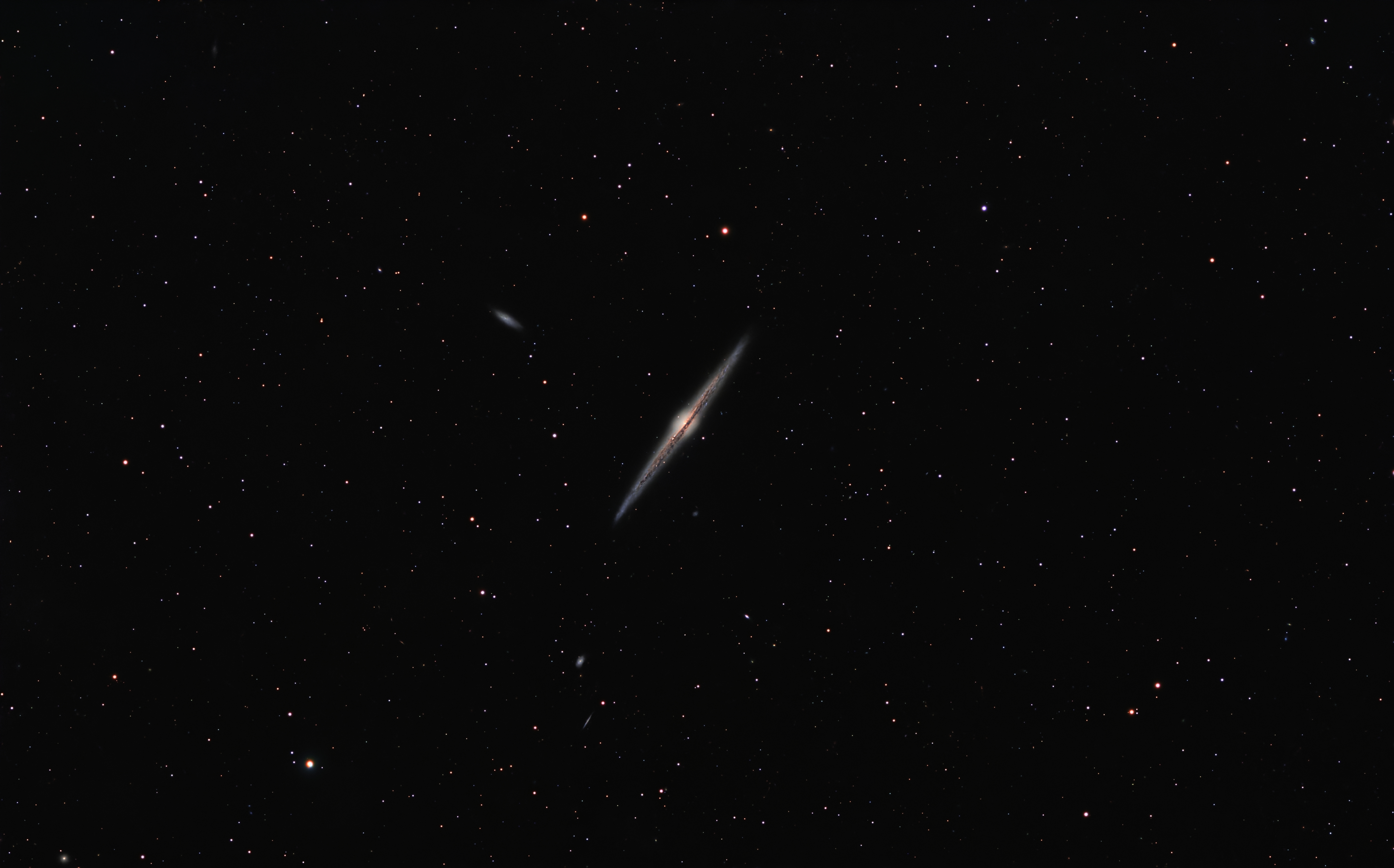
Here is 5.5 hours of urban data taken in April of 2023 and 70 minutes in June of NGC4565.
With the right equipment and techniques, interesting images can be captured even in a bright urban setting like my driveway.
According to Wikipedia - NGC 4565 (also known as the Needle Galaxy or Caldwell 38) is an edge-on spiral galaxy about
30 to 50 million light-years away in the constellation Coma Berenices. It lies close to the North Galactic Pole and has a visual magnitude of approximately 10.
It is known as the Needle Galaxy for its narrow profile, and is a prominent example of an edge-on spiral galaxy. It was discovered by German-British astronomer William Herschel
on 6 April 1785.
Move your mouse over the image to zoom. The center of the image will track the cursor position, so move your mouse to pan the zoomed image.
| RA: | 12:36:21 |
| Dec: | +25:59:13 |
| Date: | April 2023 & June 2026 |
| Exposure: | 320 minutes (50 X 5 minute plus 7 X 10 subs) |
| Conditions: | Bortle 7 skies with first quarter Moon |
| Gain: | 100 |
| Camera: | Zwo ASI2600MC Pro |
| Optics: | Prime focus of a SkyWatcher Esprit 120 f/7 APO refractor with a focal length of 840 mm |
| Filter: | none |
| Location: | Bedford, Nova Scotia |
Processed entirely in PixInsight using several plug-ins, Blur Exterminator for deconvolution, Noise Exterminator for noise reduction, GHS for stretching, Seti-Astro
suite for mask generation, GraXpert for gradient removal and StarNet++ to produce a starless image.
1. Calibration and stacking done in PixIngsight.
2. Deconvolution using Blur Exterminator.
3. Gradient Correction used to remove the gradient in the image.
4. Colour calibration using spectrophotometric colour calibration function.
5. Noise reduction using Noise Exterminator with 3 iterations and luminance and colour separation.
6. StarNet++ was used to produce a starless galaxy image and star only image.
7. GHS in colour mode used to stretch each one differently.
8. Local Histogram Equalization was used with a mask to enhance some of the core.
9. Unsharp mask used to sharpen the core detail using the same mask.
10. Multiscale median transform used to add final sharpen using a mask.
11. A range mask and a very slight curve adjustment used boost the red in the dust lane.
12. The image identifer set to g.
13. Saturation increased using a curve.
14. The star only image identifier set to s.
15. Pixel math used to recombine the star image with the galaxy image with combine(g,s,op_screen()) as the combination expression.
16. Image stored for web upload as a jpeg.