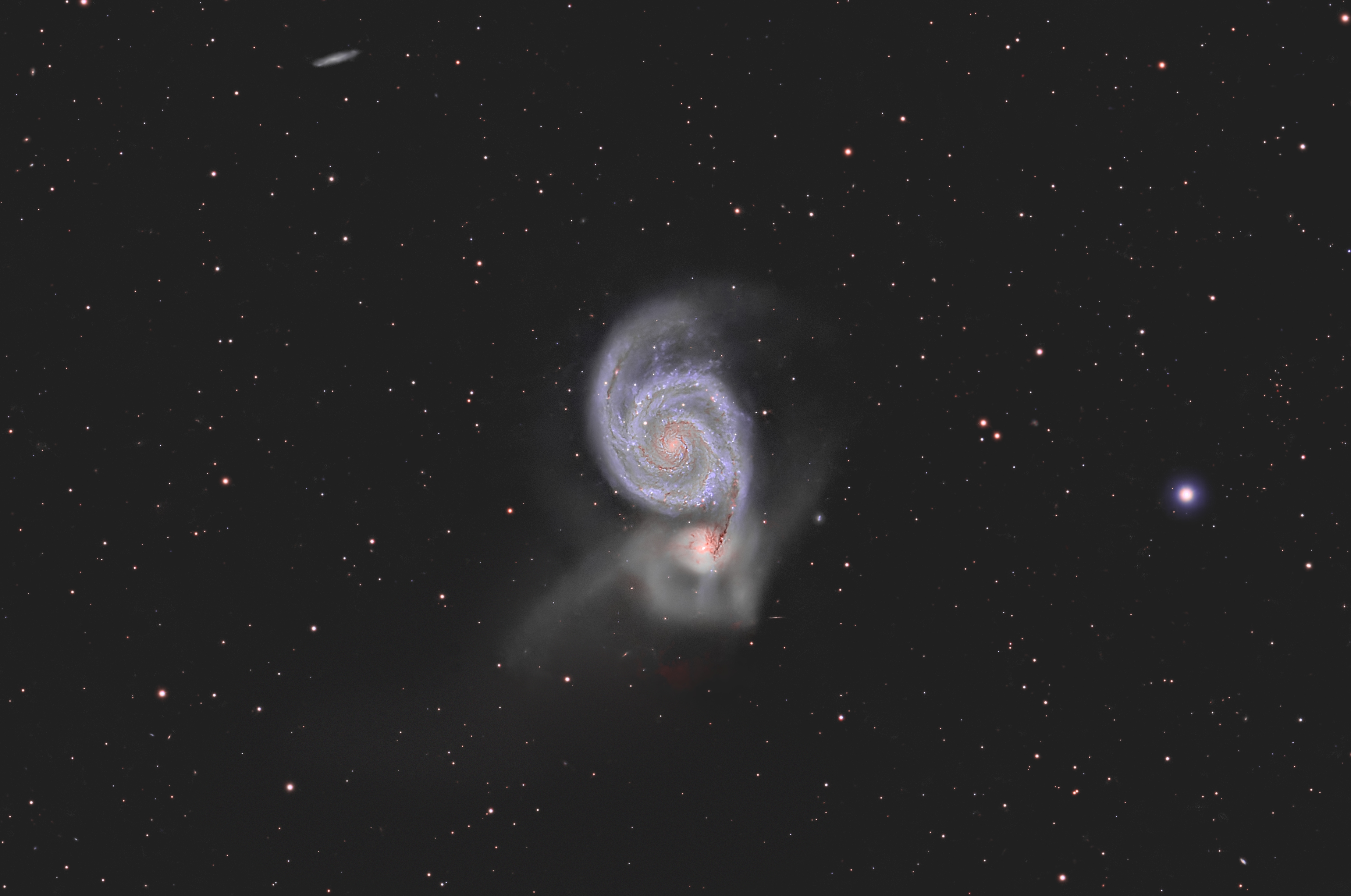

This is a DEO image taken from my light polluted urban driveway.
It is the combination of data collected in 2021 and 2026 and processed in PixInsight. The additional exposure and some
improved processing tools and techniques allowed me to bring out significantly more faint detail around the main galaxy.
The Whirlpool Galaxy, also known as Messier 51, is an interacting grand-design spiral galaxy
with a Seyfert 2 active galactic nucleus. It lies in the constellation Canes Venatici and was the first galaxy to
be classified as a spiral galaxy. Its distance is estimated to be 31 million light-years away from Earth. The galaxy
and its companion, NGC 5195 are easily observed by amateur astronomers, and the two galaxies may be seen with binoculars.
The Whirlpool Galaxy has been extensively observed by professional astronomers, who study it to understand galaxy structure (
particularly structure associated with the spiral arms) and galaxy interactions.
| RA: | 13:30:46 |
| Dec: | +47:05:11 |
| Date: | June 2021 and January, 2026 |
| Exposure: | 390 minutes (2021) & 120 minutes (2026) for a total of 8.5 hours |
| Conditions: | Bortle 7 skies |
| Gain: | 100 |
| Camera: | Zwo ASI2600MC-Pro |
| Optics: | Prime focus of a SkyWatcher Esprit 120 f/7 APO refractor with a focal length of 840 mm |
| Filter: | None |
| Location: | Bedford, Nova Scotia |
Processed entirely in PixInsight using several plug-ins, Blur Exterminator for deconvolution, Noise Exterminator for noise reduction, GHS for stretching, Seti-Astro
suite for gradient removal and StarNet++ to produce a starless image.
1. Calibration and stacking done in PixInsight using the WBPS.
2. Deconvolution using Blur Exterminator.
3. Spectrophotometric Colour Calibration used to calibrate the colour of the image and remove the green cast.
4. Gradient removal using Seti-Astro's Automatic DBE.
5. Noise reduction using Noise Exterminator with three iterations.
6. StarNet++ was used to produce starless and star only images.
7. GHS was used multiple times to stretch the starless image, with the first stretch using colour mode to enhance the colour in the deep sky object (DSO).
8. Local Histogram Equalization was used with a mask to enhance the contrast of the DSO.
9. Unsharp mask used to sharpen the detail using the same mask.
10. TVGDenoise used to smooth the background using the inverse of the mask to protect the DSO.
11. GHS used in linear mode to set the black point.
12. The image identifer set to d.
13. GHS used to stretch the star only image paying attention to the star profile. No attempt to retain colour. Image luminance extracted.
14. GHS used on a copy of the unstretched star only image in colour mode to stretch the image. Attention was paid to the star colour.
15. Convolution used in three iterations to slightly blur the colour star image to remove odd colour halos made by GHS using an inverted mask made from the star luminance image.
16. Saturation increased using GHS in saturation mode.
17. The LRGB tool was used to combine the star luminance image with the star colour image. This produces a better colour star image than GHS alone. Image ID set to s.
18. Pixel math used to recombine the star image with the galaxy image with s+d-s*d as the combination expression.
19. ICC profile set to sRGB.
20. Image stored then binned by two for web upload and stored as a jpeg.