
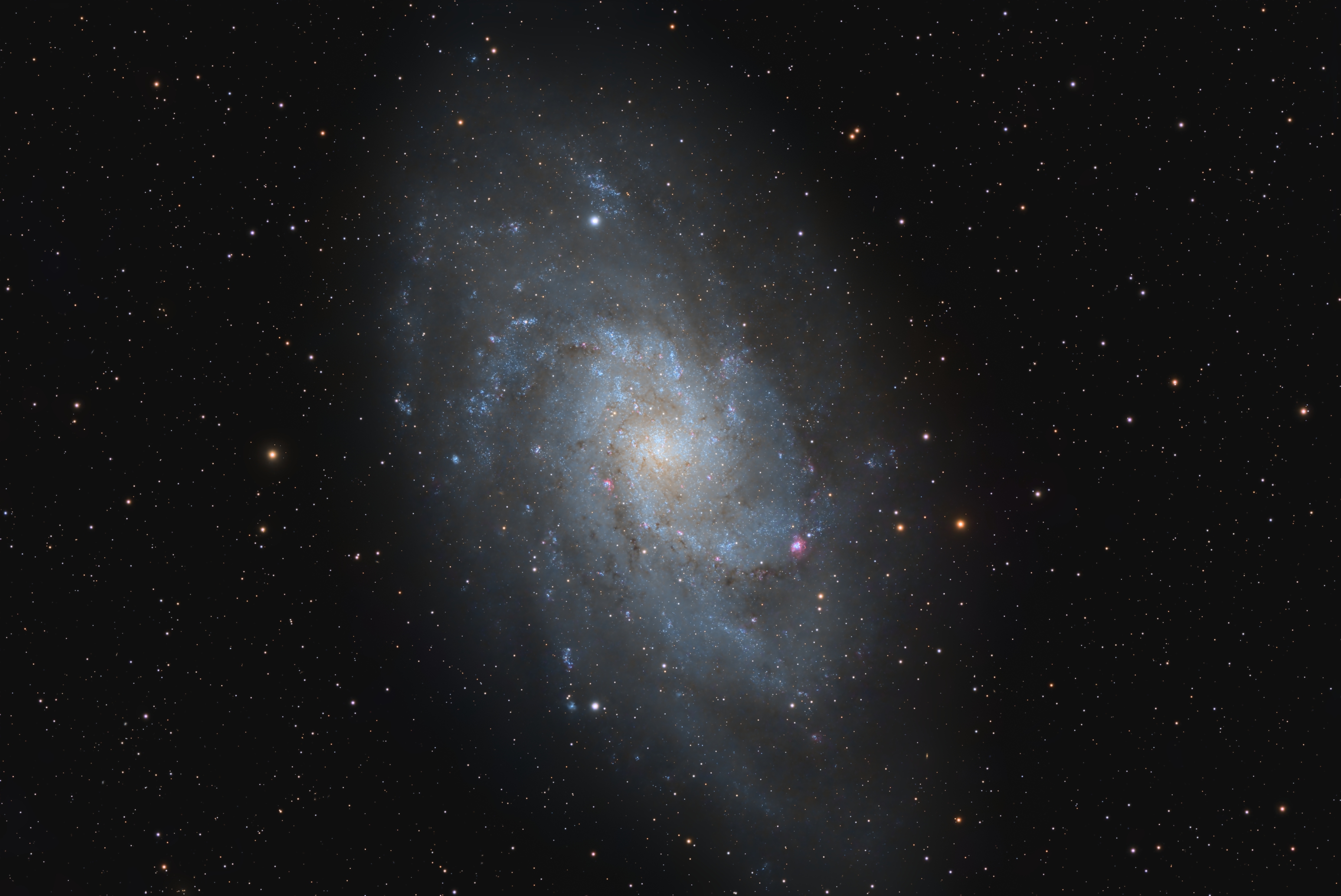
| Here is a unfiltered
urban shot, from DEO,
that shows what APO refractors, modern CMOS OSC cameras and newer
processing tools can
do from a city environment. This shot was taken from my driveway with Bortle 7
skies and no sign of the Milky Way to be seen. Noise Exterminator is
an AI based tool used to reduce noise in astronomical images and it did
a fantastic job on eliminating the fine noise throughout the shot
caused by the bright sky background. There was still some low spatial
frequency noise left in the dark background, and a classic masked low
pass filter with a Gaussian kernel was used to remove it. According to Wikipedia - The Triangulum Galaxy is a spiral galaxy 2.73 million light-years (ly) from Earth in the constellation Triangulum. It is catalogued as Messier 33 or NGC (New General Catalogue) 598. With the D25 isophotal diameter of 18.74 kiloparsecs (61,100 light-years), the Triangulum Galaxy is the third-largest member of the Local Group of galaxies, behind the Andromeda Galaxy and the Milky Way. The galaxy is the smallest spiral galaxy in the Local Group (although the smaller Large and Small Magellanic Clouds may have been spirals before their encounters with the Milky Way), and is believed to be a satellite of the Andromeda Galaxy or on its rebound into the latter due to their interactions, velocities, and proximity to one another in the night sky. It also has an H II nucleus. There are several deep sky objects in the frame, click on the image to see an annotated version showing the location of several, click again to see a much higher resolution version. Finally click one more time to return to this page. |
||||||||||||||||||||
 |
||||||||||||||||||||
|