
| Here is the completion of last year's urban
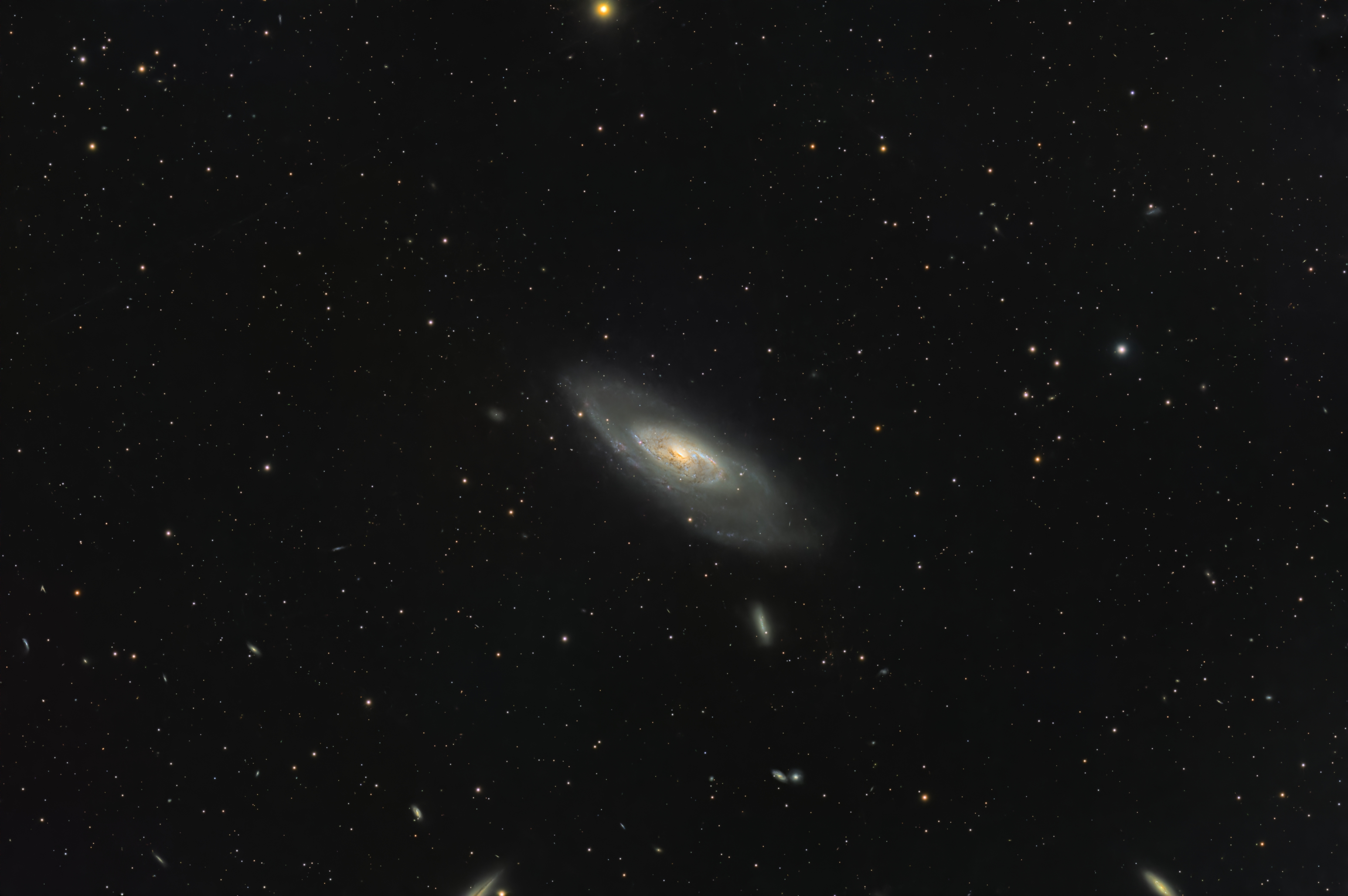
M106
project. Due to my bright urban skies
this one took about four hours
to bring out most of the faint galaxies that are within the range of my
equipment. The processing used for this shot had to contend with light
pollution bands
and blotches throughout the shot. After a few dead ends a little pixel
math in PixInsight came to the rescue replacing the blotchy background
with the median level to provide a smooth flat background. M106 is a spiral galaxy in Canes Venatici, near the Big Dipper, and because of its relatively large size exhibits rather low surface brightness, making it a difficult target for the urban imager. According to Wikipedia - Messier 106 (also known as NGC 4258) is an intermediate spiral galaxy in the constellation Canes Venatici. It was discovered by Pierre Méchain in 1781. M106 is at a distance of about 22 to 25 million light-years away from Earth. M106 contains an active nucleus classified as a Type 2 Seyfert, and the presence of a central supermassive black hole has been demonstrated from radio-wavelength observations of the rotation of a disk of molecular gas orbiting within the inner light-year around the black hole. Click on the image to see an annotated version showing some of
the other galaxies in the field then click again for a higher
resolution version, Click one
last time to return to the initial
image. Click here to see last
year's effort with about half the data. |
||||||||||||||||||||
 |
||||||||||||||||||||
|