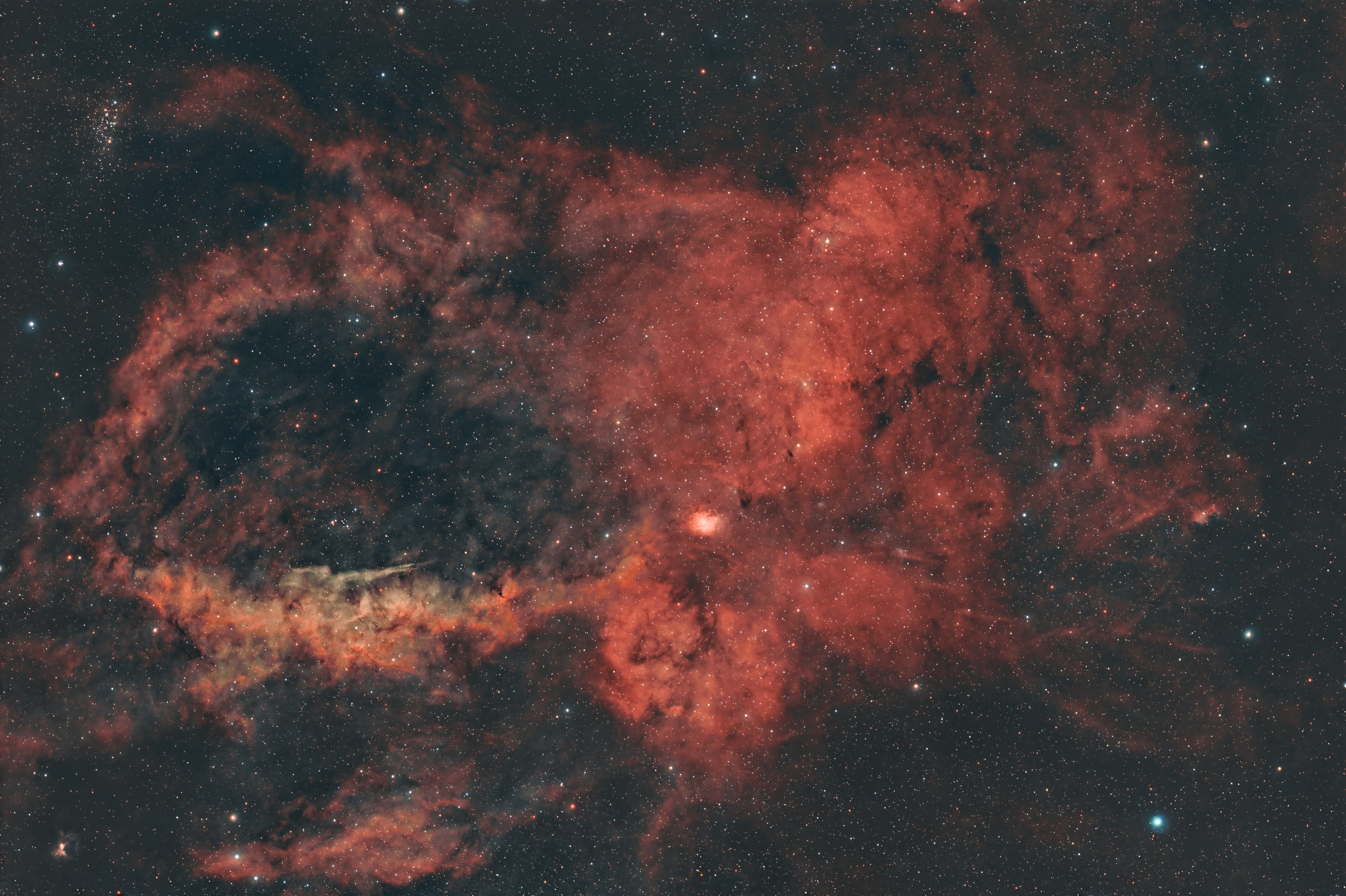

Sh2-157 is a faint, large emission nebula in the constellation Cassiopeia. It is located in the Perseus Arm approximately 11,000 light-years from Earth
and is associated with a large OB and OB2 association. Inside it is a cluster of very young stars,
which represent the latest generation of star formation and includes the nearby open cluster NGC 7510.
Compare this image with one of a similar exposure, taken with my Canon 60Da DSLR.
| RA: | 23:16:07 |
| Dec: | +60:02:00 |
| Date: | 22 July, 2025 |
| Exposure: | 3 hours 45 minutes (15 X 15 minutes) |
| Conditions: | Bortle 4 to 5 skies, reasonable seeing |
| Gain: | 100 |
| Camera: | Zwo ASI2600MC-Pro |
| Optics: | Prime focus of a SkyWatcher Esprit 120 f/7 APO refractor with a focal length of 840 mm |
| Filter: | Optolong L-eNhance |
| Location: | Marion Bridge, Nova Scotia |
Processed entirely in PixInsight using several plug-ins, Blur Exterminator for deconvolution, Noise Exterminator for noise reduction, GHS for stretching, Seti-Astro
suite for gradient removal and StarNet++ to produce a starless image.
1. Calibration and stacking done using the WBPS.
2. Deconvolution using Blur Exterminator.
3. Gradient removal using GraXpert.
4. Spectrophotometric Colour Calibration used to calibrate the colour of the image and remove the green cast.
5. Noise reduction using Noise Exterminator with three iterations.
6. StarNet++ was used to produce a starless nebula image and star only image.
7. GHS was used multiple times to stretch the starless image, with the first stretch using colour mode to enhance the colour in the nebula.
8. Local Histogram Equalization was used with a mask to enhance the core contrast of the nebula.
9. Unsharp mask used to sharpen the core detail using the same mask.
10. TVGDenoise used to smooth the background using the inverse of the mask to protect the nebula core.
11. The image was duplicated and the duplicate switched to an HOO palette then blended back into the original image using pixel math with a mask. This was done to remove the green cast from the red and still blend some of the green back into the lighter areas of the nebula.
12. HistogramTransformation used to set the black point.
13 The image identifer set to n.
14. GHS used to stretch the star only image paying attention to the star profile. No attempt to retain colour. Image luminance extracted.
15. GHS used on a copy of the unstretched star only image in colour mode to stretch the image. Attention was paid to the star colour.
16. Convolution used in three iterations to slightly blur the colour star image to remove odd colour halos made by GHS using an inverted mask made from the star luminance image.
17. Saturation increased using GHS in saturation mode.
18. The LRGB tool was used to combine the star luminance image with the star colour image. This produces a better colour star image than GHS alone. Image ID set to s.
19. Pixel math used to recombine the star image with the nebula image with s+n-s*n*0.9 as the combination expression.
20. ICC profile set to sRGB.
21. Image stored then binned by two for web upload and stored as a jpeg.