
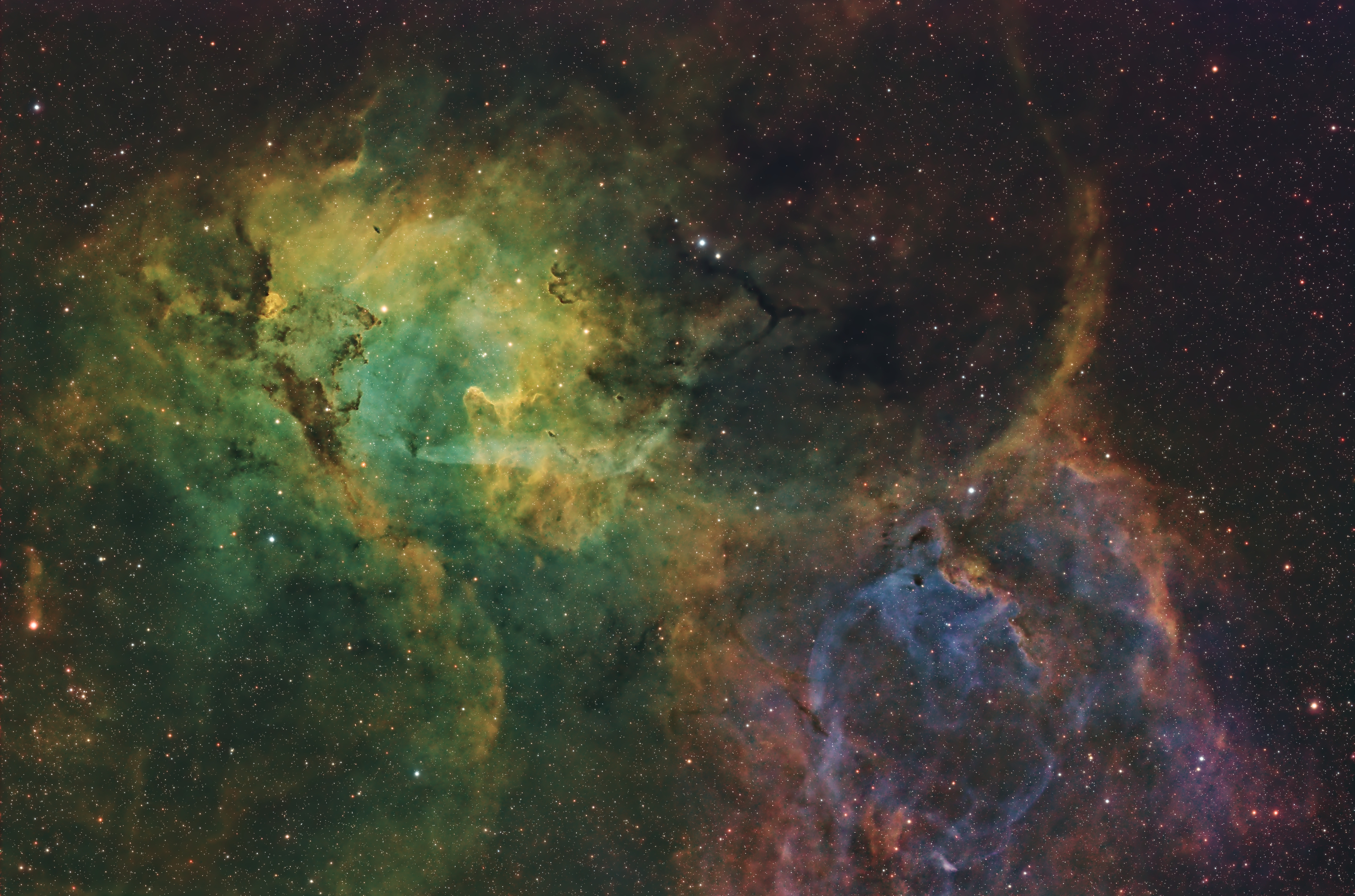
Here is 8 hours worth of exposure, four through an Optolong L-eXtreme narrow band filter and four through an Optolong L-Synergy
filter combined to produce the final SHO palette image with HOO palette stars. The SHO palette, which uses data from sulphur emission
for the red channel, emission from Hydrogen for the green channel, and emission from oxygen for the blue channel, was popularized
by the Hubble Heritage Project team based at the Space Telescope Science Institute (STScI). While the SHO palette produces striking
nebula colour, the stars can appear purple and to my eye it isn't appealing. To solve this issue, I generally insert HOO stars
for a more natural appearance.
The Lion Nebula, listed by Shapless in his catalogue of galactic nebula, is named for its shape in long exposure photographs,
where it resembles a lion with its mouth open. Its faint glow is caused by two Wolf-Rayet star, HD 211564 and HD 211853,
along with several hot O and B-type stars. The nebula is located in the constellation Cepheus approximately 10,400 light-years away in the Perseus Arm of the Milky Way,
at that distance it is about 125 light-years in diameter.
The nebula is known for being dim with an estimated surface brightness of 22 to 23 mag/arcsec^2. To put this in perspective, the night sky at the darkest places on Earth
a surface brightness of 21.5 to 22 mag/arcsec^2. Although listed as very dim, it is relatively easy to image using modern cameras with
narrowband filters. For comparison, here is a previous wideband attempt using the same optics and my Canon 60Da camera.
Click on the image repeatedly to zoom in and click and drag to look around the zoomed image. Move your mouse off the image to reset the zoom.
Here is 4 hours exposure through an Optolong L-eXtreme narrow band filter to produce a first pass at SH2-132, the Lion Nebula. This
was used for the stars in the SHO image and for the HOO image.
The Lion Nebula, listed by Shapless in his catalogue of galactic nebula, is named for its shape in long exposure photographs,
where it resembles a lion with its mouth open. Its faint glow is caused by two Wolf-Rayet star, HD 211564 and HD 211853,
along with several hot O and B-type stars. The nebula is located in the constellation Cepheus approximately 10,400 light-years away in the Perseus Arm of the Milky Way,
at that distance it is about 125 light-years in diameter.
The nebula is known for being dim with an estimated surface brightness of 22 to 23 mag/arcsec^2. To put this in perspective, the night sky at the darkest places on Earth
a surface brightness of 21.5 to 22 mag/arcsec^2. Although listed as very dim, it is relatively easy to image using modern cameras with
narrowband filters. For comparison, here is a previous wideband attempt using the same optics and my Canon 60Da camera.
Click on the image repeatedly to zoom in and click and drag to look around the zoomed image. Move your mouse off the image to reset the zoom.
| RA: | 22:17:57 |
| Dec: | +55:55:58 |
| Date: | July 2026 |
| Exposure: | 240 minutes L-eXtreme and 240 minutes L-Synergy |
| Conditions: | Bortle 4 skies with lots of smoke causing poor transparency |
| Gain: | 100 |
| Camera: | Zwo ASI2600MC Pro |
| Optics: | Prime focus of a SkyWatcher Esprit 120 f/7 APO refractor with a focal length of 840 mm |
| Filter: | L-eXtreme & L-Synergy |
| Location: | Marion Bridge, Nova Scotia |
Processed entirely in PixInsight using several plug-ins, Blur Exterminator for deconvolution, Noise Exterminator for noise reduction, GHS for stretching, Seti-Astro
suite for mask generation, and Star Exterminator to produce a starless image. The SHO workflow is as follows:
1. Calibration and stacking of both the L-eXtreme and L-Synergy filtered images done in PixIngsight.
2. Deconvolution using Blur Exterminator.
3. Noise reduction using Noise Exterminator with one iterations and luminance and colour separation.
4. Star Exterminator was used to produce starless and star only images.
5. The L-eXtreme star image was kept.
6. Pixel math used to create the SHO nebula image.
7. Multiple iterations of GHS in GHS mode then in linear mode to align the histogram peaks. This increased the red in the image.
8. GHS used to stretch the SHO nebula and the HOO star images differently.
9. Local Histogram Equalization was used with a mask to enhance some of the nebula.
10. Unsharp mask used to sharpen the nebula detail using the same mask.
11. TVGDenoise used with a mask to reduce the noise in the nebula image.
12. The image identifer set to n.
13. Saturation increased using a curve.
14. Pixel math used to recombine the nebula and star images using combine(g,s,op_screen()) as the combination expression.
15. Image binned by 2 and stored for web upload as a jpeg.