
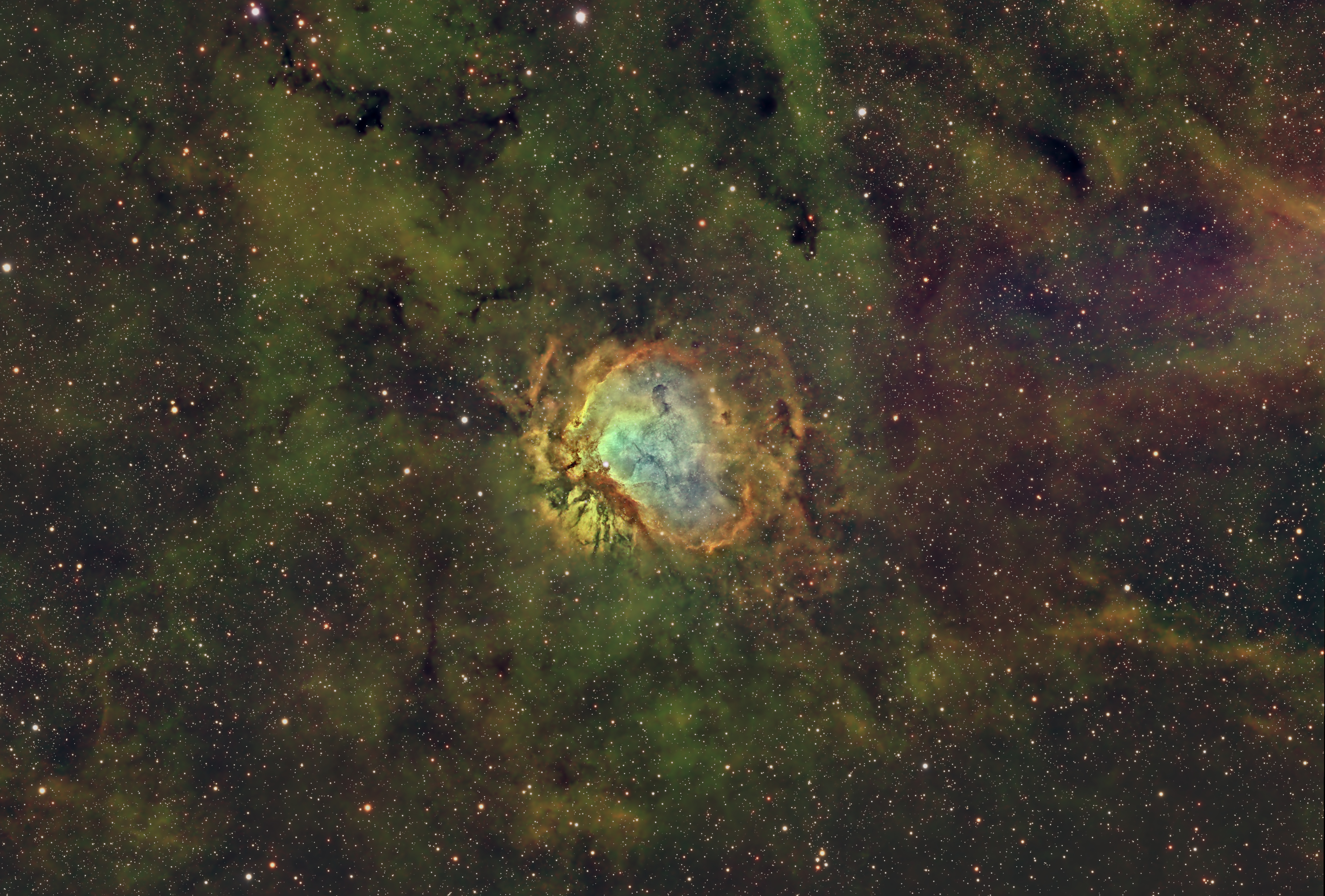
Sh2-112 (Sharpless 112) is a diffuse emission nebula in the constellation Cygnus. It is approximately 5,600 light-years from Earth in the Orion Arm of our galaxy. The nebula has a visual magnitude of 13.8 and an appearant size of 15 by 15 arc-seconds making it very difficult to detect visually due to its low surface brightness. It is located less than 1.5 degrees from Deneb, making it tricky to capture clean photographic data as stray light from the bright star shows up in long exposure images. Powered by the bright double blue star BD+45 3216, the nebula features glowing ionized hydrogen gas and a prominent dark dust band. Click on the image repeatedly to zoom in and click and drag to look around the zoomed image. Move your mouse off the image to reset the zoom.
| RA: | 20:22:55 |
| Dec: | +45:39:06 |
| Date: | August 2026 |
| Exposure: | 4.75 hours of L-eXtreme data and 3.25 hours of L-Synergy data |
| Conditions: | Bortle 4 skies with a bright last quarter Moon in the sky. |
| Gain: | 100 |
| Camera: | Zwo ASI2600MC Pro |
| Optics: | Prime focus of a SkyWatcher Esprit 120 f/7 APO refractor with a focal length of 840 mm |
| Filter: | L-eXtreme and L-Synergy |
| Location: | Marion Bridge, Nova Scotia |
Processed entirely in PixInsight using several plug-ins, Blur Exterminator for deconvolution, Noise Exterminator for noise reduction, GHS for stretching, Seti-Astro
suite for mask generation, and Star Exterminator to produce a starless image. The workflow is as follows:
1. Calibration and stacking done in PixIngsight.
2. Deconvolution using Blur Exterminator applied to both the L-eXtreme and L-Synergy images.
3. Both images had Gradient Correction applied to handle a slight gradient caused by moonlight.
4. Noise reduction using Noise Exterminator with three iterations and luminance and colour separation.
5. Pixel math was used to produce an SHO palette.
6. Star Exterminator was used to produce starless and star only images. The stars from the SHO image were thrown away and the stars from the L-eXtreme data were kept for the final image.
7. GHS used to stretch the nebula and the star images differently.
8. Local Histogram Equalization was used with a mask to enhance some of the nebula.
9. Unsharp mask used to sharpen the nebula detail using the same mask.
10. TVGDenoise used with a mask to reduce the noise in the nebula image.
11. The image identifer set to n.
12. Saturation increased using a curve.
13. Pixel math used to recombine the nebula and star images using combine(g,s,op_screen()) as the combination expression.