
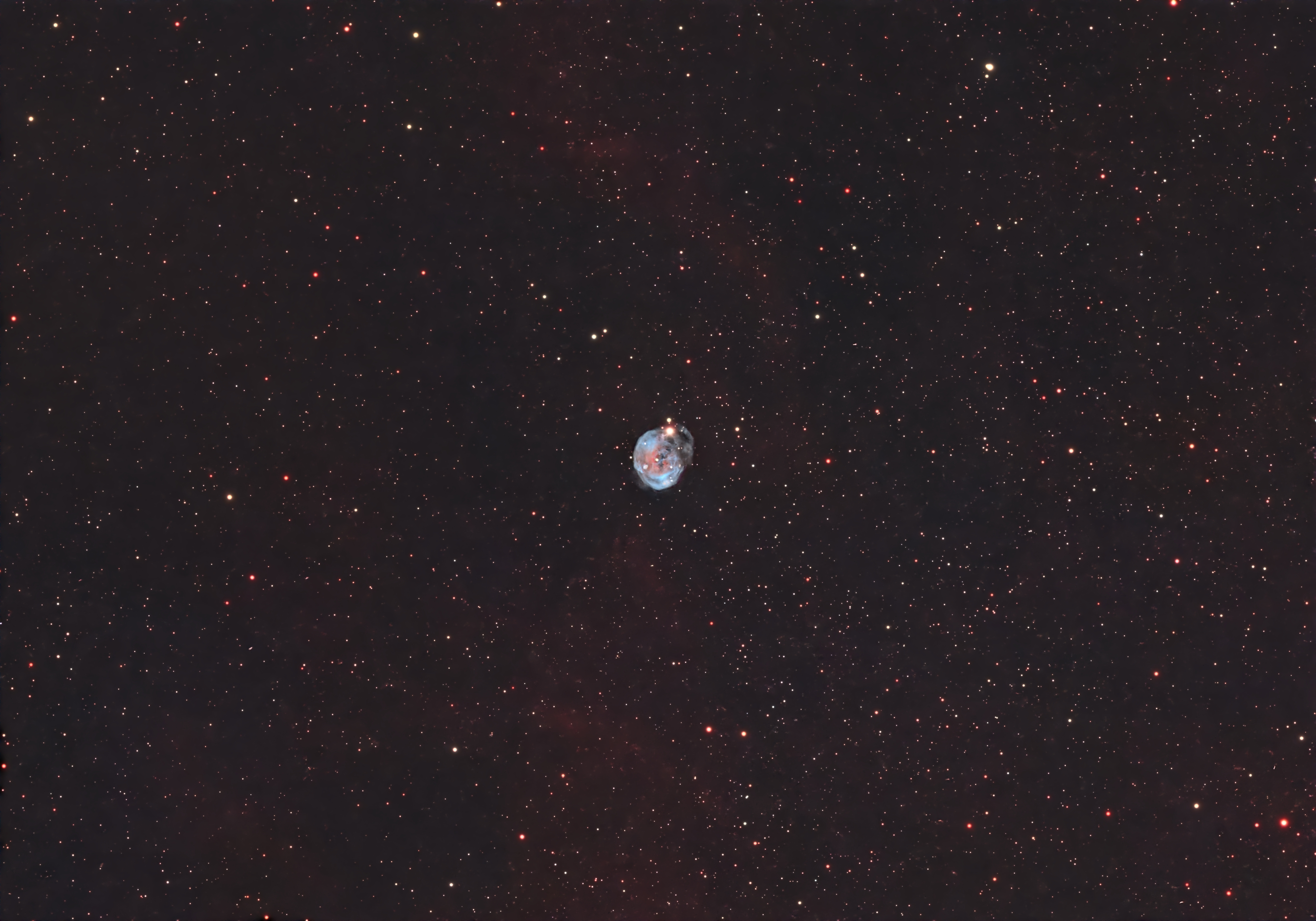
NGC7008, known as the Fetus Nebula is a planetary nebula in Cygnus. The nebula itself is relatively bright at magnitude 11, but it took 7 hours of
15 minute subs to bring out the faint H-alpha clouds throughout the background.
According to Wikipedia NGC 7008 (PK 93+5.2), is a planetary nebula with a
diameter of approximately 1 light-year located at a distance of 2800 light years in northern Cygnus. It was discovered by
William Herschel in 1787, in Slough, England. NGC 7008 (H I-192) is included in the Astronomical League's Herschel 400 observing program.
Click on the image repeatedly to zoom in and click and drag to look around the zoomed image. Move your mouse off the image to reset the zoom.
| RA: | 21:00:35 |
| Dec: | +54:32:28 |
| Date: | 3 nights during July 2026 |
| Exposure: | 7 hours |
| Conditions: | Bortle 4 skies with a bright first quarter Moon in the sky. |
| Gain: | 100 |
| Camera: | Zwo ASI2600MC Pro |
| Optics: | Prime focus of a SkyWatcher Esprit 120 f/7 APO refractor with a focal length of 840 mm |
| Filter: | L-eXtreme |
| Location: | Marion Bridge, Nova Scotia |
Processed entirely in PixInsight using several plug-ins, Blur Exterminator for deconvolution, Noise Exterminator for noise reduction, GHS for stretching, Seti-Astro
suite for mask generation, and Star Exterminator to produce a starless image. The workflow is as follows:
1. Calibration and stacking done in PixIngsight.
2. Deconvolution using Blur Exterminator.
3. Spectrophotometric colour calibration used to correct the colour.
4. Noise reduction using Noise Exterminator with three iterations and luminance and colour separation.
5. Star Exterminator was used to produce starless and star only images.
6. GHS used to stretch the nebula and the star images differently.
7. Local Histogram Equalization was used with a mask to enhance some of the nebula.
8. Unsharp mask used to sharpen the nebula detail using the same mask.
9. TVGDenoise used with a mask to reduce the noise in the nebula image.
10. The image identifer set to n.
11. Saturation increased using a curve.
12. Pixel math used to recombine the nebula and star images using combine(g,s,op_screen()) as the combination expression.
13. Image binned by 2 and stored for web upload as a jpeg.