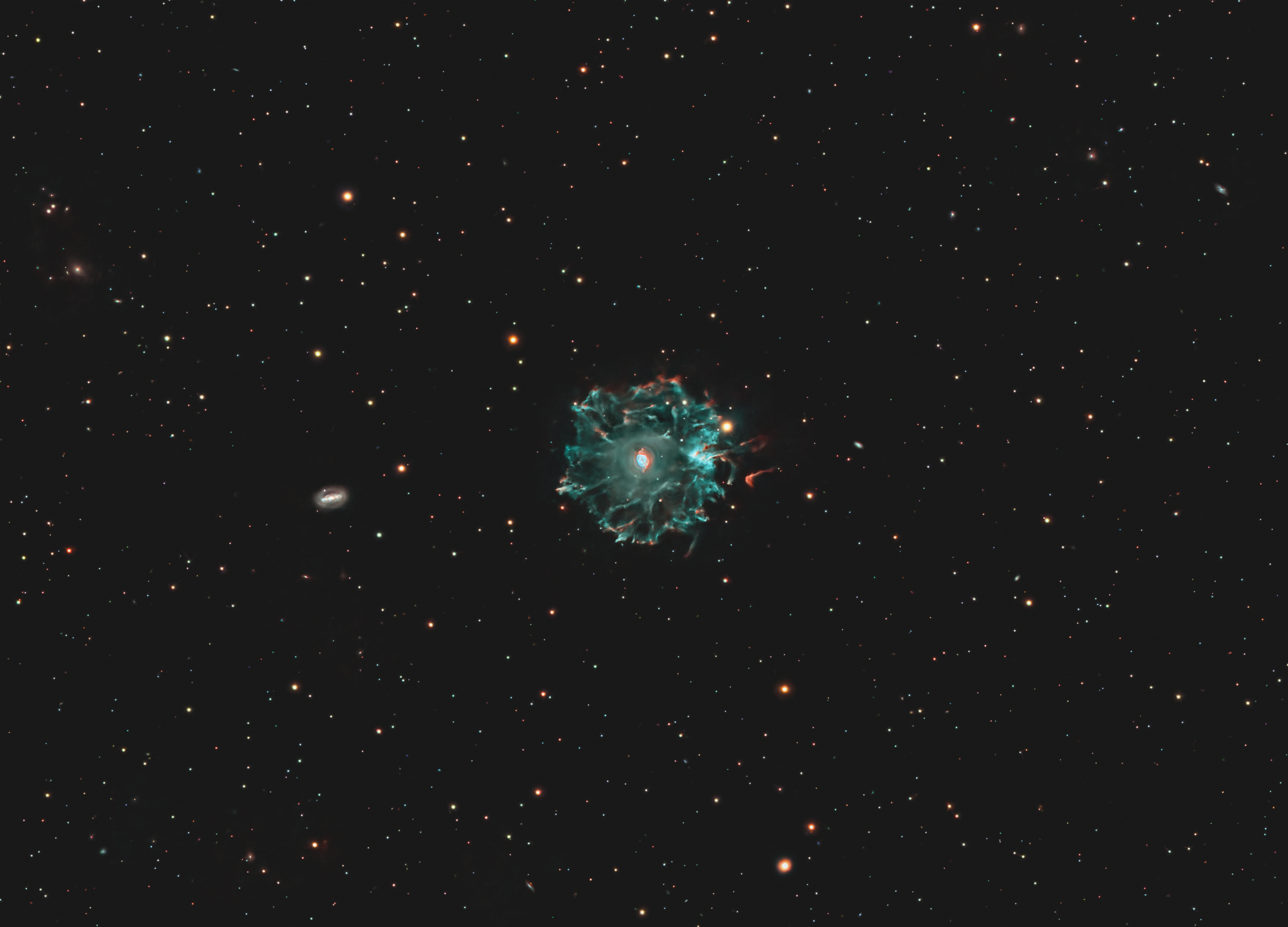

NGC6543, known as the Cat's Eye Nebula is a small, planetary nebula in the constellation Draco discovered by William Herschel on February 15, 1786. It is located approximately 3200 light-years from Earth. The core is approximately 25 by 16 arcseconds while the outer envelope is 3 arcminutes across and is composed of material ejected from the central star during its red giant phase.
| RA: | 17:58:36 |
| Dec: | +66:38:16 |
| Date: | 1 August, 2025 |
| Exposure: | 2 hours 55 minutes (70 X 150 seconds) |
| Conditions: | Bortle 4 to 5 skies, good seeing |
| Gain: | 100 |
| Camera: | Zwo ASI2600MC-Pro |
| Optics: | Prime focus of a SkyWatcher Esprit 120 f/7 APO refractor with a focal length of 840 mm |
| Filter: | Optolong L-eNhance |
| Location: | Marion Bridge, Nova Scotia |
Processed entirely in PixInsight using several plug-ins, Blur Exterminator for deconvolution, Noise Exterminator for noise reduction, GHS for stretching, Seti-Astro
suite for mask generation, GraXpert for gradient removal and StarNet++ to produce a starless image.
1. Calibration and stacking done using the WBPS using drizzle to increase the image resolution by two.
2. Deconvolution using Blur Exterminator.
3. Spectrophotometric Colour Calibration used to calibrate the colour of the image and remove the green cast.
4. Slight stretch applied in colour mode using GHS. This was done to allow Noise Exterminator to work properly as the signal was very close to the noise in some cases.
5. Noise reduction using Noise Exterminator with three iterations.
6. StarNet++ was used to produce a starless nebula image and star only image.
7. Starless image was duplicated one named b and the other d.
8. GHS was used to stretch the image b, concentrating on the faint outer envelope.
9. GHS was used to stretch the image d, concentrating on the core detail.
10. A mask was created from image b using the FAME script to isolate the core and named m.
11. Images d and b were combined using pixelmath with the expression m*d+(1-m)*b.
12. Local Histogram Equalization was used with the mask to enhance the core contrast of the nebula.
13. Unsharp mask used to sharpen the core detail using the same mask.
14. TVGDenoise used to smooth the background using another FAME generated mask to smooth the noise in the dim parts of the outer envelope.
15 The image identifer set to n.
16. Saturation increased using GHS in saturation mode.
17. Pixel math used to recombine the star image with the nebula image with s+n-s*n*0.9 as the combination expression.
18. Gradient removal using GraXpert to remove most of the red cast to the sky.
19. ICC profile set to sRGB.
20. Image stored for web upload as a jpeg.