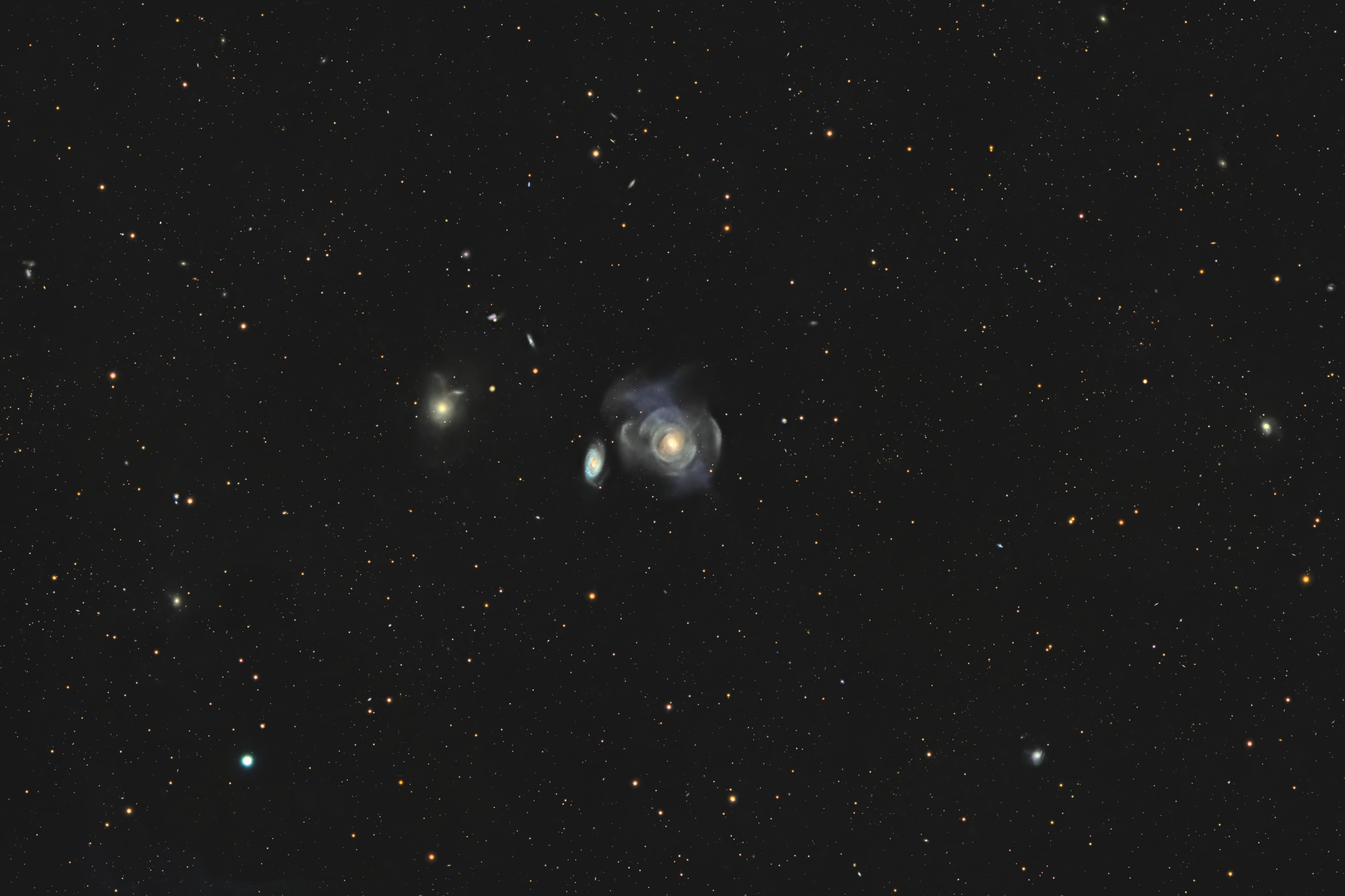

NGC 474 is an elliptical galaxy about 100 million light years distant in the constellation Pisces.
This galaxy possesses tidal shells and tails, possibly caused by an interaction with another galaxy
several billion years ago.
The spectacular tidal features around NGC 474 have been extensively studied, and several papers offering explanations have been published.
Some have argued that the tidal tails were formed because of a collision with a galaxy 2 billion years ago.
NGC 474 is absorbing gas from its neighbor, NGC 470, possibly since the ancient collision. Another study says the tidal shells can be explained
by a gas-rich spiral galaxy colliding with NGC 474 twice, before finally merging.
The field is full of faint distant galaxies, some of which are marked in an annotated version of the image. The annotated version
can be seen by clicking on the image, a higher resolution crop can be viewed by clicking on the image again. Clicking one more time
will return the view to the original image.
| RA: | 01:20:06 |
| Dec: | +03:24:57 |
| Date: | 22 & 24 September, 2025 |
| Exposure: | 420 minutes (42 X 10 minutes) |
| Conditions: | Bortle 4 to 5 skies |
| Gain: | 100 |
| Camera: | Zwo ASI2600MC-Pro |
| Optics: | Prime focus of a SkyWatcher Esprit 120 f/7 APO refractor with a focal length of 840 mm |
| Filter: | None |
| Location: | Marion, Nova Scotia |
Processed entirely in PixInsight using several plug-ins, Blur Exterminator for deconvolution, Noise Exterminator for noise reduction, GHS for stretching, Seti-Astro
suite for gradient removal and StarNet++ to produce a starless image.
1. Calibration and stacking done using the WBPS.
2. Deconvolution using Blur Exterminator.
3. Spectrophotometric Colour Calibration used to calibrate the colour of the image and remove the green cast.
4. Gradient removal using GraXpert.
5. Noise reduction using Noise Exterminator with 5 iterations.
6. StarNet++ was used to produce a starless and star only images.
7. GHS was used multiple times to stretch the starless image, with the first stretch using colour mode to enhance the colour in the galaxies.
8. Local Histogram Equalization was used with a mask to enhance the core contrast of the galaxies.
9. Unsharp mask used to sharpen the core detail using the same mask.
10. HistogramTransformation used to set the black point.
11. The image identifer set to g.
12. GHS used to stretch the star only image paying attention to the star profile. No attempt to retain colour. Image luminance extracted.
13. GHS used on a copy of the unstretched star only image in colour mode to stretch the image. Attention was paid to the star colour.
14. Convolution used in three iterations to slightly blur the colour star image to remove odd colour halos made by GHS using an inverted mask made from the star luminance image.
15. Saturation increased using GHS in saturation mode.
16. The LRGB tool was used to combine the star luminance image with the star colour image. This produces a better colour star image than GHS alone. Image ID set to s.
17. Pixel math used to recombine the star image with the galaxy image with s+g-s*g as the combination expression.
18. ICC profile set to sRGB.
19. Image stored then binned by two for web upload and stored as a jpeg.