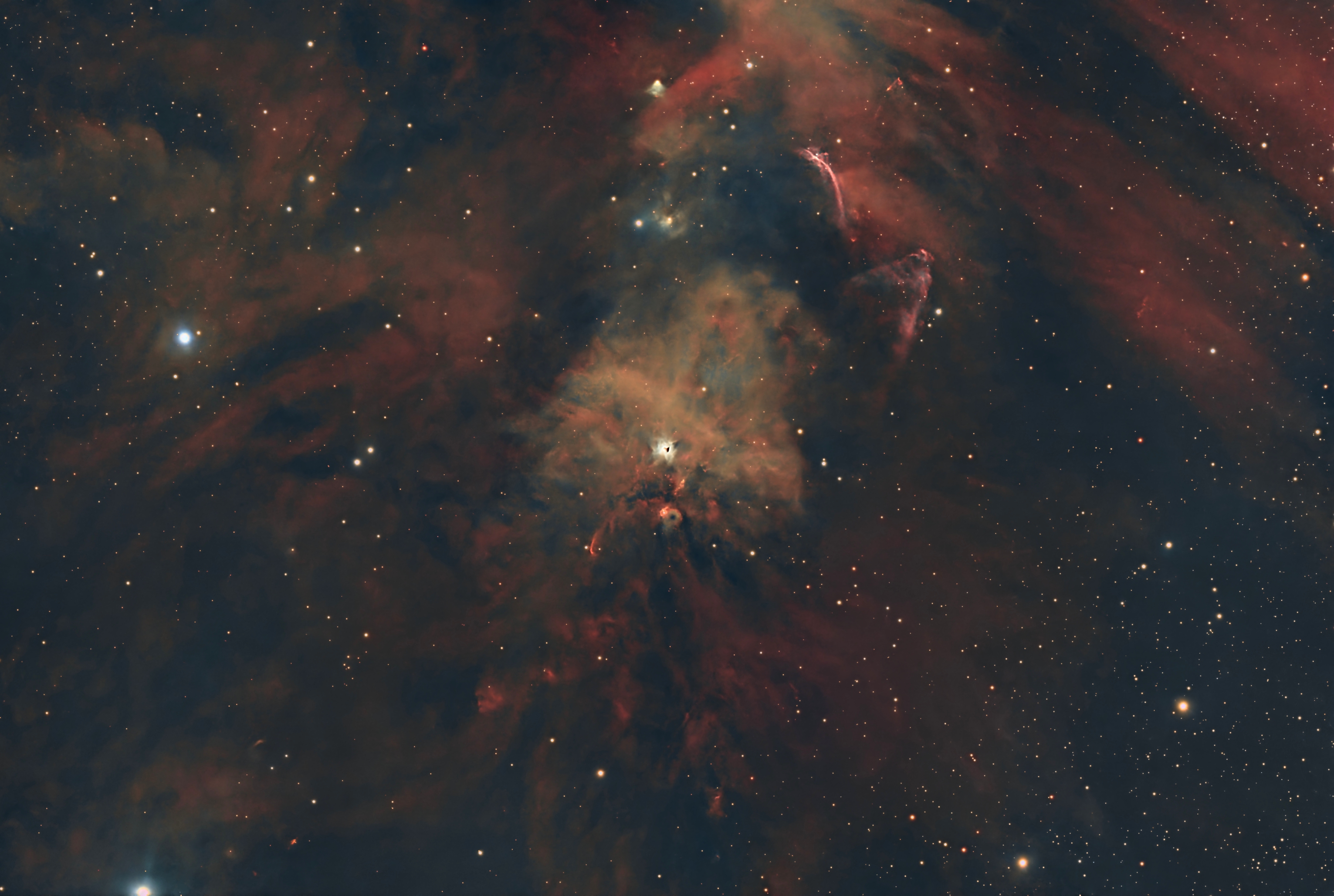

NGC1999, also known as the Cosmic Keyhole Nebula, is located in Orion just below the bright M42 Orion Nebula. At a distance of about 1500 lightyears
it is a dark nebula surrounded by the glowing hydrogen-alpha emitting gas and dust clouds that cover the constellation. The dark keyhole feature appears to be a void as
opposed to a dark cloud blocking starlight from behind.
This data was collected on a night of poor seeing and cold temperatures casused a bit of backlash in my mount's RA axis resulting is a slightly blurred image.
Click on the image to see a 50 percent zoom.
This is my first foray into narrow band imaging and the object is presented here in three different palettes. This modified HOSS palette shows more of the internal
structure of the H-alpha clouds that make up the bright central portion of the nebula. The palette is constructed from a standard HOSS palette with red = (H-alpha+OIII)/2,
green = blue = SII. To this, some of the original HOO data from the L-eXtreme filter was blended in using 0.7*HOSS + 0.3*HOO with the stars from the HOO data. This seems
to give a better colour balance to the final image.
NGC1999, also known as the Cosmic Keyhole Nebula, is located in Orion just below the bright M42 Orion Nebula. At a distance of about 1500 lightyears
it is a dark nebula surrounded by the glowing hydrogen-alpha emitting gas and dust clouds that cover the constellation. The dark keyhole feature appears to be a void as
opposed to a dark cloud blocking starlight from behind.
This data was collected on a night of poor seeing and cold temperatures casused a bit of backlash in my mount's RA axis resulting is a slightly blurred image.
Click on the image to see a 50 percent zoom.
This version is the data straight from the L-eXtreme filter. This filter has a 7 nm bandpass centered on H-alpha and another centered on OIII. This effectively produces an
HOO palette as the OIII light is picked up by both the green and blue channels of my camera at about equal levels.
NGC1999, also known as the Cosmic Keyhole Nebula, is located in Orion just below the bright M42 Orion Nebula. At a distance of about 1500 lightyears
it is a dark nebula surrounded by the glowing hydrogen-alpha emitting gas and dust clouds that cover the constellation. The dark keyhole feature appears to be a void as
opposed to a dark cloud blocking starlight from behind.
This data was collected on a night of poor seeing and cold temperatures casused a bit of backlash in my mount's RA axis resulting is a slightly blurred image.
Click on the image to see a 50 percent zoom.
This version is done in the classic Hubble palette where light from SII (Sulphur) is mapped to the red channel, H-alpha light is mapped to the green channel and the
OIII light from both filters was averaged and mapped to the blue channel yielding the classic SHO palette.
NGC1999 core. This is at 100% so no zoom is available.
The image shows the keyhole structure at the center of the nebula. It was once thought that this was a dark cloud in front of the background stars, gas and dust,
but work done with the infrared Herschel telescope has shown that this is a true void possibly created by the stellar wind from the star at the left edge of the structure.
| RA: | 5:36:30 |
| Dec: | -6:42:16 |
| Date: | 17&19 January, 2026 |
| Exposure: | 180 minutes (12 X 15 minutes) |
| Conditions: | Bright Bortle 4 skies. |
| Gain: | 100 |
| Camera: | Zwo ASI2600MC-Pro |
| Optics: | Prime focus of a SkyWatcher Esprit 120 f/7 APO refractor with a focal length of 840 mm |
| Filter: | L-eXtreme & L-Synergy |
| Location: | St. Croix, Nova Scotia |
Processed entirely in PixInsight using several plug-ins, Blur Exterminator for deconvolution, Noise Exterminator for noise reduction, GHS for stretching, Seti-Astro
suite for gradient removal and StarNet++ to produce a starless image.
1. Calibration, stacking of images from both filters done using the WBPS.
2. Both stacked images were run through deconvolution using Blur Exterminator.
3. Seti-Astro Automatic DBE was used to remove gradients.
4. Noise reduction using Noise Exterminator with three iterations.
5. Pixel math was used to construct the three individual palettes for further stretching.
6. StarNet++ was used to produce a starless and star only images.
7. Starless images were stretched using GHS in colour mode. Saturation increased using GHS.
8. Star images were stretched in colour mode using GHS.
9. Pixel math was used to recombine the starless and star only images using the expression N+S-N*S where N=starless image and S=star only image.
10. Saturation boosted with curves.
11. Image binned by two and stored as a jped for web upload.