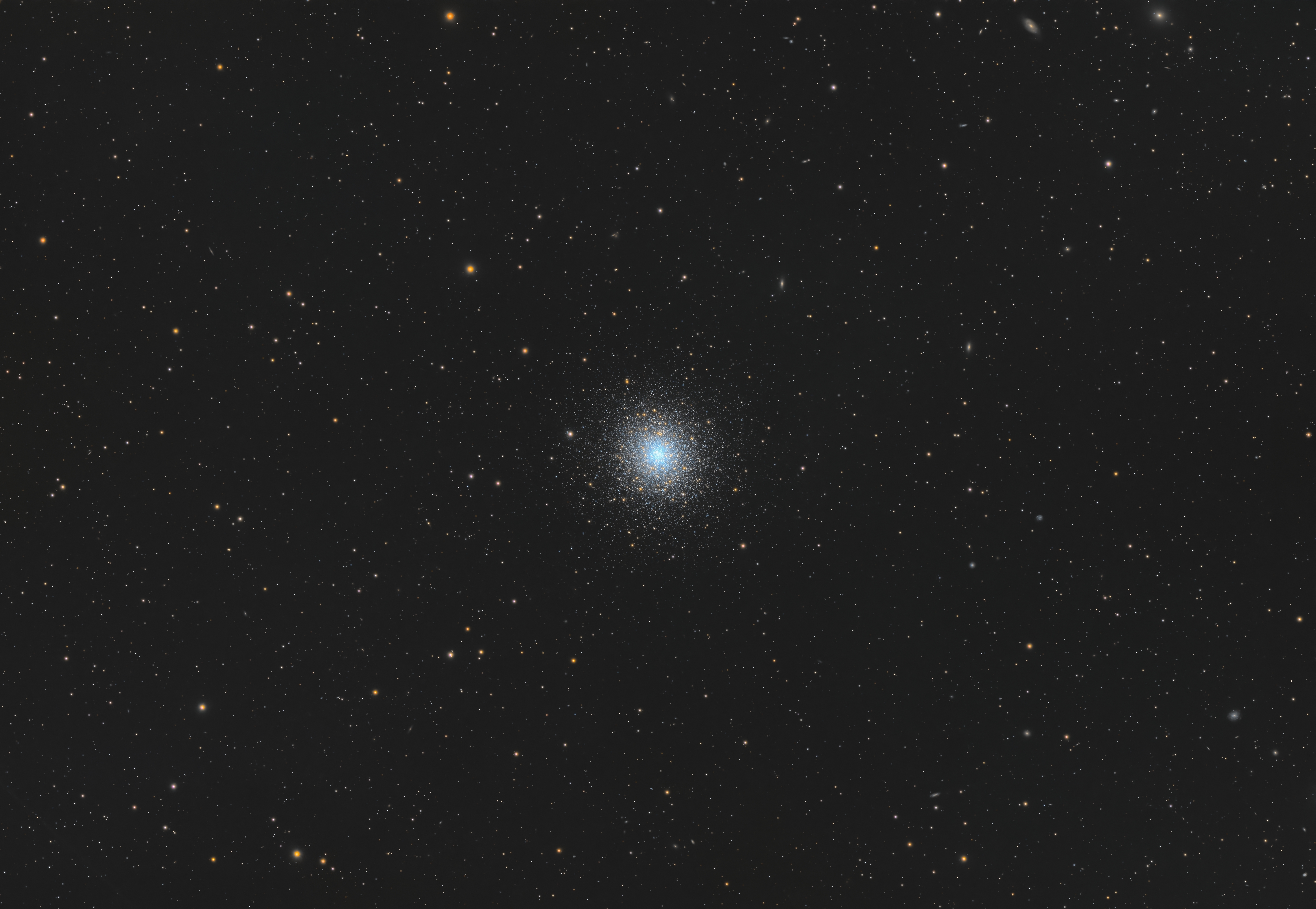

The forgotten globular cluster. M92 is often overlooked due to its proximity to M13.
M92 is a showcase object in its own right and if it were not for M13 it would be known as the Great Hercules Cluster.
According to Wikipedia
It was discovered by Johann Elert Bode on December 27, 1777, then published in the
Berliner Astronomisches Jahrbuch during 1779. It was inadvertently rediscovered by Charles Messier on March 18, 1781,
and added as the 92nd entry in his catalogue. William Herschel first resolved individual stars in 1783.
It is also one of the galaxy's oldest clusters. It is around 16,000 ly (4.9 kpc) above/below the galactic plane and 33,000 ly (10 kpc) from the Galactic Center.
It is about 26,700 light-years away from the Solar System. The half-light radius, or radius containing the upper half of its light emission, is 1.09 arcminutes,
while the tidal radius, the broadest standard measure, is 15.17'. It appears only slightly flattened: its minor axis is about 89% ± 3% of the major.
Its diameter is 108 ly, and may have a mass corresponding to 330,000 times the mass of the Sun.
| RA: | 17:17:09 |
| Dec: | +43:08:26 |
| Date: | 12 July, 2025 |
| Exposure: | 180 minutes (18 X 10 minutes) |
| Conditions: | Bortle 4 to 5 skies, but a bright, almost full Moon in the sky. |
| Gain: | 100 |
| Camera: | Zwo ASI2600MC-Pro |
| Optics: | Prime focus of a SkyWatcher Esprit 120 f/7 APO refractor with a focal length of 840 mm |
| Filter: | None |
| Location: | Marion Bridge, Nova Scotia |
Processed entirely in PixInsight using several plug-ins, Blur Exterminator for deconvolution, Noise Exterminator for noise reduction, GHS for stretching, Seti-Astro
suite for gradient removal and StarNet++ to produce a starless image.
1. Calibration, stacking and drizzle combining, increasing the resolution by 2, done using the WBPS.
2. Deconvolution using Blur Exterminator.
3. Spectrophotometric Colour Calibration used to calibrate the colour of the image and remove the green cast.
4. Gradient removal using Seti-Astro's Automatic DBE.
5. Noise reduction using Noise Exterminator with three iterations.
6. The image was stretched using GHS in colour mode.
7. StarNet++ was used to produce a starless image and PixelMath was used to produce a star only image.
8. The starless image was slightly blurred with a mask to isolate the effect to the core of the cluster.
9. Image luminance extracted.
10. Convolution used to slightly blur the colour star image to remove odd colour halos made by GHS.
11. Saturation increased using GHS in saturation mode.
12. The LRGB tool was used to combine the star luminance image with the star colour image. This produces a better colour star image than GHS alone. Image ID set to s.
13. Pixel math used to recombine the star image with the galaxy image with StarOnlyImage + StarlessImage as the combination expression.
14. ICC profile set to sRGB.
15. Image stored then binned by two for web upload and stored as a jpeg.