
| Here is a reprocess of
some data from 2021. This is a good example of why I never through away
data; with new tools and techniques it is alway interesting what you
can pull out of an image. My schedule and the
weather finally aligned with the dark of the Moon and I managed to get
some time at the St.Croix Observatory, the dark sky observing site of
the Halifax Centre of the RASC. After setting up and finding that my
intended target was still behind the trees I took the opportunity to
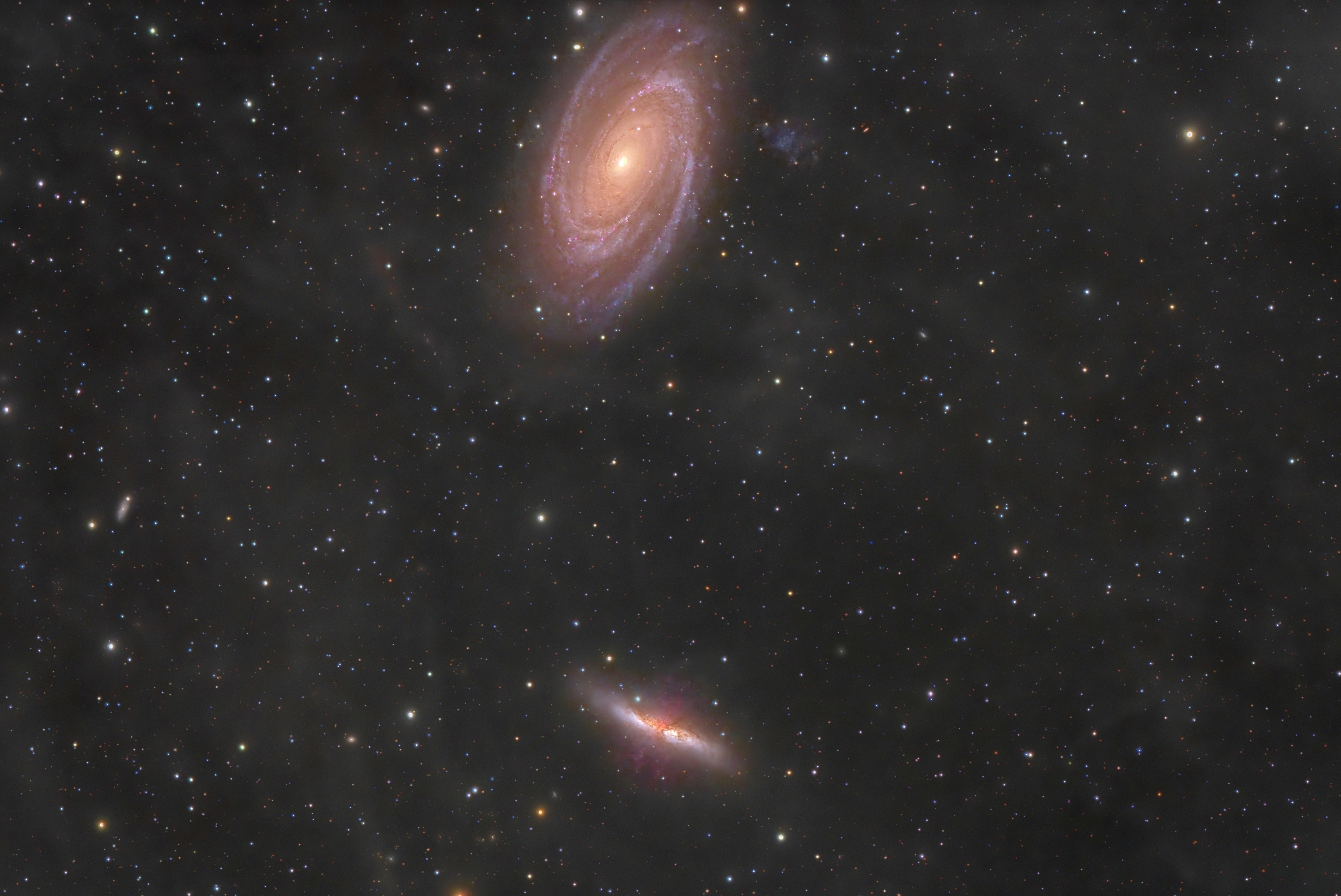
grab a couple of hours of data on a favorite galaxy pair. The image
really needs about 4 to 6 hours to do the integrated flux nebula (IFN)
any justice, but it is a tribute to the dark skies at the site that it
was visible in such a short exposure. UPDATE: I recently acquired a copy of PixInsight so I could use some of the newer plug-ins. This image used Noise Exterminator and Blur Exterminator as well as the Spectrophotometric Color Calibration tool in PixInsight before split star processing in Images Plus. As a result of the new tools I was able to really turn up the background stretch to reveal more of the IFN with only two hours of data. According to Wikipedia - Messier 81 (also known as NGC 3031 or Bode's Galaxy) is a grand design spiral galaxy about 12 million light-years away, with a diameter of 90,000 light years, in the constellation Ursa Major. Due to its proximity to our galaxy, large size, and active galactic nucleus (which harbors a 70 million solar mass supermassive black hole), Messier 81 has been studied extensively by professional astronomers. The galaxy's large size and relatively high brightness also makes it a popular target for amateur astronomers. The IFN is visible filling the frame of this shot with Arp's Loop visible just to the lower right of M81. As usual click on the image to see my earlier attempt on this data and again for a higher resolution version. Click again to return to this page. |
||||||||||||||||||||
 |
||||||||||||||||||||
|