
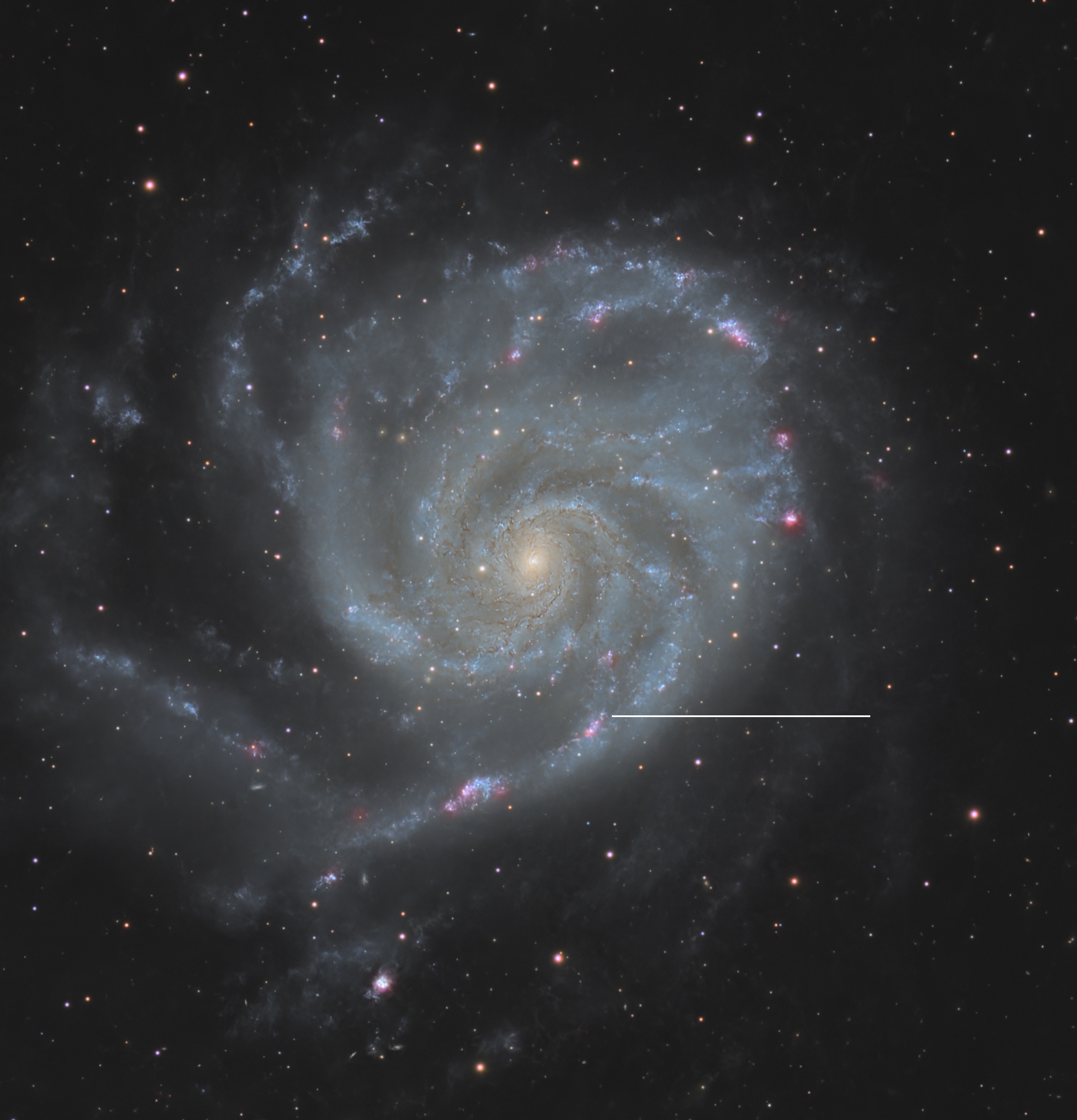
| After carefully inspecting my recent image of M101 I noticed the the
supernovae that appeared in 2023 is still faintly visible. Supernova
2023IXF exploded in May of 2023 and was immediately captured the
attention of astrophotographers worldwide. According to Wikipedia - SN 2023ixf is a type II-L (core collapse) supernova located in the Pinwheel Galaxy. It was first observed on 19 May 2023 by Kōichi Itagaki and immediately classified as a type II supernova. Initial magnitude at discovery was 14.9. After discovery, the Zwicky Transient Facility project found a precovery image of the supernova at magnitude 15.87 two days before discovery. The supernova was about 21 million light-years from Earth and is expected to have left behind either a neutron star or black hole, based on current stellar evolution models. The supernova is located near a prominent HII region, NGC 5461, in an outer spiral arm of the bright galaxy. By 22 May 2023, SN 2023ixf had brightened to about magnitude 11. It could be seen in telescopes as small as 114 mm (4.5 in) and remained visible with backyard telescopes for several months. The supernova started to fade around 10 June 2023. The last supernova that close to Earth occurred 9 years previously: SN 2014J in Messier 82, roughly 12 million light-years from Earth. Click
on the image to see a higher resolution version this will blink with a
version taken on the 28th of May 2023 when the supernova
was near its brightest then with an image
of the galaxy from May 2022, before the supernova. Click one
last time to return to this initial
image. |
||||||||||||||||||||
 |
||||||||||||||||||||
|