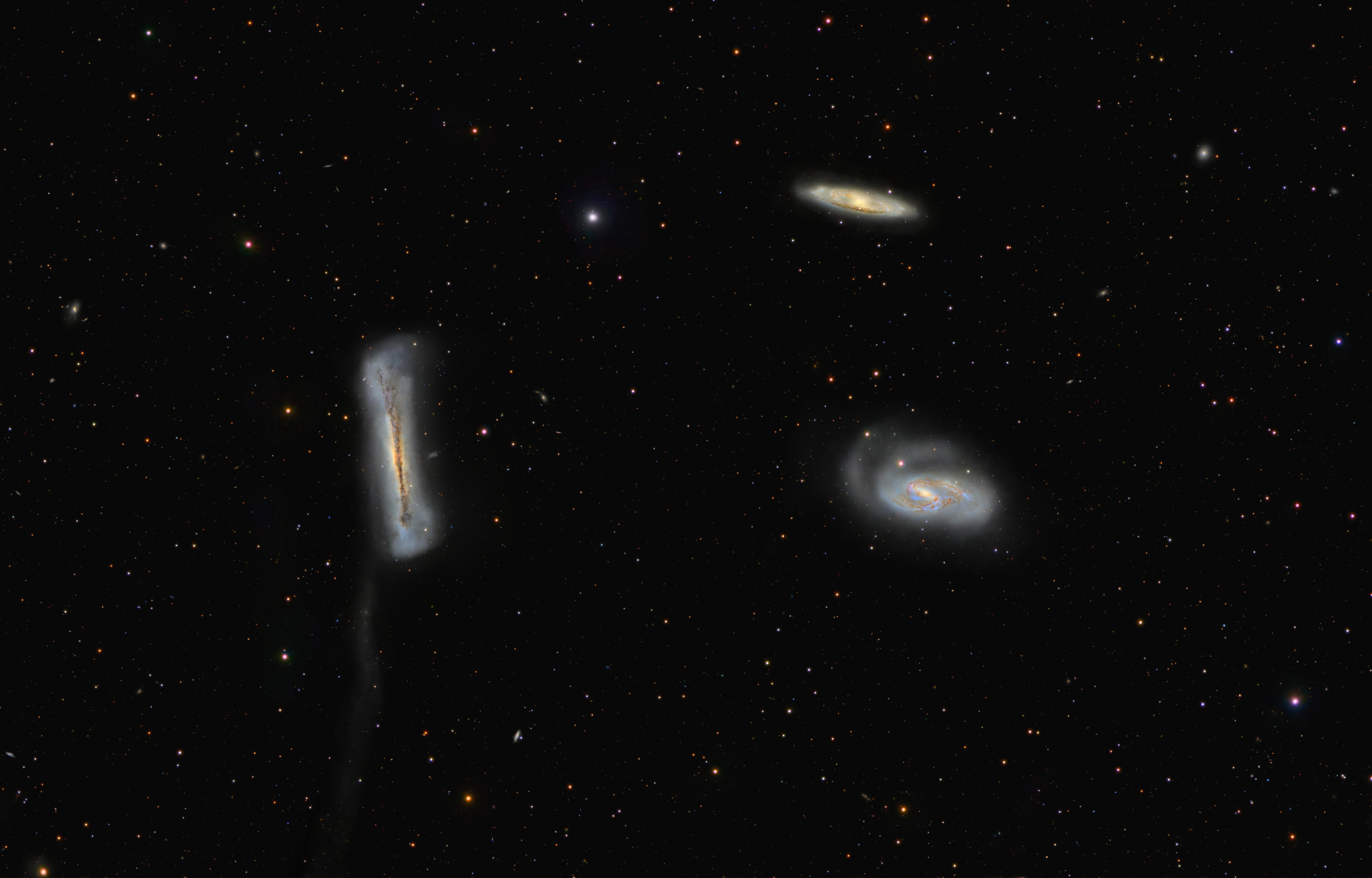

I continue to be amazed at modern CMOS cameras. I've been able
to almost double the total exposure for this image compared to my original image made from
April's data. The additional exposure made it possible to push the
stretch further
bringing out more of the tidal tail from NGC 3276 and more of the outer
spiral arms of M66.
According to Wikipedia
- The Leo Triplet (also known as the M66 Group) is a small group of
galaxies about 35 million light-years away in the constellation Leo.
This galaxy group consists of the spiral galaxies M65, M66, and NGC
3628.
NGC 3628, also known as the Hamburger Galaxy or Sarah's Galaxy, is an unbarred spiral galaxy about 35 million light-years away in the constellation Leo and is the galaxy on the left side of the image.
It was discovered by William Herschel in 1784. It has an approximately 300,000 light-years long tidal tail due to a past interaction with M66.
Its most conspicuous feature is the broad and obscuring band of dust located along the outer edge of its spiral arms, effectively transecting the galaxy to the view from Earth.
The galaxy in the upper right of the image is Messier 65 (also known as NGC 3623) is an intermediate spiral galaxy about 35 million light-years away in the constellation Leo, within its highly equatorial southern half.
It was discovered by Charles Messier in 1780.
M65 was discovered by Charles Messier and included in his Messier Objects list. However, William Henry Smyth accidentally attributed the discovery to Pierre Méchain in his
popular 19th-century astronomical work A Cycle of Celestial Objects (stating "They [M65 and M66] were pointed out by Méchain to Messier in 1780").
In the lower right of the image, M66, also known as NGC 3627, is an intermediate spiral galaxy in the southern, equatorial half of Leo.
It was discovered by French astronomer Charles Messier on 1 March 1780, who described it as "very long and very faint".
Gravitational interaction from its past encounter with neighboring NGC 3628 has resulted in an extremely high central mass concentration;
a high molecular to atomic mass ratio; and a resolved non-rotating clump of H I material apparently removed from one of the spiral arms.
The latter feature shows up visually as an extremely prominent and unusual spiral arm and dust lane structures as originally noted in the Atlas of Peculiar Galaxies.
| RA: | 11:19:54 |
| Dec: | +13:19:46 |
| Date: | April and May, 2025 |
| Exposure: | 220 minutes (22 X 10 minutes) |
| Conditions: | Bortle 4 to 5 skies |
| Gain: | 100 |
| Camera: | Zwo ASI2600MC-Pro |
| Optics: | Prime focus of a SkyWatcher Esprit 120 f/7 APO refractor with a focal length of 840 mm |
| Filter: | None |
| Location: | St. Croix, Nova Scotia |
Processed entirely in PixInsight using several plug-ins, Blur Exterminator for deconvolution, Noise Exterminator for noise reduction, GHS for stretching, Seti-Astro
suite for gradient removal and StarNet++ to produce a starless image.
1. Calibration, stacking and drizzle combining, increasing the resolution by 2, done using the WBPS.
2. Deconvolution using Blur Exterminator.
3. Spectrophotometric Colour Calibration used to calibrate the colour of the image and remove the green cast.
4. Gradient removal using Seti-Astro's Automatic DBE.
5. Noise reduction using Noise Exterminator with three iterations.
6. StarNet++ was used to produce a starless image and PixelMath was used to produce a star only image.
7. GHS was used multiple times to stretch the starless image, with the first stretch using colour mode to enhance the colour in the galaxies.
8. Local Histogram Equalization was used with a mask to enhance the core contrast of the galaxies.
9. Unsharp mask used to sharpen the core detail using the same mask.
10. TVGDenoise used to smooth the background using the inverse of the mask to protect the galaxy cores.
11. HistogramTransformation used to set the black point.
12. The image identifer set to g.
13. GHS used to stretch the star only image paying attention to the star profile. No attempt to retain colour. Image luminance extracted.
14. GHS used on a copy of the unstretched star only image in colour mode to stretch the image. Attention was paid to the star colour.
15. Convolution used in three iterations to slightly blur the colour star image to remove odd colour halos made by GHS using an inverted mask made from the star luminance image.
16. Saturation increased using GHS in saturation mode.
17. The LRGB tool was used to combine the star luminance image with the star colour image. This produces a better colour star image than GHS alone. Image ID set to s.
18. Pixel math used to recombine the star image with the galaxy image with s+g-s*g as the combination expression.
19. ICC profile set to sRGB.
20. Image stored then binned by two for web upload and stored as a jpeg.