
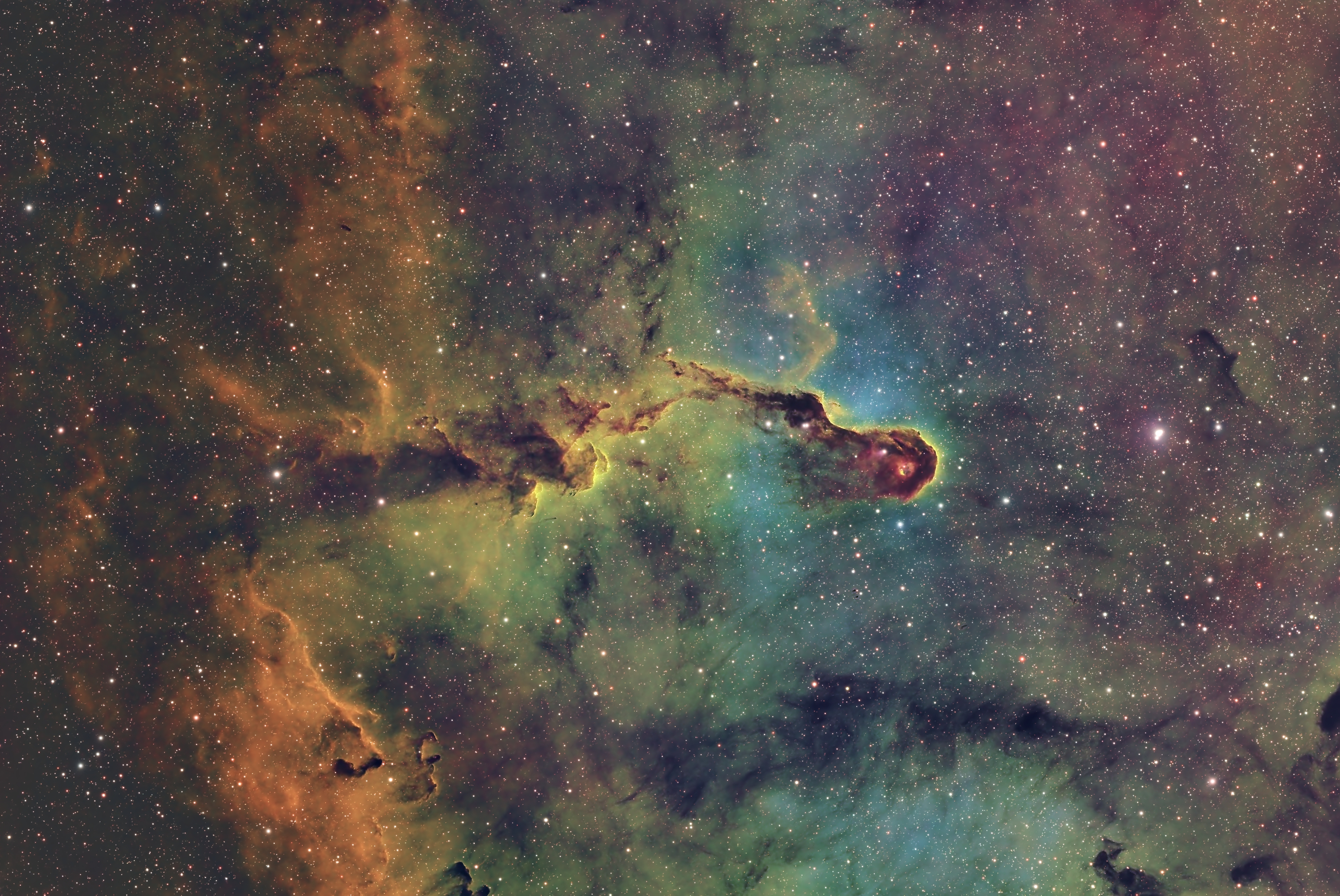
IC-1396, also know as the Elephant Trunk, is an emission Nebula in the constellation Cepheus about 2,400 light years away from Earth.
The nebula is a dark and has central region that gets its name from its visible light appearance, where a dark central pillar is surrounded by a bright rim.
The bright rim is the surface of the dense cloud illuminated and ionized by the very bright, massive multiple star (HD 206267) that is just to the east of
the elephant's trunk. The entire IC 1396 region is ionized by the massive star, except for dense packets of gas and dust that can protect themselves from
the star's extereme ultraviolet rays. Because the L-eXtreme filter is a dual narrowband filter passing hydrogen-alpha and OIII wavelengths, its data was used
for the HOO palette. The SHO palette version was created from the data produced using both the L-eXtreme and L-Synergy filters.
Click on the image repeatedly to zoom in and click and drag to look around the zoomed image. Move your mouse off the image to reset the zoom.
| RA: | 21:37:03 |
| Dec: | +57:33:10 |
| Date: | August 2026 |
| Exposure: | 4 hours of L-eXtreme data (16 X 15 minutes subs) |
| Conditions: | Bortle 4 skies. |
| Gain: | 100 |
| Camera: | Zwo ASI2600MC Pro |
| Optics: | Prime focus of a SkyWatcher Esprit 120 f/7 APO refractor with a focal length of 840 mm |
| Filter: | L-eXtreme & L-Synergy |
| Location: | Marion Bridge, Nova Scotia |
Processed entirely in PixInsight using several plug-ins, Blur Exterminator for deconvolution, Noise Exterminator for noise reduction, GHS for stretching, Seti-Astro
suite for mask generation, and Star Exterminator to produce a starless image. The workflow is as follows:
1. Calibration and stacking done in PixIngsight.
2. Deconvolution using Blur Exterminator applied.
3. Gradient correction applied to help enhance the darker areas by reducing the overall background brightness.
4. Noise reduction using Noise Exterminator with three iterations and luminance and colour separation.
5. L-eXtreme and L-Synergy images star aligned.
6. Star Exterminator was used to produce starless and star only images. The star image from the L-Synergy filter was deleted.
7. SHO palette produced using pixel math. L-eXtreme data used for HOO palette image.
8. GHS used to stretch the nebula and the star images differently.
9. Local Histogram Equalization was used with a mask to enhance some of the nebula.
10. Unsharp mask used to sharpen the nebula detail using the same mask.
11. TVGDenoise used with a mask to reduce the noise in the nebula image.
12. The image identifer set to n.
13. Saturation increased using a curve.
14. Pixel math used to recombine the nebula and star images using combine(g,s,op_screen()) as the combination expression.