
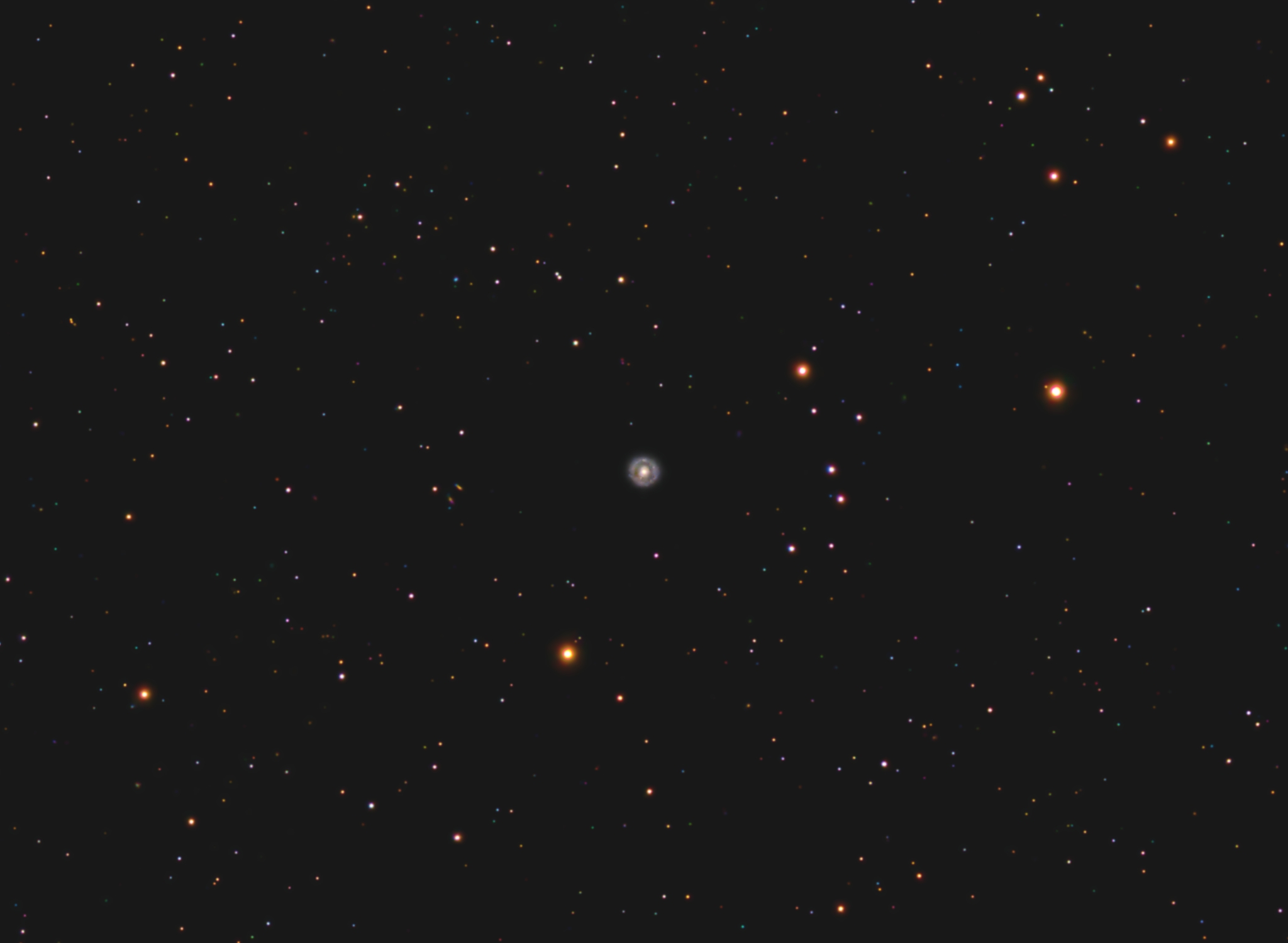
| This one is a bit if a challenging test
shot. Hoag's Object is a ring galaxy in Serpens Caput.
This one is quite small, just 17 arcseconds wide, and near the
resolution limit of my small 120 mm telescope. The Moon was rising
during the first third of the exposure, but the galaxy is so small it
didn't seem to make any difference until it was well above the horizon. According to Wikipedia - A nearly perfect ring of young hot blue stars circles the older yellow nucleus of this ring galaxy 600 million light-years away in the constellation Serpens. The ring structure is so perfect and circular that it has been referred to as "The most perfect ring galaxy". The diameter of the 6 arcsecond inner core of the galaxy is about 17±0.7 kly (5.3±0.2 kpc) while the surrounding ring has an inner 28″ diameter of 75±3 kly (24.8±1.1 kpc) and an outer 45″ diameter of 121±4 kly (39.9±1.7 kpc). The galaxy is estimated to have a mass of 700 billion suns. By comparison, the Milky Way galaxy has an estimated diameter of 150-200 kly and consists of between 100 and 500 billion stars and a mass between 800 billion and 1.54 trillion suns. Click on the image to see a much higher resolution version. Click again to return to this page. |
||||||||||||||||||||
 |
||||||||||||||||||||
| This shot was a two hour
exposure and the small size of the galaxy accurate tracking and guiding
were critical. Fortunately DEO
was up to the challenge and the CGX-L mount was able to track and
provide a stable support for my refractor and camera during the
exposure. In an effort to make the best of the good seeing during the
imaging run, the guide correction rate was set to one correction
per second. This helped to counter some wind and the occasional
tracking glitch. To see what spending another 10 billion gets you, check out this Hubble image of the interesting object. |
||||||||||||||||||||
|