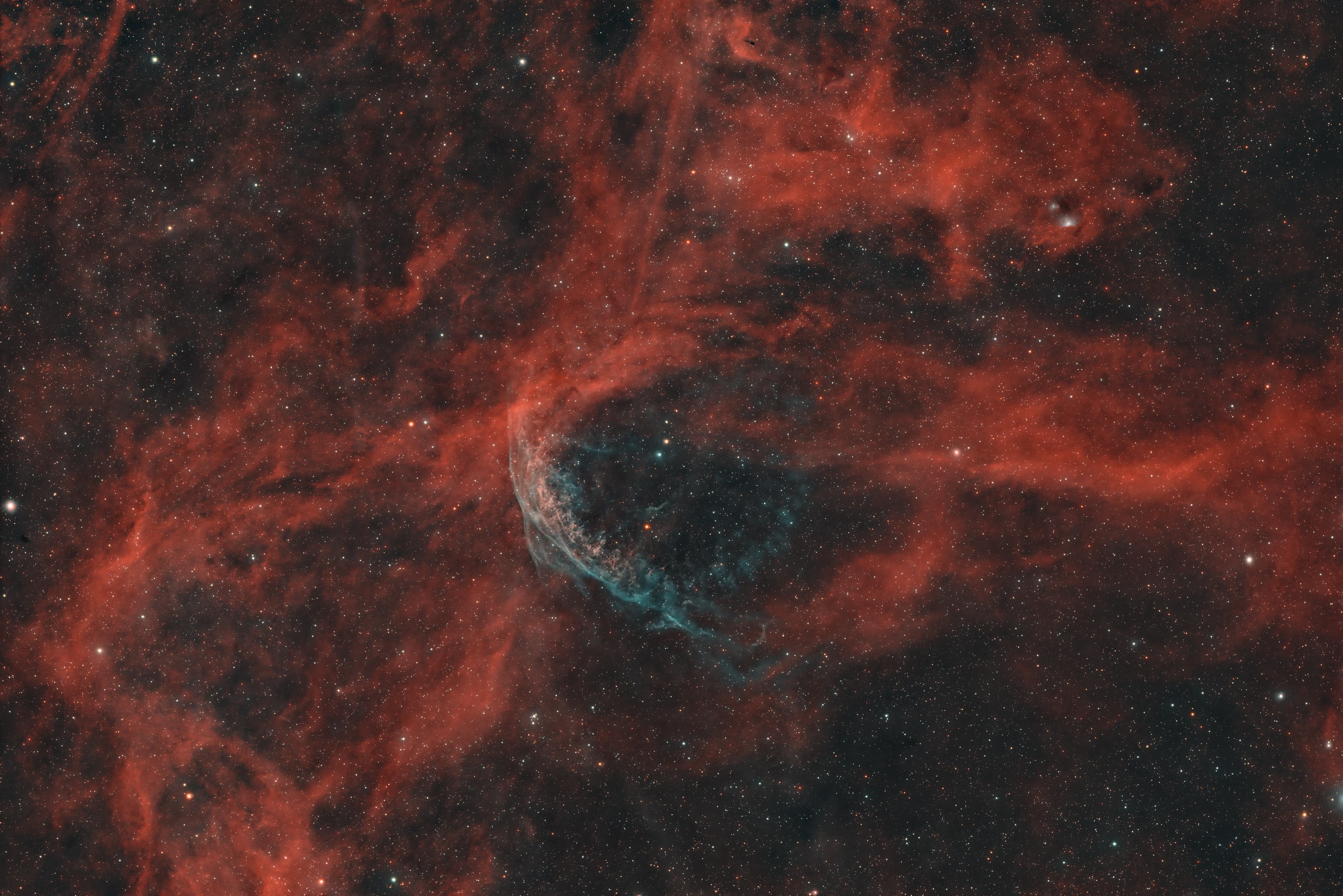

Here is a redo of the processing on a shot taken by DEO from our cottage at Marion Bridge. I only had a few minutes
to spend on the processing so the original attempt left something to be desired. This
version uses my standard split star processing and a masked stretch with curves to slightly boost the blue (see the Processing Details tab)
making the most of just 2.5 hours of data.
The target is WR 134 is a variable Wolf-Rayet star located around 6,000 light years away from Earth in the constellation
Cygnus, surrounded by a faint bubble nebula blown by the intense radiation and fast wind from the star. It is five
times the radius of the sun, but due to a temperature over 63,000 K it is 400,000 times as luminous as the Sun. The
blue, OIII, emission from the gas given off by the star contrasts with the red, H-alpha, light given off by the surrounding gas
of the Milky Way.
| RA: | 20:11:02 |
| Dec: | +36:17:54 |
| Date: | 28 July, 2022 |
| Exposure: | 2.5 hours (10 X 15 minutes) |
| Conditions: | Bortle 4 to 5 skies, good seeing |
| Gain: | 100 |
| Camera: | Zwo ASI2600MC-Pro |
| Optics: | Prime focus of a SkyWatcher Esprit 120 f/7 APO refractor with a focal length of 840 mm |
| Filter: | Optolong L-eNhance |
| Location: | Marion Bridge, Nova Scotia |
Processed entirely in PixInsight using several plug-ins, Blur Exterminator for deconvolution, Noise Exterminator for noise reduction, GHS for stretching, Seti-Astro
suite for mask generation, and StarNet++ to produce a starless image.
1. Calibration and stacking done using the WBPS.
2. Deconvolution using Blur Exterminator.
3. Gradient reduction using GraXpert.
4. Spectrophotometric Colour Calibration used to calibrate the colour of the image.
5. Noise reduction using Noise Exterminator with five iterations.
6. StarNet++ was used to produce a starless nebula image and star only image.
7. GHS in colour mode used to stretch the nebula image.
8. Local Histogram Equalization was used to enhance the contrast of the nebula.
9. Unsharp mask used to sharpen the core detail using a mask.
10. Mask made from the blue channel used with a curves adjustment to slightly brighten the blue of the core.
11. TVGDenoise used to smooth the background using a mask.
12. The image identifer set to n.
13. Saturation increased using GHS in saturation mode.
14. The star only image was stretched using GHS in colour mode and the identifier set to s.
15. Saturation increased using GHS in saturation mode.
16. Pixel math used to recombine the star image with the nebula image with s+n-s*n as the combination expression.
17. ICC profile set to sRGB.
18. Imaged binned by two for website upload.
19. Image stored for web upload as a jpeg.