
| Here is the beginning of
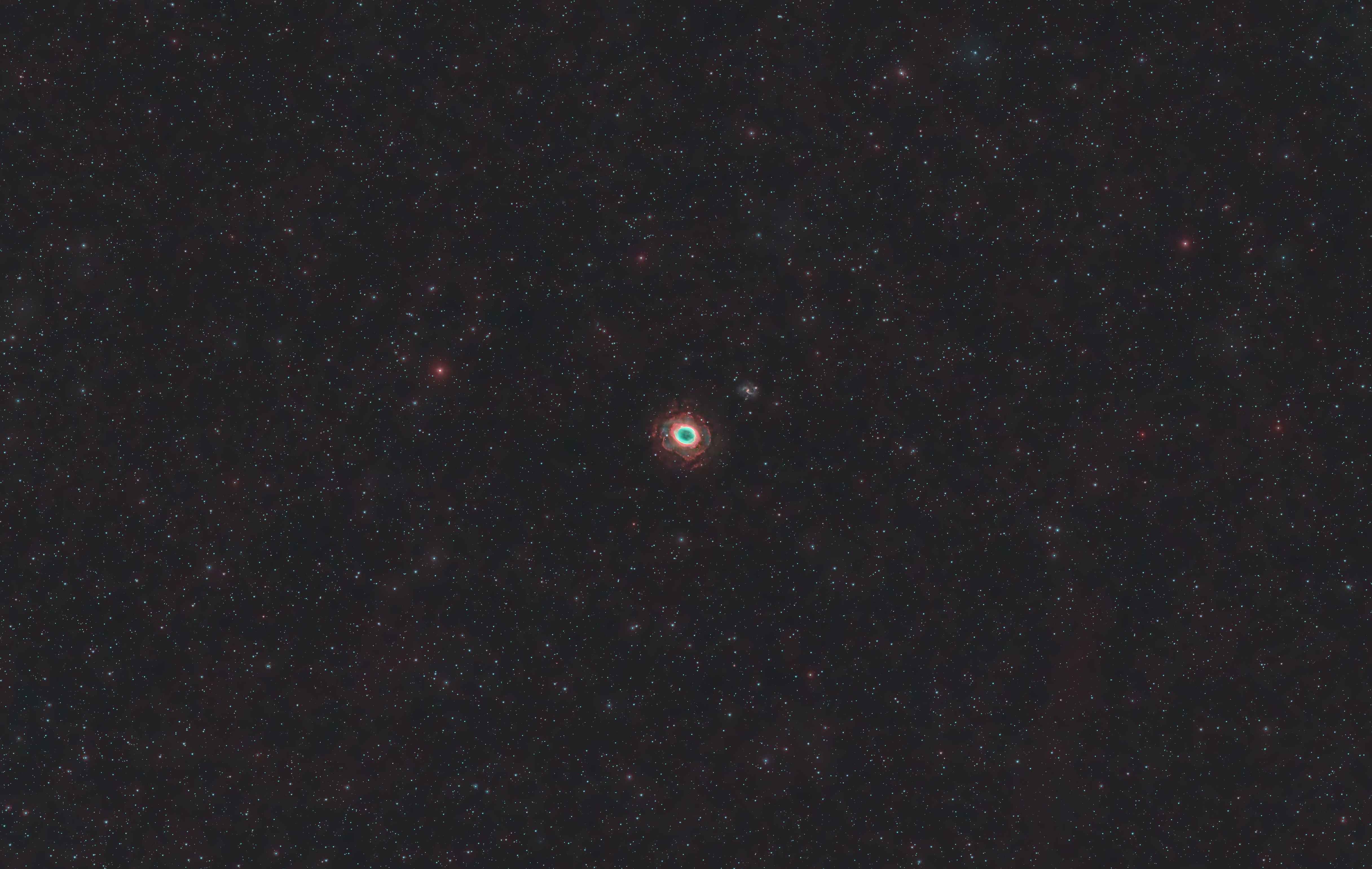
a summertime project. My plan was to collect a lot of data on M57 to
show the faint outer areas and shells of the nebula, but cloud and an
approaching hurricane have limited me to just three hours of exposure
which I've recently increased to five and added an hour worth of
barlowed core data to preserve detail, I thought I'd give
the data
set a whirl just to see if any of the faint envelope was there. So far
I'm pleased to find that the first outer shell is easily visible and
there is a hint of the faint second shell. I'll be adding more to this
one if the weather permits to pull out more detail and the second outer
shell of gas and dust. According to Wikipedia - The Ring Nebula (also catalogued as Messier 57, M57 and NGC 6720) is a planetary nebula in the northern constellation of Lyra. Such a nebula is formed when a star, during the last stages of its evolution before becoming a white dwarf, expels a vast luminous envelope of ionized gas into the surrounding interstellar space. This nebula was discovered by the French astronomer Charles Messier while searching for comets in late January 1779. Messier's report of his independent discovery of Comet Bode reached fellow French astronomer Antoine Darquier de Pellepoix two weeks later, who then independently rediscovered the nebula while following the comet. Darquier later reported that it was "...as large as Jupiter and resembles a planet which is fading" (which may have contributed to the use of the persistent "planetary nebula" terminology). It would be entered into Messier's catalogue as the 57th object. Messier and German-born astronomer William Herschel speculated that the nebula was formed by multiple faint stars that were unresolvable with his telescope. In 1800, German Count Friedrich von Hahn announced that he had discovered the faint central star at the heart of the nebula a few years earlier. He also noted that the interior of the ring had undergone changes, and said he could no longer find the central star. In 1864, English amateur astronomer William Huggins examined the spectra of multiple nebulae, discovering that some of these objects, including M57, displayed the spectra of bright emission lines characteristic of fluorescing glowing gases. Huggins concluded that most planetary nebulae were not composed of unresolved stars, as had been previously suspected, but were nebulosities. The nebula was first photographed by the Hungarian astronomer Eugene von Gothard in 1886. For more information on this nebula, please click on the "Wikipedia" link at the top of this description. Click on the image to see a annotated version then click again to see a higher resolution version, click one last time to return to this page. |
||||||||||||||||||||
 |
||||||||||||||||||||
|