| Object |
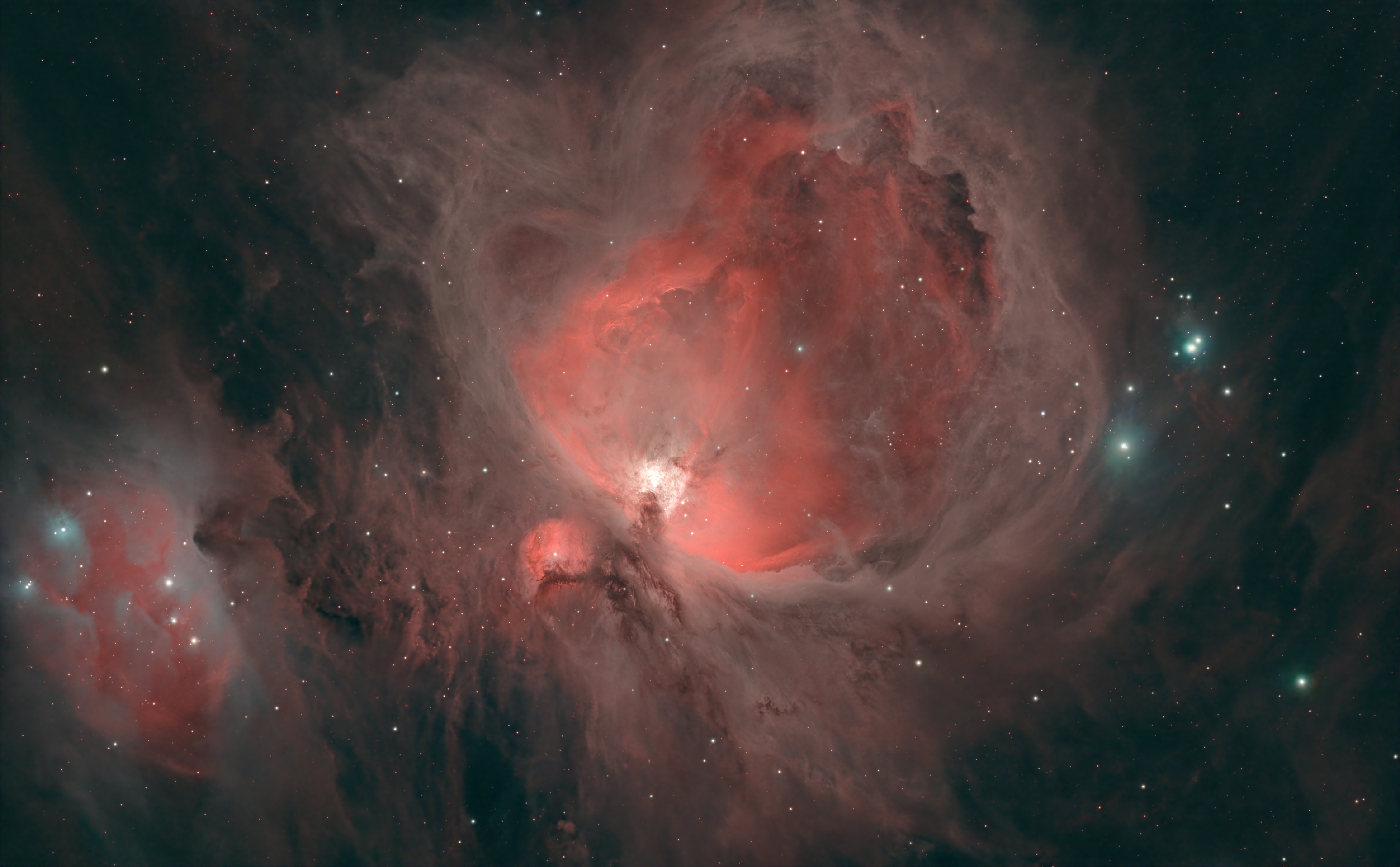
The Orion Nebula Object RA 5:35:16 Dec -5:23:01 |
| Date |
8
December, 2023 plus 8 February 2024
|
| Exposure |
120 minutes (24X 5 minutes), 60 minutes for
the core data (60 X 1 minute) |
| Conditions |
Dark
Bortle 4 skies, no Moon plus filtered urban data for the core. |
| Gain |
100 |
| Camera |
Zwo ASI2600MC-Pro |
| Optics |
Prime focus of a SkyWatcher Esprit
120 f/7 APO refractor with a focal length of 840 mm |
| Filter |
Optolong
L-eNhance |
| Location |
St. Croix & Bedford,
Nova Scotia |
| Processing |
This image was captured using Sequence Generator
Pro. Noise reduced with Noise Exterminator, sharpened with Blur
Exterminator. Starnet++ was used to split the image into a star layer
and a nebula layer. GHS was used to stretch both image layers in
PixInsight. Saturation was
increased in the star layer and a screen combine was used in pixel math
to combine the layers. Final colour and contrast tweaks applied in
Images Plus. |