
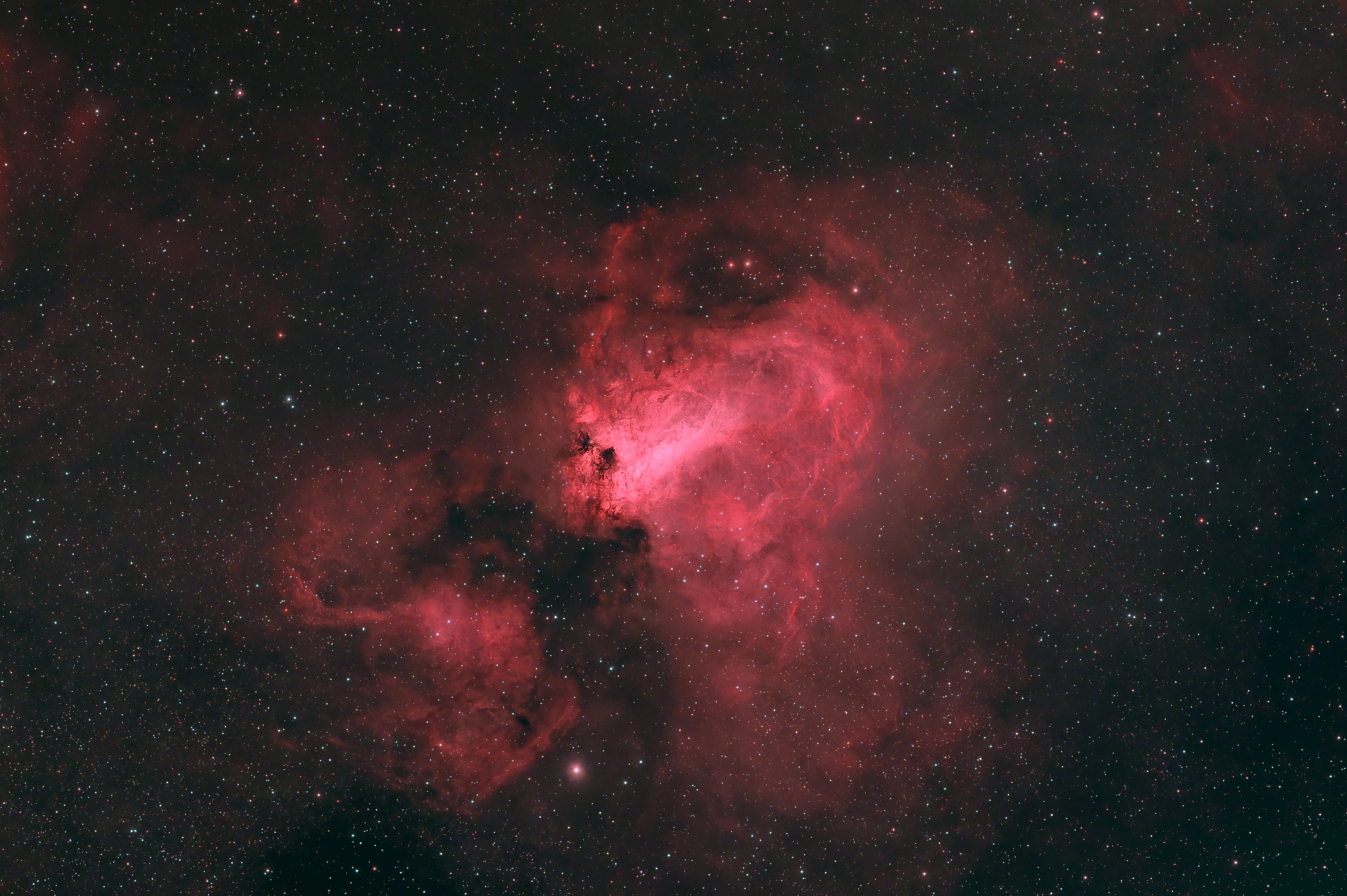
| Here is a dark sky shot
from our cottage in Marion Bridge, NS. Although the skies are dark,
there was a bright almost full moon less than 60 degrees away. The
L-eNhance filter did a good job at cutting through the bright Moon
light and allowed a reasonable data set to be captured. According to Wilipedia - The Omega Nebula, also known as the Swan Nebula, Checkmark Nebula, Lobster Nebula, and the Horseshoe Nebula (catalogued as Messier 17 or M17 or NGC 6618) is an H II region in the constellation Sagittarius. It was discovered by Philippe Loys de Chéseaux in 1745. Charles Messier catalogued it in 1764. It is by some of the richest starfields of the Milky Way, figuring in the northern two-thirds of Sagittarius. The Omega Nebula is between 5,000 and 6,000 light-years from Earth and it spans some 15 light-years in diameter. The cloud of interstellar matter of which this nebula is a part is roughly 40 light-years in diameter and has a mass of 30,000 solar masses. The total mass of the Omega Nebula is an estimated 800 solar masses. It is considered one of the brightest and most massive star-forming regions of our galaxy. Its local geometry is similar to the Orion Nebula except that it is viewed edge-on rather than face-on. Click on the image to see a higher resolution version, click again to return to this page. |
||||||||||||||||||||
 |
||||||||||||||||||||
|