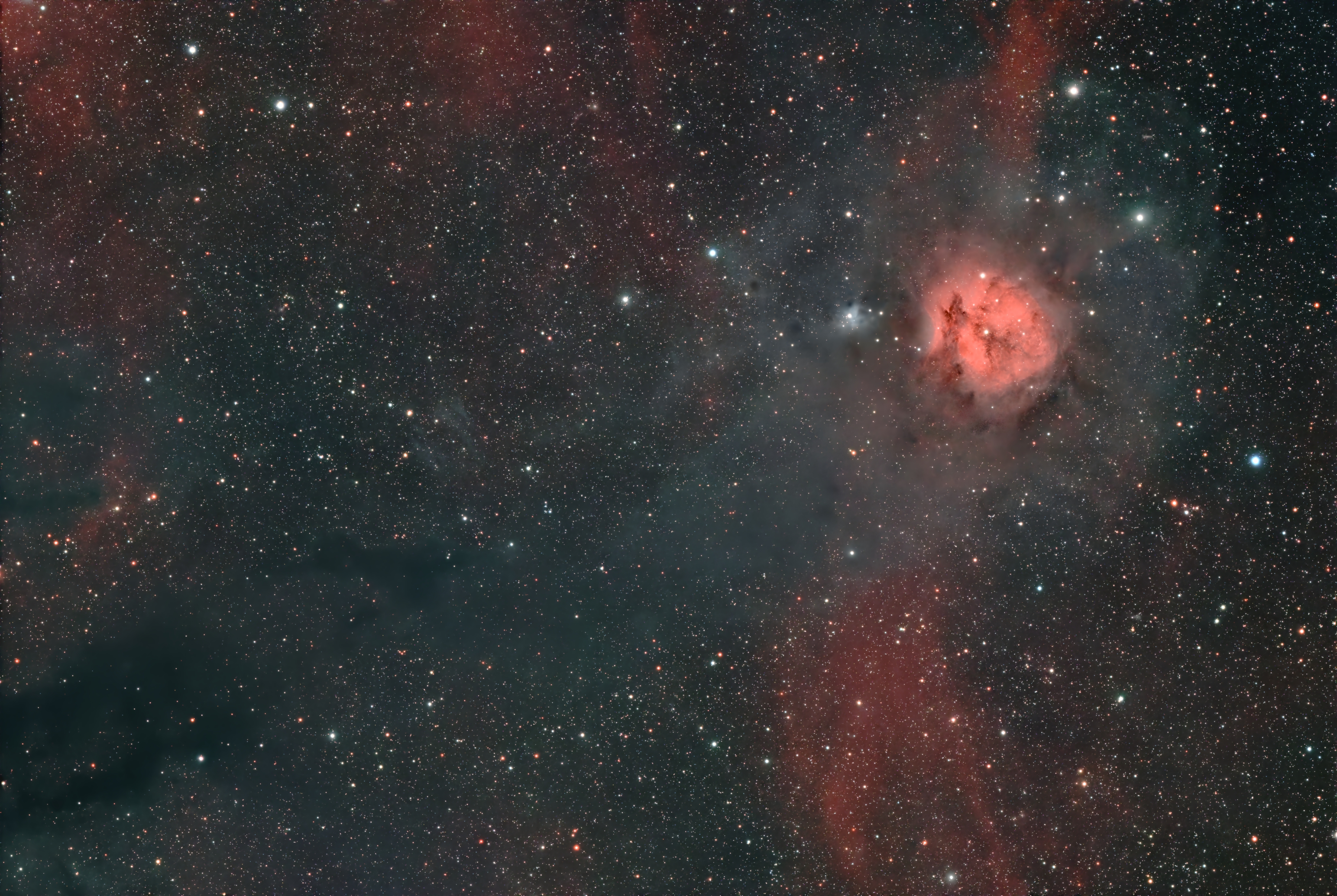

Here is a redo of the processing on a shot taken by DEO from our cottage at Marion Bridge.
The target is the Cocoon Nebula, IC5146, in Cygnus. To view the original image click on the picture. Click again to see a higher resolution view.
Click one more time to return to the original image.
According to Wikipedia - IC 5146 (also Caldwell 19, Sh 2-125,
Barnard 168, and the Cocoon Nebula) is a reflection/emission
nebula and Caldwell object in the constellation Cygnus. The NGC description refers to IC 5146 as a cluster of 9.5 mag stars
involved in a bright and dark nebula. The cluster is also known as Collinder 470. It shines at magnitude +10.0/+9.3/+7.2.
Its celestial coordinates are RA 21h 53.5m , dec +47° 16'. It is located near the naked-eye star Pi Cygni, the open cluster
NGC 7209 in Lacerta, and the bright open cluster M39. The cluster is about 4,000 ly away, and the central star that lights
it formed about 100,000 years ago; the nebula is about 12 arcmins across, which is equivalent to a span of 15 light years.
When viewing IC 5146, dark nebula Barnard 168 (B168) is an inseparable part of the experience, forming a dark lane that
surrounds the cluster and projects westward forming the appearance of a trail behind the Cocoon.
| RA: | 21:53:32 |
| Dec: | +47:16:03 |
| Date: | 23 August, 2023 |
| Exposure: | 3 hours (12 X 15 minutes) |
| Conditions: | Bortle 4 to 5 skies, good seeing |
| Gain: | 100 |
| Camera: | Zwo ASI2600MC-Pro |
| Optics: | Prime focus of a SkyWatcher Esprit 120 f/7 APO refractor with a focal length of 840 mm |
| Filter: | Optolong L-eNhance |
| Location: | Marion Bridge, Nova Scotia |
Processed entirely in PixInsight using several plug-ins, Blur Exterminator for deconvolution, Noise Exterminator for noise reduction, GHS for stretching, Seti-Astro
suite for mask generation, and StarNet++ to produce a starless image.
1. Calibration and stacking done using the WBPS.
2. Deconvolution using Blur Exterminator.
3. Spectrophotometric Colour Calibration used to calibrate the colour of the image and remove the green cast.
4. Noise reduction using Noise Exterminator with three iterations.
5. StarNet++ was used to produce a starless nebula image and star only image.
6. GHS in colour mode used to stretch the nebula image.
7. Local Histogram Equalization was used with the mask to enhance the core contrast of the nebula.
8. Unsharp mask used to sharpen the core detail using the same mask.
9. TVGDenoise used to smooth the background using a mask.
10. The image identifer set to n.
11. Saturation increased using GHS in saturation mode.
12. The star only image was stretched using GHS in colour mode and the identifier set to s.
13. Pixel math used to recombine the star image with the nebula image with s+n-s*n as the combination expression.
14. ICC profile set to sRGB.
15. Image stored for web upload as a jpeg.