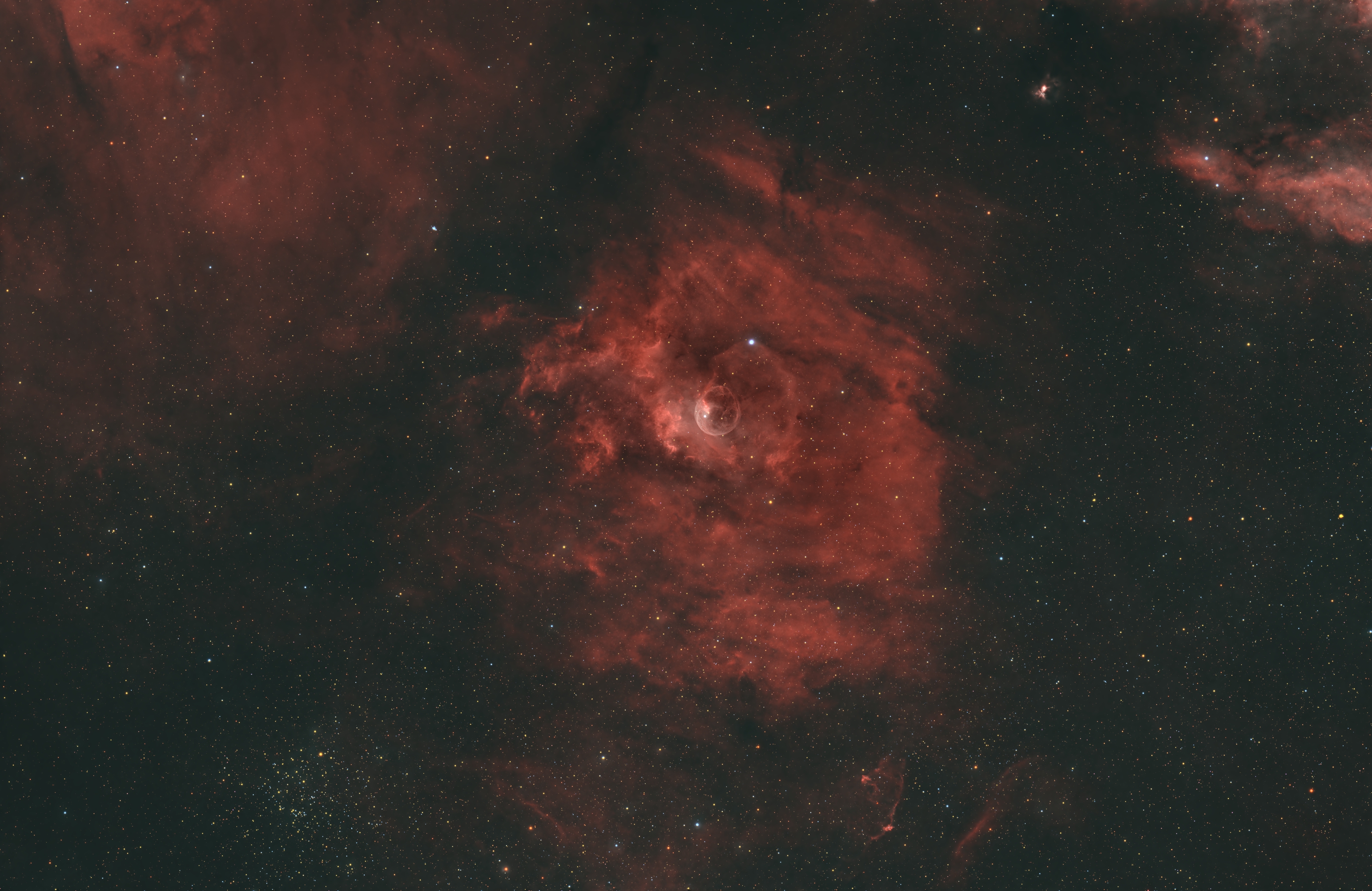

Here is a redo of the processing on a shot taken by DEO from our cottage at Marion Bridge.
The target is the Bubble Nebula, NGC 7635, in Cassiopeia. To view the original image click on the picture. Click again to see a higher resolution view.
Click one more time to return to the original image.
According to Wikipedia - NGC 7635, also known as the Bubble Nebula, Sharpless 162, or Caldwell 11,
is an H II region emission nebula in the constellation Cassiopeia. It lies close to the direction of the open cluster Messier 52. The "bubble" is
created by the stellar wind from a massive hot, 8.7 magnitude young central star, SAO 20575 (BD+60°2522). The nebula is near a giant molecular cloud
which contains the expansion of the bubble nebula while itself being excited by the hot central star, causing it to glow. It was discovered in 1787
by William Herschel. The star BD+60°2522 is thought to have a mass of about 44 solar masses.
| RA: | 20:14:16 |
| Dec: | +38:08:02 |
| Date: | 3 August, 2022 & 20 Sept 2025 |
| Exposure: | 3.75 hours (15 X 15 minutes) |
| Conditions: | Bortle 4 to 5 skies, good seeing |
| Gain: | 100 |
| Camera: | Zwo ASI2600MC-Pro |
| Optics: | Prime focus of a SkyWatcher Esprit 120 f/7 APO refractor with a focal length of 840 mm |
| Filter: | Optolong L-eNhance |
| Location: | Marion Bridge, Nova Scotia |
Processed entirely in PixInsight using several plug-ins, Blur Exterminator for deconvolution, Noise Exterminator for noise reduction, GHS for stretching, Seti-Astro
suite for mask generation, and StarNet++ to produce a starless image.
1. Calibration and stacking done using the WBPS.
2. Deconvolution using Blur Exterminator.
3. Spectrophotometric Colour Calibration used to calibrate the colour of the image and remove the green cast.
4. Noise reduction using Noise Exterminator with three iterations.
5. StarNet++ was used to produce a starless nebula image and star only image.
6. GHS in colour mode used to stretch the nebula image.
7. Local Histogram Equalization was used with the mask to enhance the core contrast of the nebula.
8. Unsharp mask used to sharpen the core detail using the same mask.
9. TVGDenoise used to smooth the background using a mask.
10. The image identifer set to n.
11. Saturation increased using GHS in saturation mode.
12. The star only image was stretched using GHS in colour mode and the identifier set to s.
13. Pixel math used to recombine the star image with the nebula image with s+n-s*n as the combination expression.
14. ICC profile set to sRGB.
15. Image stored for web upload as a jpeg.