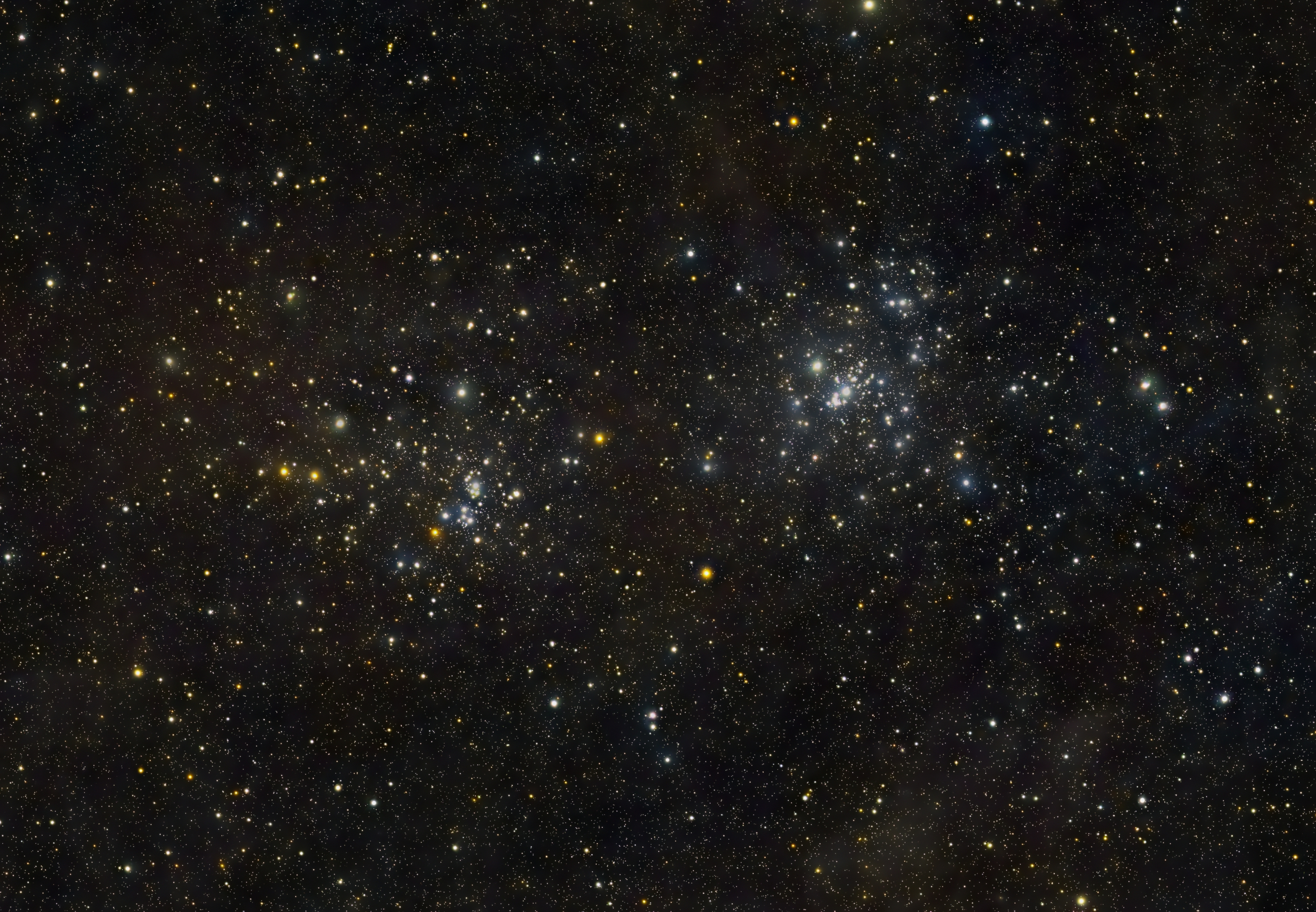

The Double Cluster, known as Caldwell 14, is comprised of two open clusters NGC 869 and NGC 884, which are close together in the constellation Perseus.
Both visible to the naked eye, they are approximately 7,500 light-years away from Earth.
In this shot I have emphasized the gas and dust surrounding the clusters showing some of the material from which the clusters formed.
Click on the image to see a higher resolution version. Click again to return to this page.
| RA: | 2:20:36 |
| Dec: | +57:07:28 |
| Date: | 24 Sept, 2025 |
| Exposure: | 40 minutes (4 X 10 minutes) |
| Conditions: | Bortle 4 to 5 skies. |
| Gain: | 100 |
| Camera: | Zwo ASI2600MC-Pro |
| Optics: | Prime focus of a SkyWatcher Esprit 120 f/7 APO refractor with a focal length of 840 mm |
| Filter: | None |
| Location: | Marion Bridge, Nova Scotia |
Processed entirely in PixInsight using several plug-ins, Blur Exterminator for deconvolution, Noise Exterminator for noise reduction, GHS for stretching, Seti-Astro
suite for gradient removal and StarNet++ to produce a starless image.
1. Calibration, stacking done using the WBPS.
2. Deconvolution using Blur Exterminator.
3. Spectrophotometric Colour Calibration used to calibrate the colour of the image and remove the green cast.
4. Noise reduction using Noise Exterminator with three iterations.
5. StarNet++ was used to produce a starless and star only images.
6. The starless image was noise reduced using a multiscale median transform.
7. The star only image was stretched using GHS in colour mode.
8. Convolution used to slightly blur the colour star image to soften the abrupt star edges.
9. Saturation increased using GHS in saturation mode.
10. Pixel math used to recombine the star image with the background image.
11. ICC profile set to sRGB.
12. Image stored then binned by two for web upload and stored as a jpeg.