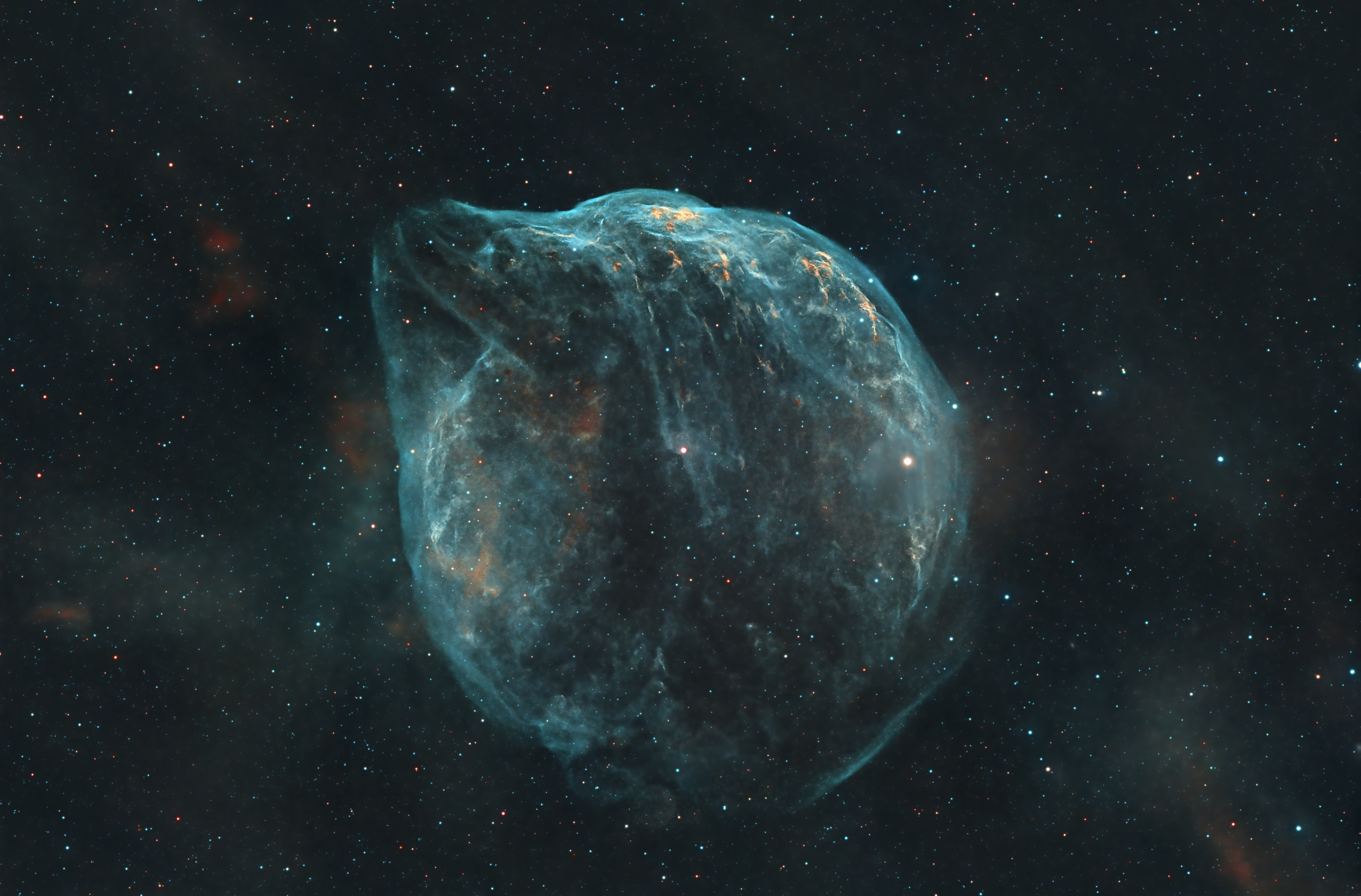

Adding another four hours or so to the data did wonders for this image. As I
added more data, less noise reduction was needed so the detail in the
filaments of the nebula become sharper and it was able
to stand up to a more extreme stretch making the stars less prominent.
The nebula surrounds the 6.7 magnitude Wolf-Rayet star EZ Canis Majoris.
This star is very hot and luminous approaching the end of its life.
The nebula was formed about 70,000 years ago when the star started throwing off
its outer hydrogen layers, revealing inner layers of heavier elements.
Fast stellar winds, inherent in Wolf-Rayet stars, create the dolphin head shape
as they blow a bubble in the slower moving material from an earlier phase of the star's evolution.
The hydrogen bubble glows because it is ionised by intense ultraviolet
radiation from the star at its center.
The nebula is approximately 60 light-years across at its widest point.
According to Wikipedia
- Sh2-308, also designated as Sharpless 308, RCW 11, or LBN 1052, and
commonly known as the Dolphin-Head Nebula, is an H II region located
near the center of the constellation Canis Major, composed of ionised
hydrogen. It is about 8 degrees south of Sirius, the brightest star in
the night sky. The nebula is bubble-like and surrounds a Wolf-Rayet
star named EZ Canis Majoris. This star is in the brief, pre-supernova
phase of its stellar evolution. The nebula is about 4,530 light-years
(1,389 parsecs) away from Earth, but some sources indicate that both
the star and the nebula are up to 5,870 ly (1,800 pc) away. Yet others
indicate the nebula is as close as 1,875 ly (575 pc) from Earth.
| RA: | 6:54:14 |
| Dec: | -23:55:59 |
| Date: | January & February, 2024 & February & March, 2025 |
| Exposure: | 8 hours (32 X 15 minutes) |
| Conditions: | Bortle 4 to 5 skies, very poor seeing due to low altitude |
| Gain: | 100 |
| Camera: | Zwo ASI2600MC-Pro |
| Optics: | Prime focus of a SkyWatcher Esprit 120 f/7 APO refractor with a focal length of 840 mm |
| Filter: | Optolong L-eNhance |
| Location: | St. Croix, Nova Scotia |
Processed entirely in PixInsight using several plug-ins, Blur Exterminator for deconvolution, Noise Exterminator for noise reduction, GHS for stretching, Seti-Astro
suite for gradient removal and StarNet++ to produce a starless image.
1. Calibration, stacking and drizzle combining, increasing the resolution by 2, done using the WBPS.
2. Deconvolution using Blur Exterminator.
3. Spectrophotometric Colour Calibration used to calibrate the colour of the image and remove the green cast.
4. Gradient removal using Seti-Astro's Automatic DBE.
5. Noise reduction using Noise Exterminator with three iterations.
6. StarNet++ was used to produce a starless image and PixelMath was used to produce a star only image.
7. GHS was used multiple times to stretch the starless image, with the first stretch using colour mode to enhance the colour in the galaxies.
8. Local Histogram Equalization was used with a mask to enhance the core contrast of the galaxies.
9. Unsharp mask used to sharpen the core detail using the same mask.
10. TVGDenoise used to smooth the background using the inverse of the mask to protect the galaxy cores.
11. HistogramTransformation used to set the black point.
12. The image identifer set to g.
13. GHS used to stretch the star only image paying attention to the star profile. No attempt to retain colour. Image luminance extracted.
14. GHS used on a copy of the unstretched star only image in colour mode to stretch the image. Attention was paid to the star colour.
15. Convolution used in three iterations to slightly blur the colour star image to remove odd colour halos made by GHS using an inverted mask made from the star luminance image.
16. Saturation increased using GHS in saturation mode.
17. The LRGB tool was used to combine the star luminance image with the star colour image. This produces a better colour star image than GHS alone. Image ID set to s.
18. Pixel math used to recombine the star image with the galaxy image with s+g-s*g as the combination expression.
19. ICC profile set to sRGB.
20. Image stored then binned by two for web upload and stored as a jpeg.