
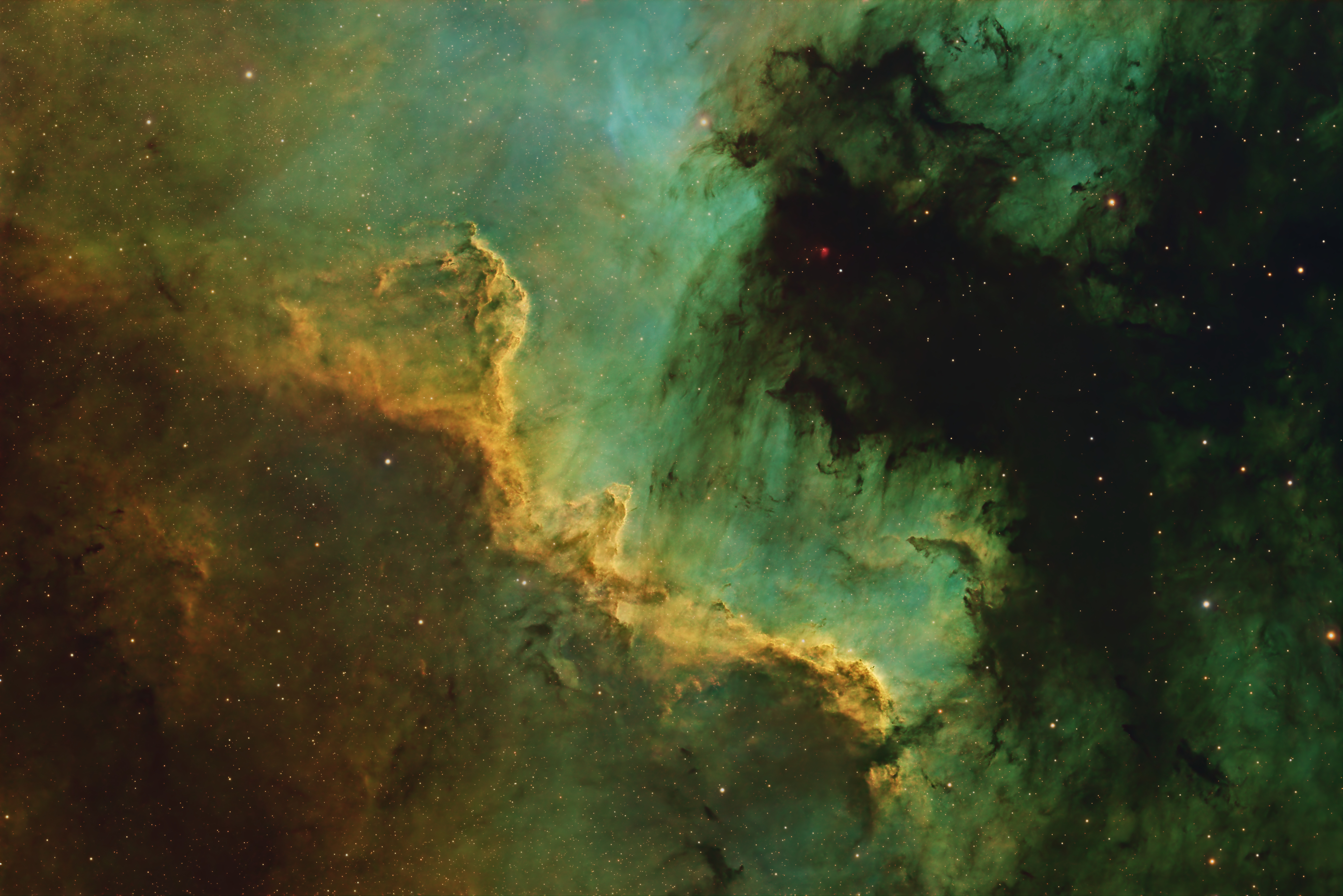
Here is 3 hours total exposure through two narrow band filters to produce a first pass at the Wall in Cygnus. The Wall is a star
producing region on the west coast of mexico in the North America Nebula.
The wall is a hotbed of star formation that is a long stellar nursery spanning roughly 15 to 20 light-years from end to end. It is the most active and
dense area of star birth within the entire Sh2-117 complex. The striking, bright "edge" of the Wall is actually an ionization front. Massive, hot,
young stars embedded deep inside the nebula (and largely hidden behind interstellar dust) blast out fierce ultraviolet radiation.
This energetic UV wind ionizes the hydrogen gas along the ridge, causing it to glow fiercely while simultaneously eroding the colder, dense gas clouds.
Narrow band techniques, such as this SHO palette image, really make the Wall area stand out from the surrounding nebula.
Click on the image repeatedly to zoom in and click and drag to look around the zoomed image. Move your mouse off the image to reset the zoom.
| RA: | 20:59:26 |
| Dec: | +43:41:33 |
| Date: | June 2026 |
| Exposure: | 120 minutes L-eXtreme and 60 monutes L-Synergy |
| Conditions: | Bortle 4 skies with no Moon |
| Gain: | 100 |
| Camera: | Zwo ASI2600MC Pro |
| Optics: | Prime focus of a SkyWatcher Esprit 120 f/7 APO refractor with a focal length of 840 mm |
| Filter: | L-eXtreme & L-Synergy |
| Location: | St.Croix, Nova Scotia |
Processed entirely in PixInsight using several plug-ins, Blur Exterminator for deconvolution, Noise Exterminator for noise reduction, GHS for stretching, Seti-Astro
suite for mask generation, GraXpert for gradient removal and StarNet++ to produce a starless image.
1. Calibration and stacking of both the L-eXtreme and L-Synergy filtered images done in PixIngsight.
2. Deconvolution using Blur Exterminator.
3. Noise reduction using Noise Exterminator with 3 iterations and luminance and colour separation.
4. Pixel math used to combine both data sets into a SHO pallete image.
5. StarNet++ was used to produce starless and star only images out of the L-eXtreme data and the combined SHO image.
6. Colour of the SHO starless image was adjusted using multiple iterations of GHS.
7. GHS in colour mode used to stretch each one differently.
8. Local Histogram Equalization was used with a mask to enhance some of the core areas.
9. Unsharp mask used to sharpen the core detail using the same mask.
10. Multiscale median transform used to add final sharpen using a mask.
11. The image identifer set to n.
12. Saturation increased using a curve.
13. The L-eXtreme star only image was stretched and saturation boosted using GHS.
14. Pixel math used to recombine the L-eXtreme star image with the SHO nebula image using combine(g,s,op_screen()) as the combination expression.
15. Image stored for web upload as a jpeg.