
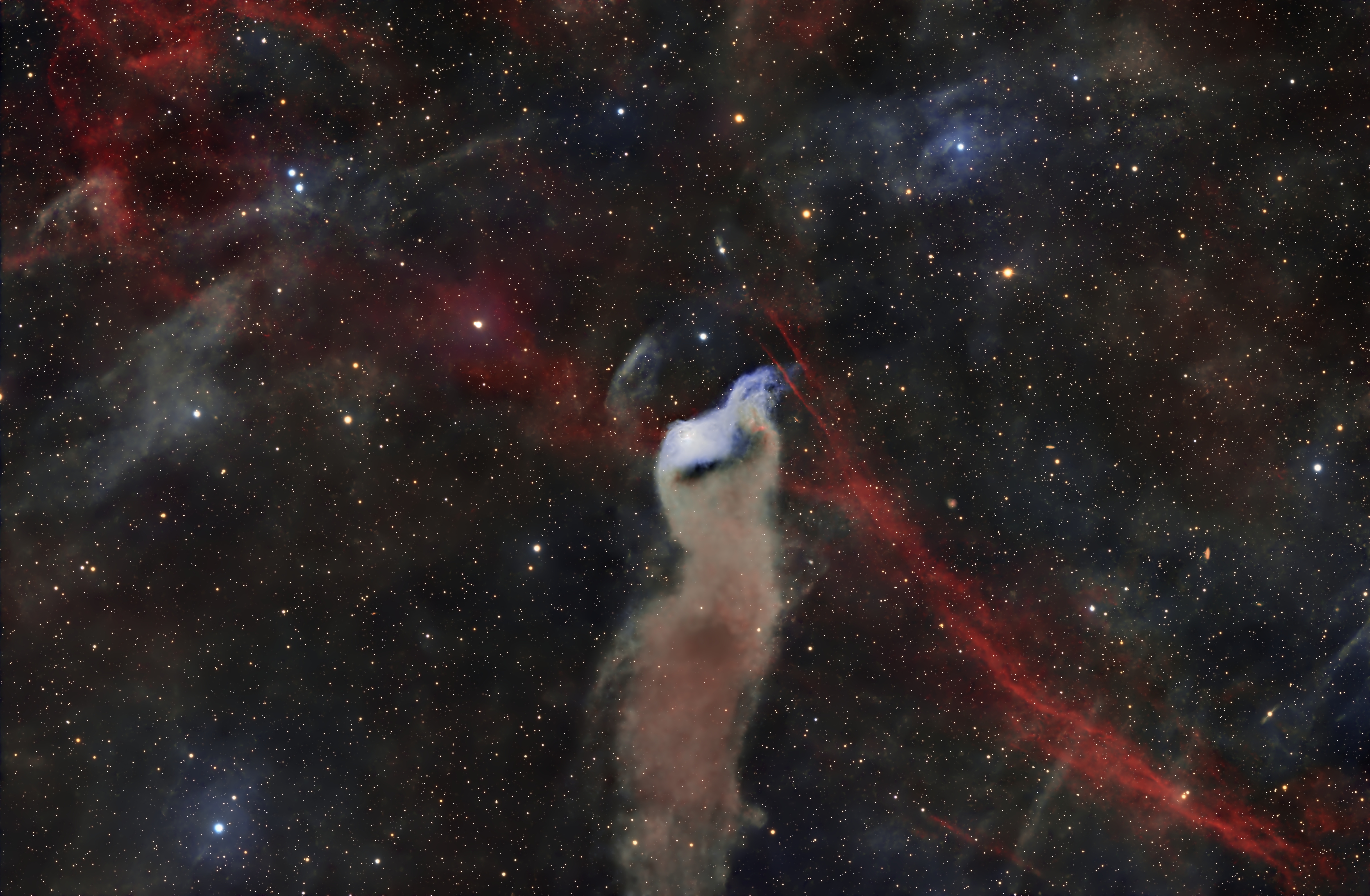
Barnard 175.
Barnard 175, also known as B175, is a cometary-shaped Bok globule located around 400 parsecs from Earth in the constellation of Cepheus. It is embedded within the Cepheus Flare shell, a giant complex of molecular clouds.
This image contains several small galaxies and an interesting supernova remnant comprised of the red filimentary structure that spans the image.
This image is a combination of RGB data and H-alpha data blended into the red channel, see the "Processing Details" tab for a information on how the image was built.
Click on the image repeatedly to zoom in and click and drag to look around the zoomed image. Move your mouse off the image to reset the zoom.
| RA: | 21:37:03 |
| Dec: | +57:33:10 |
| Date: | September 2026 |
| Exposure: | 2 hours of RGB data (12 X 10 minutes) and 5.5 hours (22 X 15 minutes) of H-alpha data using an L-eXtreme filter |
| Conditions: | Bortle 4 skies with a first quarter Moon in the sky for 12 of the H-alpha frames. |
| Gain: | 100 |
| Camera: | Zwo ASI2600MC Pro |
| Optics: | Prime focus of a SkyWatcher Esprit 120 f/7 APO refractor with a focal length of 840 mm |
| Filter: | L-eXtreme and clear |
| Location: | St.Croix, Nova Scotia |
Processed entirely in PixInsight using several plug-ins, Blur Exterminator for deconvolution, Noise Exterminator for noise reduction, GHS for stretching, Seti-Astro
suite for mask generation, and Star Exterminator to produce a starless image. The workflow is as follows:
1. Calibration and stacking done in PixIngsight.
2. Deconvolution using Blur Exterminator applied to both images.
3. Gradient correction applied to help enhance the darker areas by reducing the overall background brightness of both images.
4. Noise reduction using Noise Exterminator with three iterations and luminance and colour separation applied to both images.
5. L-eXtreme and RGB images star aligned.
6. Star Exterminator was used to produce starless and star only images. The star image from the L-eXtreme filter was deleted.
7. The red channel of the L-eXtreme image was combined with the red channel of the RGB image using pixel math.
8. GHS used to stretch the nebula and the star images differently.
9. Local Histogram Equalization was used with a mask to enhance some of the nebula.
10. Unsharp mask used to sharpen the nebula detail using the same mask.
11. TVGDenoise used with a mask to reduce the noise in the nebula image.
12. Multiscale medium transform used with a mask to clean up the nebula image.
13. The image identifer set to n.
14. Saturation increased using a curve.
15. Pixel math used to recombine the nebula and star images using combine(n,s,op_screen()) as the combination expression.