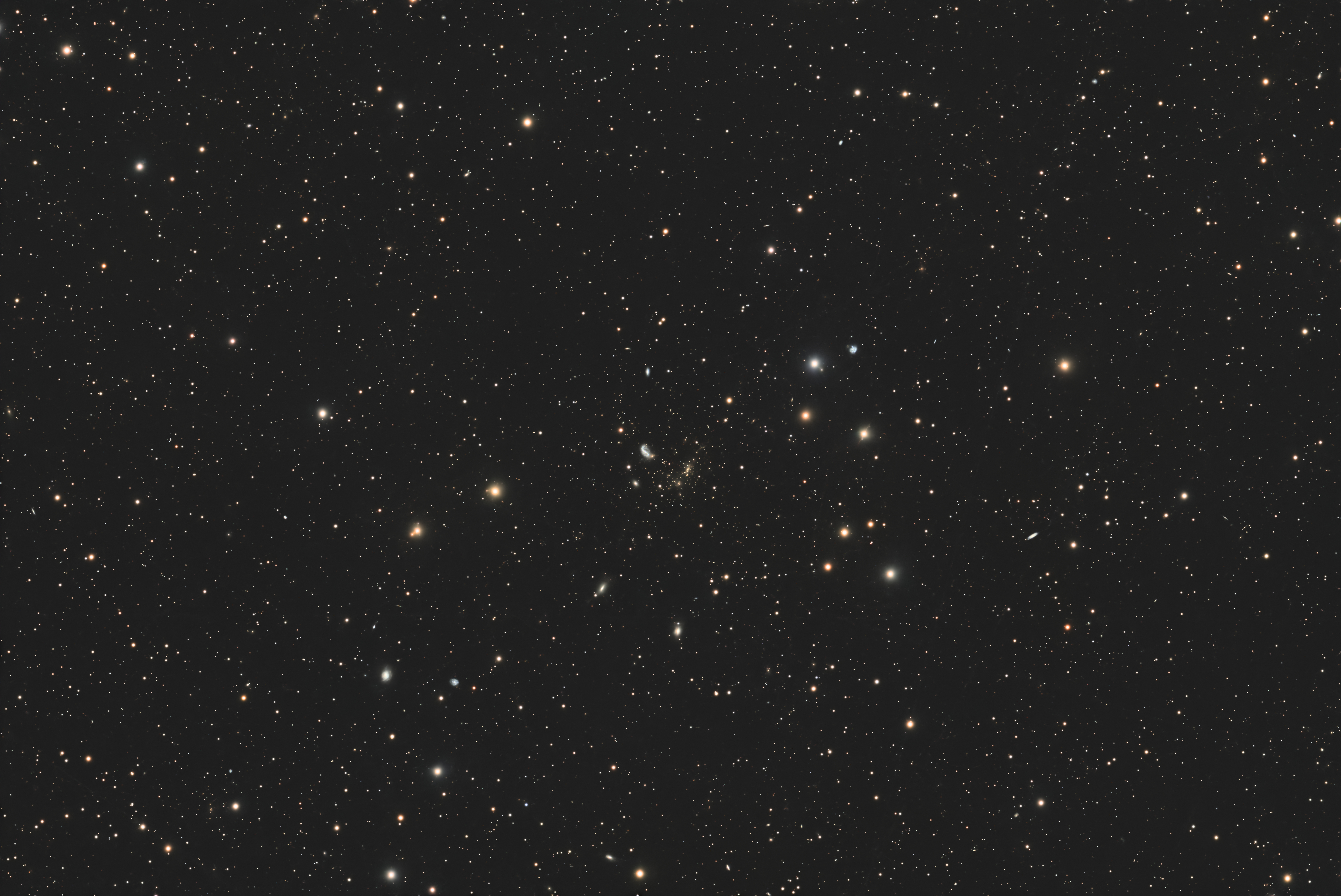

These may be the furthest and the dimmest objects I have photographed to date. At the center of the image is a distant galaxy cluster known as Abell 2218, located some 2.3 billion light-years away
in the constellation Draco. But, the personal distance record holder in this image is the more distant, gravitationally lensed galaxies behind the cluster at 7 to 11 billion light-years away. For perspective, this is
22 percent of the way to the edge of the observable universe! The gravitational field of the cluster bends spacetime and focuses the light of these more distant galaxies making them visible as distorted arc segments
around some of the cluster members. Check out the 500 percent zoom to see the very faint arcs of the background galaxies. A Hubble Space Telescope view is included for reference.
An obscene amount of processing went into this image to pull the faint, magnitude 22-23, arcs out of the background noise. After the first GHS stretch, multiple iterations of masked stretching were used to make the lensed galaxies stand out.
For each iteration a mask was produced from the previous iteration using the range mask tool. The clone stamp tool was used to remove any bright galaxies that the range mask tool missed. Next the average value of the mask was used to fill
in the black areas left where the galaxies were removed, and the mask was very slightly
blurred using a convolution to reduce the high frequency noise. This mask was used on a curve stretch for the next iteration. After 11 iterations, the faint arcs started to pop out of the background noise.
Due to the limited focal length of my optical system, most of the galaxies in the main cluster were close enough to stellar that Blur Exterminator treated them as stars for deconvolution and as a result they look like
stars in the image. Most of the smudges surrounding the cluster are very dim stars and galaxies in the image that were too faint to resolve in the 4 hours of data I captured. They have been left in as they line up with
objects shown in the Hubble Space Telescope view.
This is a 500 percent zoom and crop of the central part of the image showing the main cluster and the gravitational lensed galaxies behind it. The lensed arcs are indicated by the white lines in the image.
This is the view from the Hubble Space Telescope.
| RA: | 16:35:56 |
| Dec: | +66:13:58 |
| Date: | May 2026 |
| Exposure: | 240 minutes(24 X 10 minute subs) |
| Conditions: | Bortle 4 skies with lower transparency |
| Gain: | 100 |
| Camera: | Zwo ASI2600MC Pro |
| Optics: | Prime focus of a SkyWatcher Esprit 120 f/7 APO refractor with a focal length of 840 mm |
| Filter: | none |
| Location: | St. Croix, Nova Scotia |
Processed entirely in PixInsight using several plug-ins, Blur Exterminator for deconvolution, Noise Exterminator for noise reduction, GHS for stretching, Seti-Astro
suite for mask generation, GraXpert for gradient removal and StarNet++ to produce a starless image.
1. Calibration and stacking done in PixIngsight.
2. Deconvolution using Blur Exterminator.
3. Gradient Correction used to remove the gradient in the image.
4. Colour calibration usinf spectrophotometric colour calibration function.
5. Noise reduction using Noise Exterminator with 5 iterations and frequency and colour separation.
6. StarNet++ was used to produce a starless galaxy image and star only image.
7. GHS in colour mode used to stretch each one differently. Eleven iterations of a masked stretche used on the galaxy image.
8. Local Histogram Equalization was used with the mask to enhance some of the galaxies.
9. Unsharp mask used to sharpen the core detail using the same mask.
10. Multiscale median transform used to add final sharpen using a mask.
11. TGV denoise to clean up the noise produced by the masked stretch
12. The image identifer set to g.
13. Saturation increased using a curve.
14. The star only image identifier set to s.
15. Pixel math used to recombine the star image with the galaxy image with combine(g,s,op_screen()) as the combination expression.
16. Image cropped and stored for web upload as a jpeg.