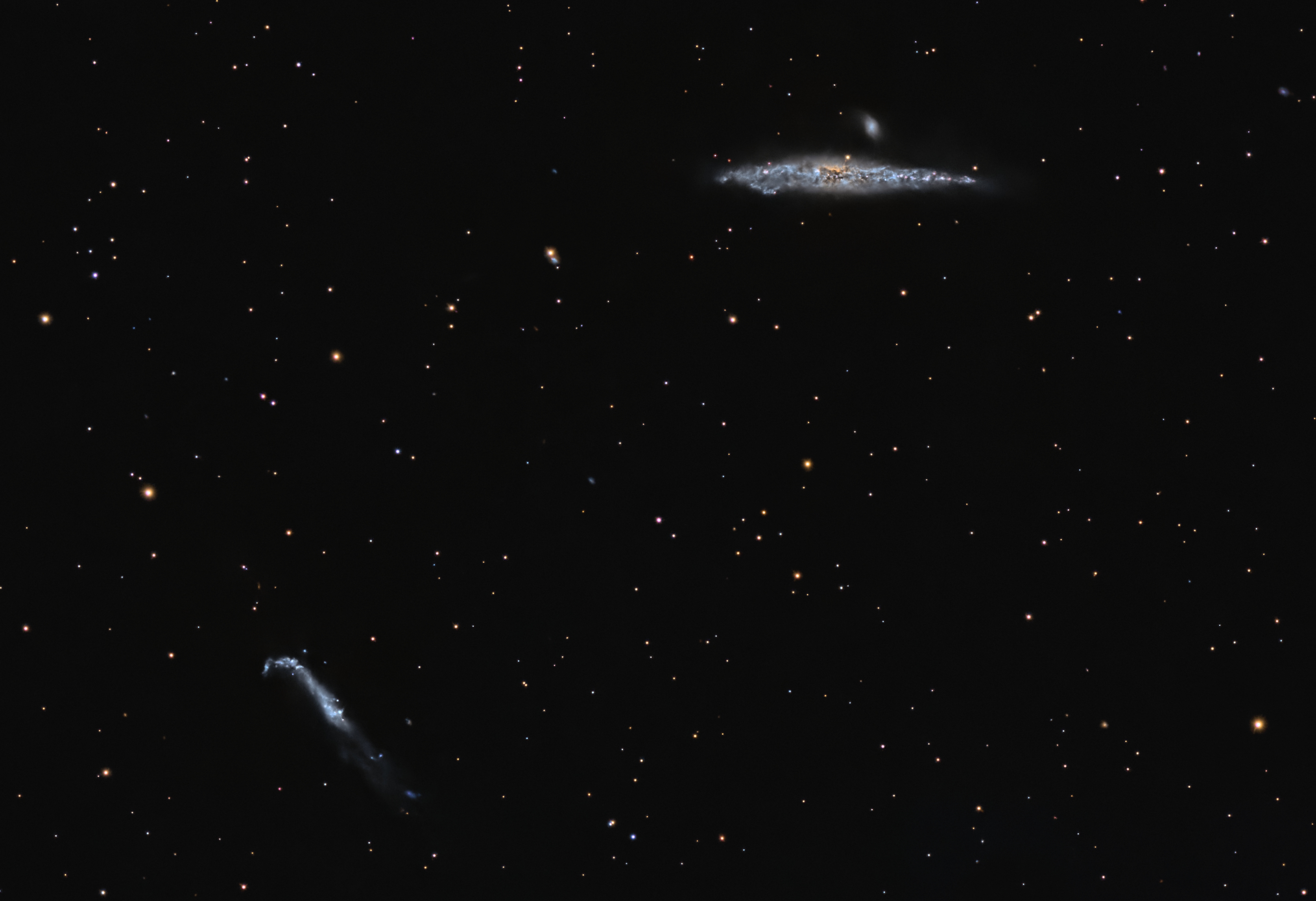

Here is another in a series of urban efforts taken from my driveway during the COVID-19 madness.
This is an image of the Whale (NGC4631) and Hockey Stick (NGC4656/7) galaxies. According to Wikipedia
- NGC 4631 (also known as the Whale Galaxy or Caldwell 32) is a barred spiral galaxy in the constellation Canes Venatici. This galaxy's
slightly distorted wedge shape gives it the appearance of a herring or a whale, hence its nickname.
NGC4656/57 is a highly warped barred spiral galaxy located in the constellation
Canes Venatici and is sometimes informally called the Hockey Stick Galaxies or the Crowbar Galaxy. The galaxy is a member of the NGC 4631
Group. A Luminous Blue Variable in "super-outburst" was discovered in NGC 4656/57 on March 21, 2005.
The data was calibrated and stacked in Images Plus and processed in PixInsight using AI based sharpening and noise removal (Blur Exterminator and Noise Exterminator).
This is the same data, just processed with older tools before AI based sharpenning and noise removal were available. This version was processed entirely using Images Plus in April of 2020.
| RA: | 12:42:49 |
| Dec: | +32:17:49 |
| Date: | 25 April 2020 |
| Exposure: | 69 minutes (23 X 180 seconds) |
| Conditions: | Bortle 7 urban skies |
| ISO: | 800 |
| Camera: | Canon 60Da |
| Optics: | Prime focus of a SkyWatcher Esprit 120 f/7 APO refractor with a focal length of 840 mm |
| Filter: | none |
| Location: | Bedford, Nova Scotia |
Processed entirely in PixInsight using several plug-ins, Blur Exterminator for deconvolution, Noise Exterminator for noise reduction, GHS for stretching, Seti-Astro
suite for mask generation, GraXpert for gradient removal and StarNet++ to produce a starless image.
1. Calibration and stacking done in Images Plus.
2. Deconvolution using Blur Exterminator.
3. Spectrophotometric Colour Calibration used to calibrate the colour of the image and remove the green cast.
4. Gradient Correction used to remove the gradient in the image.
5. Noise reduction using Noise Exterminator with three iterations.
6. StarNet++ was used to produce a starless galaxy image and star only image.
7. GHS in colour mode used to stretch each one differently.
8. Local Histogram Equalization was used with the mask to enhance the galaxies.
9. Unsharp mask used to sharpen the core detail using the same mask.
10. Multiscale median transform used to add final sharpen using a mask.
11. The image identifer set to g.
12. Saturation increased using a curve.
13. The star only image was stretched using GHS in colour mode and the identifier set to s.
14. Pixel math used to recombine the star image with the galaxy image with combine(g,s,op_screen()) as the combination expression.
15. Image cropped and stored for web upload as a jpeg.