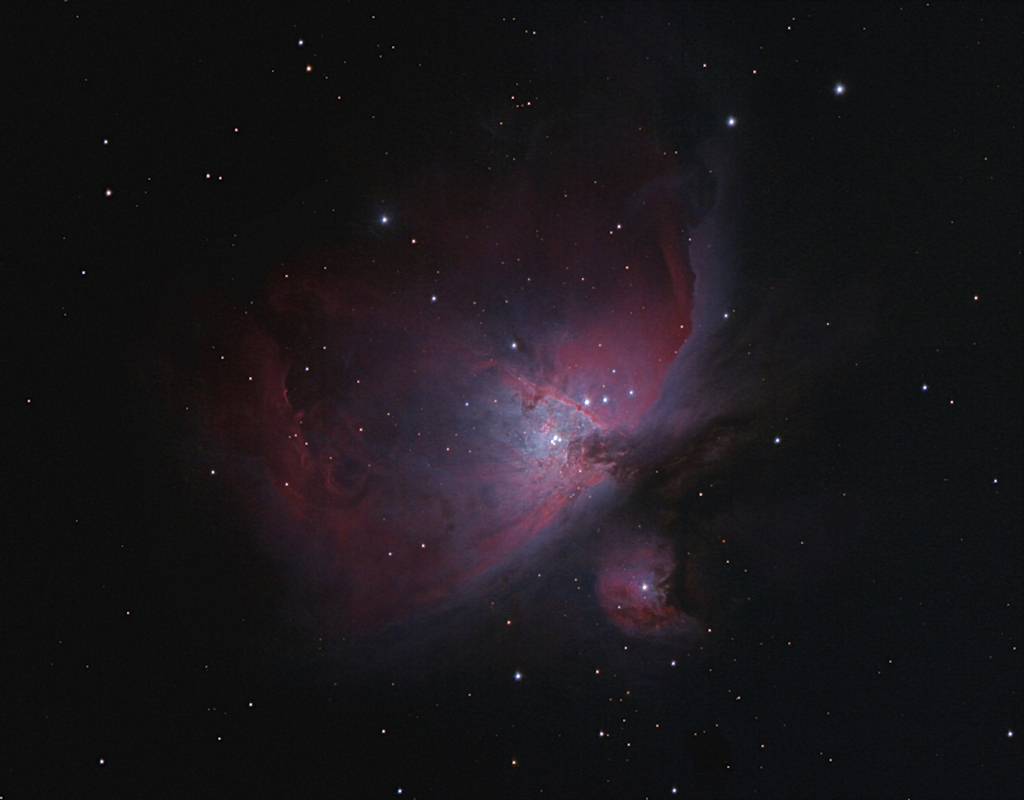
| This is an urban imaging effort with a
bright waxing Moon nearby. I decided to focus on the core of the nebula
instead of the faint outer wisps which wouldn't turn out well given the
conditions. My front yard is located on the edge of a red zone with a
bright sky at the best of times, add in a waxing gibbous Moon about 26
degrees away and the result was one very washed out sky.
Click on the image to see a crop of the central region. Click a second
time to see a version that was taken using five second subexposures.
This version was interpolated by two to enlarge the Trapezium area and
then processed to bring out the faint stars in the region. Finally,
click on the image one last time to return to the wider field. |
 |
| I
have asked several
times if it is possible to image from more urban areas. I think the
image above shows it is definitely possible, even with a bright Moon in
the sky. The trick is to stick to the brighter targets and process for
the bright detail instead of the faint areas of your target. To give
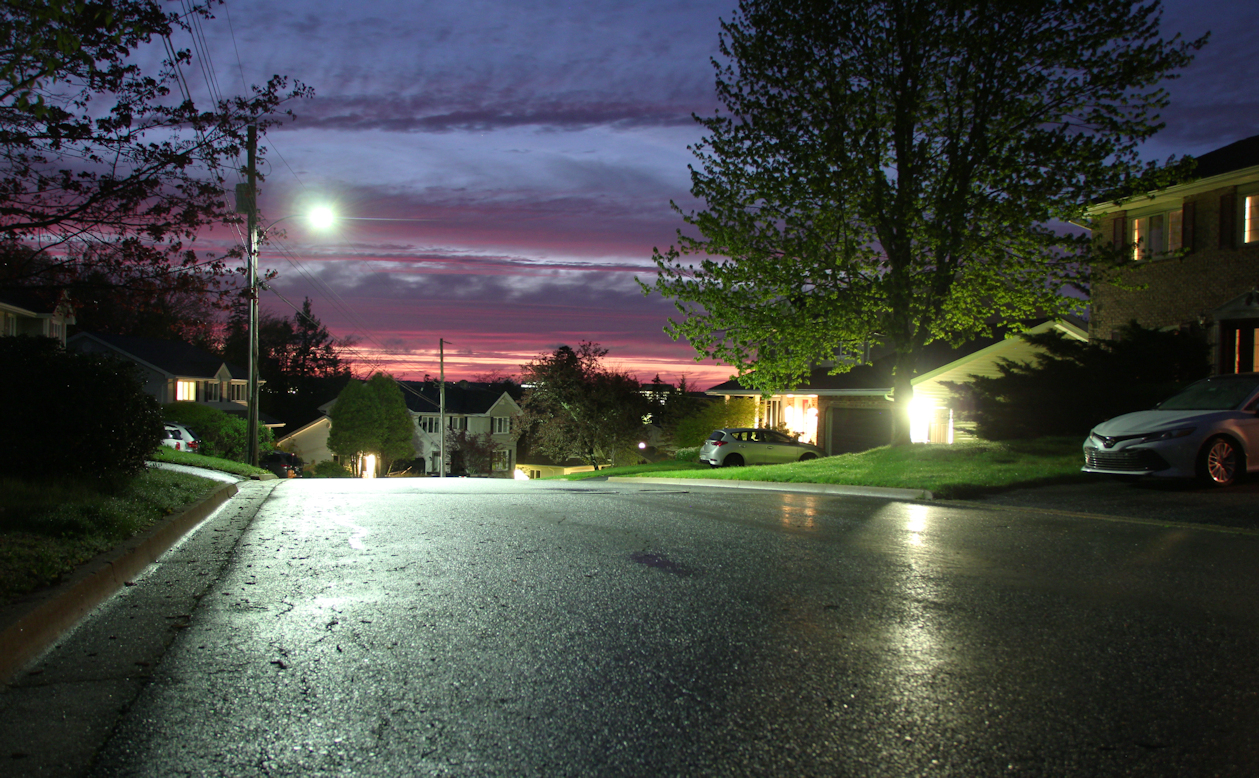
you an idea of the light pollution in my neighbourhood here is a
nighttime view of my front yard where this image was taken.
|
 |
| Object |
The Orion Nebula Object RA 5:35:16 Dec -5:23:01 |
| Date |
17
January 2019 |
| Exposure |
26 minutes (78 X 20 seconds), 90 seconds (18 X 5 seconds) for the highest resolution version |
| ISO |
1600 |
| Camera |
Canon 60Da DSLR |
| Optics |
SkyWatcher Esprit 120 f/7 APO refractor
with a focal length of 840 mm |
| Location |
Bedford, St. Croix, Nova Scotia
|
| Processing |
Calibration,
stacking and arcsinh stretch in Images Plus . Masked noise
reduction
with a lighten combine used to reduce the background noise. Image
sharpened using the multi resolution tool. Finally a copy of the
resulting image was stretched to show some of the outer area and LMS combined with the
less stretched version to produce the final image with core detail.
|
|
