
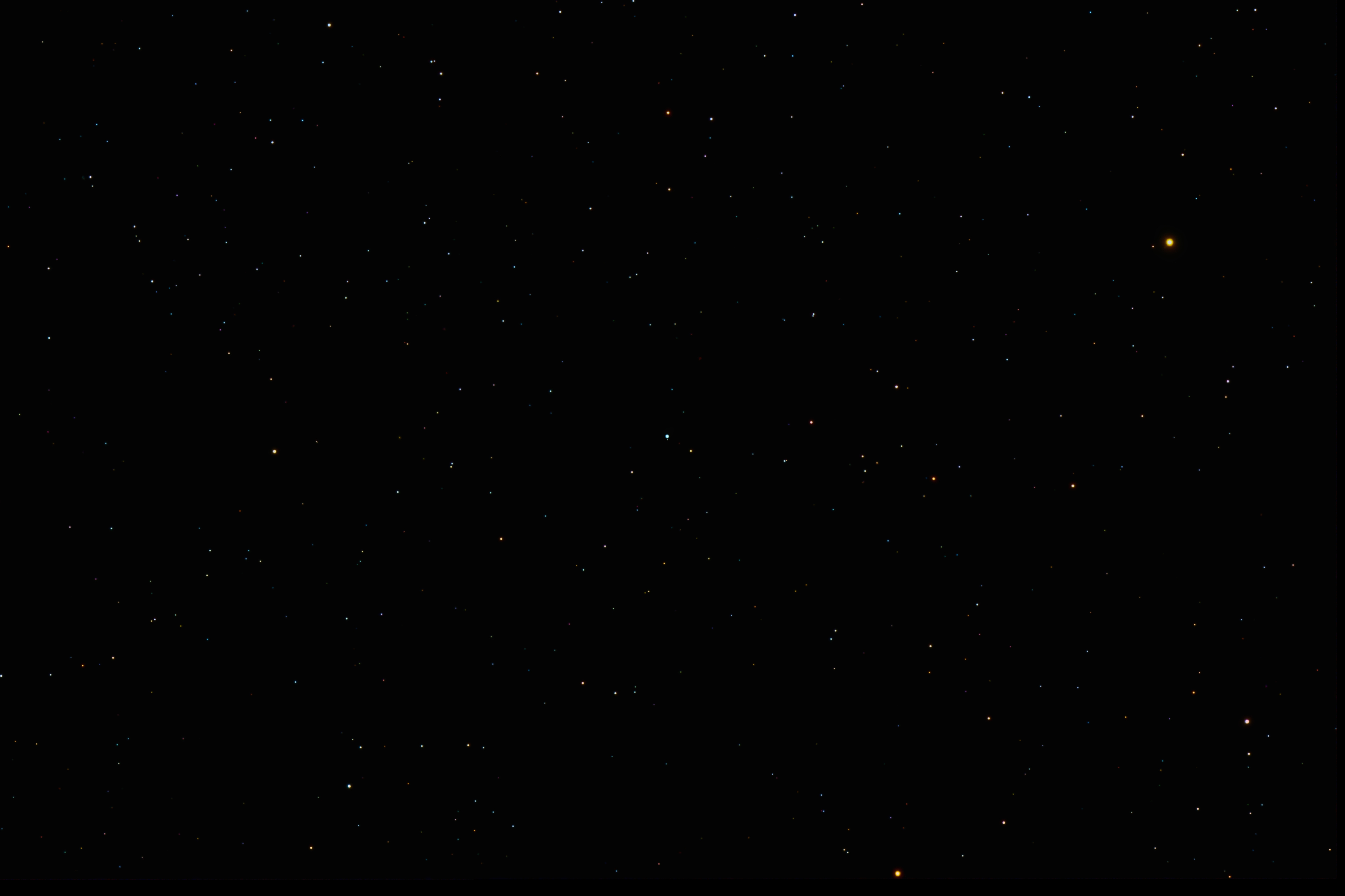
Neptune, Triton and Nereid
I was testing the latest version of MosaicEngine, which includes increased pointing accuracy when autocentering, and took advantage of it to line Neptune up for a quick shot. After taking a look at my favorite planetarium program,
I found that a couple of its moons were visible and decided to attempt to get them in the image. The image was shot at prime focus of my Esprit 120 and is a 30 minute exposure made from 5 minute sub-exposures so don't expect any planetary detail.
Detail on Neptune was not the point of the image, instead I was trying to see if I could capture and identify some of the planets many moons.Neptune is in the center of this frame as the blue "star" with its large moon Triton immediatly above it
and a much fainter moon, Nereid to the left of the planet. Both are labelled in the image on the "Annotated Image" tab. Triton is Neptune's larget moon at 2707 km in diameter, while Nereid, some 250 times fainter than Triton, is much smaller at just 340 km in diameter.
Originally I took a much shorter exposure to capture just Neptune and Triton on the 17'th of November and the "Blink" tab will switch between the two images, showing Neptune's movement against the background stars and Triton's orbit around the planet.
Click on the image repeatedly to zoom in and click and drag to look around the zoomed image. Move your mouse off the image to reset the zoom.
| RA: | |
| Dec: | |
| Date: | 20 November 2026 |
| Exposure: | 30 minute (6 X 300 seconds) and 1 minute (12 X 5 seconds) |
| Conditions: | Bortle 7 urban skies, first quarter Moon. |
| Gain: | 100 |
| Camera: | Zwo ASI2600MC Pro |
| Optics: | Prime focus of a SkyWatcher Esprit 120 f/7 APO refractor with a focal length of 840 mm |
| Filter: | none |
| Location: | Bedford, Nova Scotia |
Processed entirely in PixInsight using several plug-ins, Blur Exterminator for deconvolution, Noise Exterminator for noise reduction, GHS for stretching, Seti-Astro
suite for mask generation, and Star Exterminator to produce a starless image. The workflow is as follows:
1. Calibration and stacking done in PixIngsight.
2. Deconvolution using Blur Exterminator.
3. Gradient correction applied using dynamic background extraction.
4. Colour calibration using SPCC in PixInsight.
5. Noise reduction using Noise Exterminator with three iterations and luminance and colour as well as frequency separation.
6. Imaged stretched using GHS
7. The image was cropped and rotated for this web page.