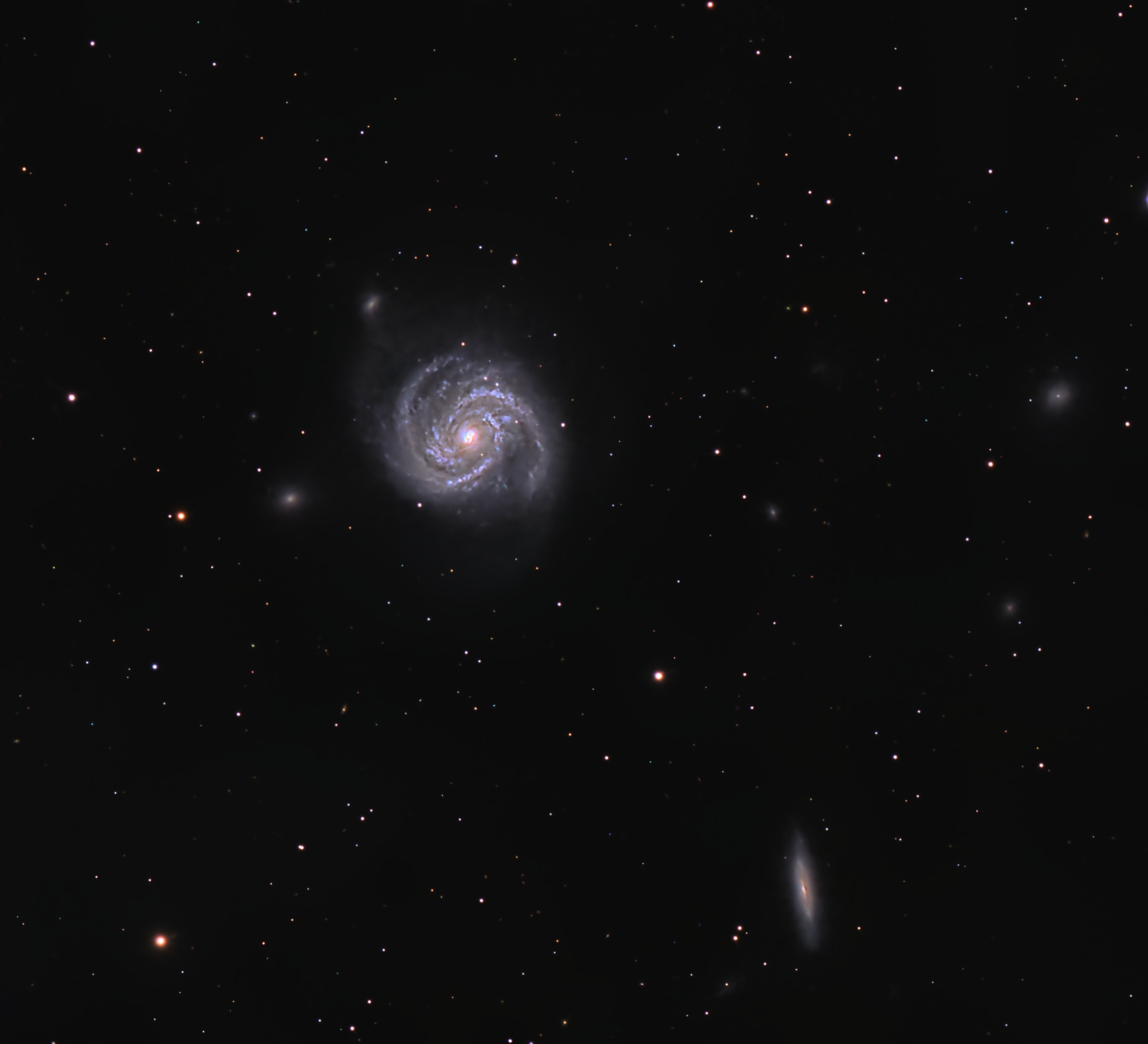

Here is another redo of an urban effort taken from my driveway processed with newer tools and techniques. This shot combines data taken with two different cameras and two telescopes to produce an image with just over 130 minutes of exposure. According to Wikipedia Messier 100 (also known as NGC 4321 or the Mirror Galaxy) is a grand design intermediate spiral galaxy in the constellation of Coma Berenices. It is one of the brightest and largest galaxies in the Virgo Cluster and is approximately 55 million light-years from our galaxy, about 166,000 light-years in diameter. It was discovered by Pierre Méchain in 1781 and 29 days later seen again and entered by Charles Messier in his catalogue "of nebulae and star clusters". It was one of the first spiral galaxies to be discovered, and was listed as one of fourteen spiral nebulae by Lord William Parsons of Rosse in 1850. NGC 4323 and NGC 4328 are satellite galaxies of M100; the former is connected with it by a bridge of luminous matter.
This is the same data, just processed with older tools before AI based sharpenning and noise removal were available. This version was processed entirely using Images Plus in April of 2020.
| RA: | 12:22:55 |
| Dec: | +15:49:19 |
| Date: | 2015 & 2017 |
| Exposure: | 137 minutes |
| Conditions: | Bortle 7 urban skies |
| ISO: | 1600 for the 60Da and 200 for the 350D |
| Camera: | Canon 60Da and 350D |
| Optics: | Prime focus of a SkyWatcher Esprit 120 f/7 APO refractor with a focal length of 840 mm and a 200 mm f/4 SNT |
| Filter: | none |
| Location: | Bedford, Nova Scotia |
Processed entirely in PixInsight using several plug-ins, Blur Exterminator for deconvolution, Noise Exterminator for noise reduction, GHS for stretching, Seti-Astro
suite for mask generation, GraXpert for gradient removal and StarNet++ to produce a starless image.
1. Calibration and stacking done in PixIngsight.
2. PixelMath used to combine images for different systems.
3. Deconvolution using Blur Exterminator.
4. Gradient Correction used to remove the gradient in the image.
5. Noise reduction using Noise Exterminator with three iterations.
6. StarNet++ was used to produce a starless galaxy image and star only image.
7. GHS in colour mode used to stretch each one differently.
8. Local Histogram Equalization was used with the mask to enhance the galaxies.
9. Unsharp mask used to sharpen the core detail using the same mask.
10. Multiscale median transform used to add final sharpen using a mask.
11. The image identifer set to g.
12. Saturation increased using a curve.
13. The star only image was stretched using GHS in colour mode and the identifier set to s.
14. Pixel math used to recombine the star image with the galaxy image with combine(g,s,op_screen()) as the combination expression.
15. Image cropped and stored for web upload as a jpeg.