
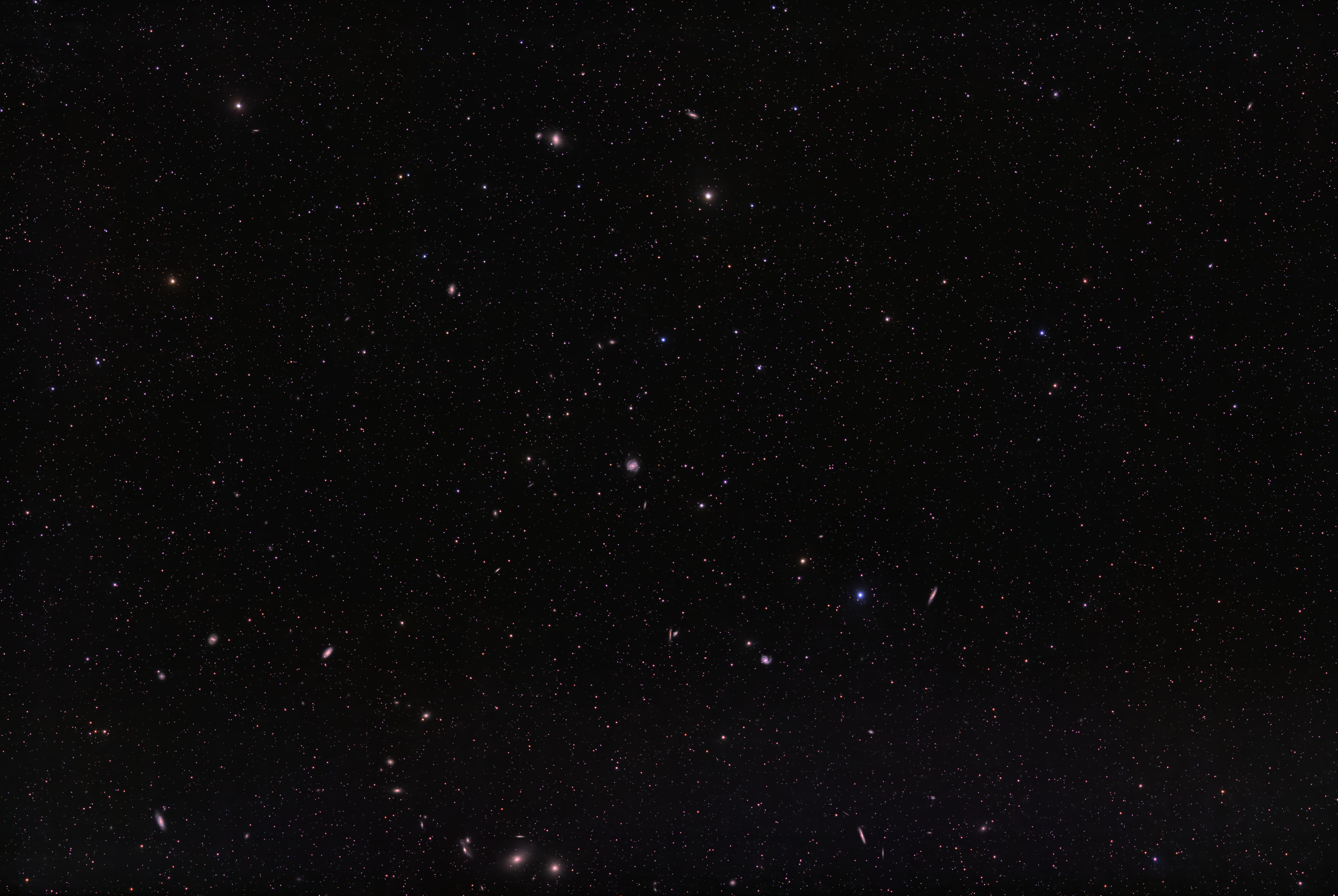
| This was shot from SCO during New
Moon in March, 2025. While my main scope was busy imaging M101, I used my DSLR to capture the Orion Nebula region and this
shot of the Virgo Galaxy Cluster. According to Wikipedia - The Virgo Cluster is a cluster of galaxies whose center is 53.8 ± 0.3 Mly (16.5 ± 0.1 Mpc) away in the Virgo constellation. Comprising approximately 1,300 (and possibly up to 2,000) member galaxies, the cluster forms the heart of the larger Virgo Supercluster, of which the Local Group (containing the Milky Way galaxy) is a member. The Local Group actually experiences the mass of the Virgo Supercluster as the Virgocentric flow. It is estimated that the Virgo Cluster's mass is 1.2×10¹⁵ M☉ out to 8 degrees of the cluster's center or a radius of about 2.2 Mpc. Many of the brighter galaxies in this cluster, including the giant elliptical galaxy Messier 87, were discovered in the late 1770s and early 1780s and subsequently included in Charles Messier's catalogue of non-cometary fuzzy objects. Described by Messier as nebulae without stars, their true nature was not recognized until the 1920s. The cluster extends across approximately 8 degrees centered in the constellation Virgo. Some of its most prominent members can be seen with binoculars and small telescopes, while a 6-inch telescope will reveal about 160 of the cluster's galaxies on a clear night. Click on the image to see
an annotated version showing some of
the galaxies in the field then click again for the highest
resolution version, Click one
last time to return to this initial
image. |
||||||||||||||||||||
 |
||||||||||||||||||||
|