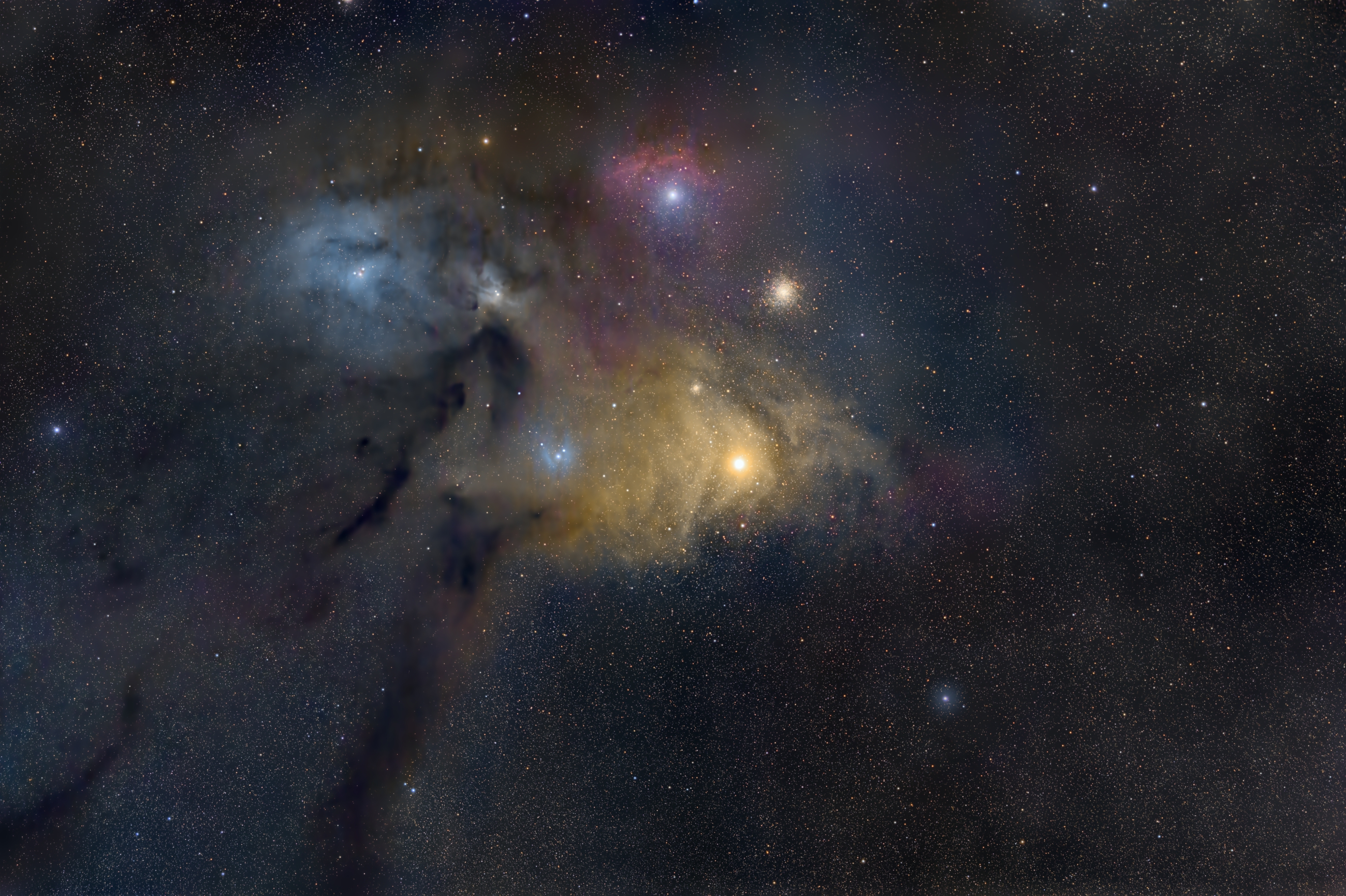

The Rho Ophiuchi cloud complex is a complex of interstellar clouds with different nebulae, particularly a dark nebula which is centered 1 degree south of the star Rho Ophiuchi,
and extends all the way to the constellation Ophiuchus. At an estimated distance of about 460 light years, it is one of the closest star-forming regions to Earth.
Just to the upper right of center is the globular star cluster M4, catalogued by Charles Messier in 1764.
This is a wide field image spanning over four degrees, centered on Antares, taken with a Canon 60Da and a 135 mm lens on a tracking mount.
| RA: | 16:29:24 |
| Dec: | -26:25:55 |
| Date: | 21 June, 2025 |
| Exposure: | 1 hour (120 X 30 seconds) |
| Conditions: | Bortle 4 to 5 skies, reasonable seeing |
| ISO: | 1600 |
| Camera: | Canon 60Da |
| Optics: | Rokinon 135 mm f/2 APO lens |
| Filter: | None |
| Location: | St. Croix, Nova Scotia |
Processed entirely in PixInsight using several plug-ins, Blur Exterminator for deconvolution, Noise Exterminator for noise reduction, GHS for stretching, Seti-Astro
suite for gradient removal and StarNet++ to produce a starless image.
1. Calibration, stacking and drizzle combining, increasing the resolution by 2, done using the WBPS.
2. Deconvolution using Blur Exterminator.
3. Spectrophotometric Colour Calibration used to calibrate the colour of the image and remove the green cast.
4. Gradient removal using Seti-Astro's Automatic DBE.
5. Noise reduction using Noise Exterminator with three iterations.
6. StarNet++ was used to produce a starless image and PixelMath was used to produce a star only image.
7. GHS was used multiple times to stretch the starless image, with the first stretch using colour mode to enhance the colour in the galaxies.
8. Local Histogram Equalization was used with a mask to enhance the core contrast of the galaxies.
9. Unsharp mask used to sharpen the core detail using the same mask.
10. TVGDenoise used to smooth the background using the inverse of the mask to protect the galaxy cores.
11. HistogramTransformation used to set the black point.
12. The image identifer set to g.
13. GHS used to stretch the star only image paying attention to the star profile. No attempt to retain colour. Image luminance extracted.
14. GHS used on a copy of the unstretched star only image in colour mode to stretch the image. Attention was paid to the star colour.
15. Convolution used in three iterations to slightly blur the colour star image to remove odd colour halos made by GHS using an inverted mask made from the star luminance image.
16. Saturation increased using GHS in saturation mode.
17. The LRGB tool was used to combine the star luminance image with the star colour image. This produces a better colour star image than GHS alone. Image ID set to s.
18. Pixel math used to recombine the star image with the galaxy image with s+g-s*g as the combination expression.
19. ICC profile set to sRGB.
20. Image stored then binned by two for web upload and stored as a jpeg.