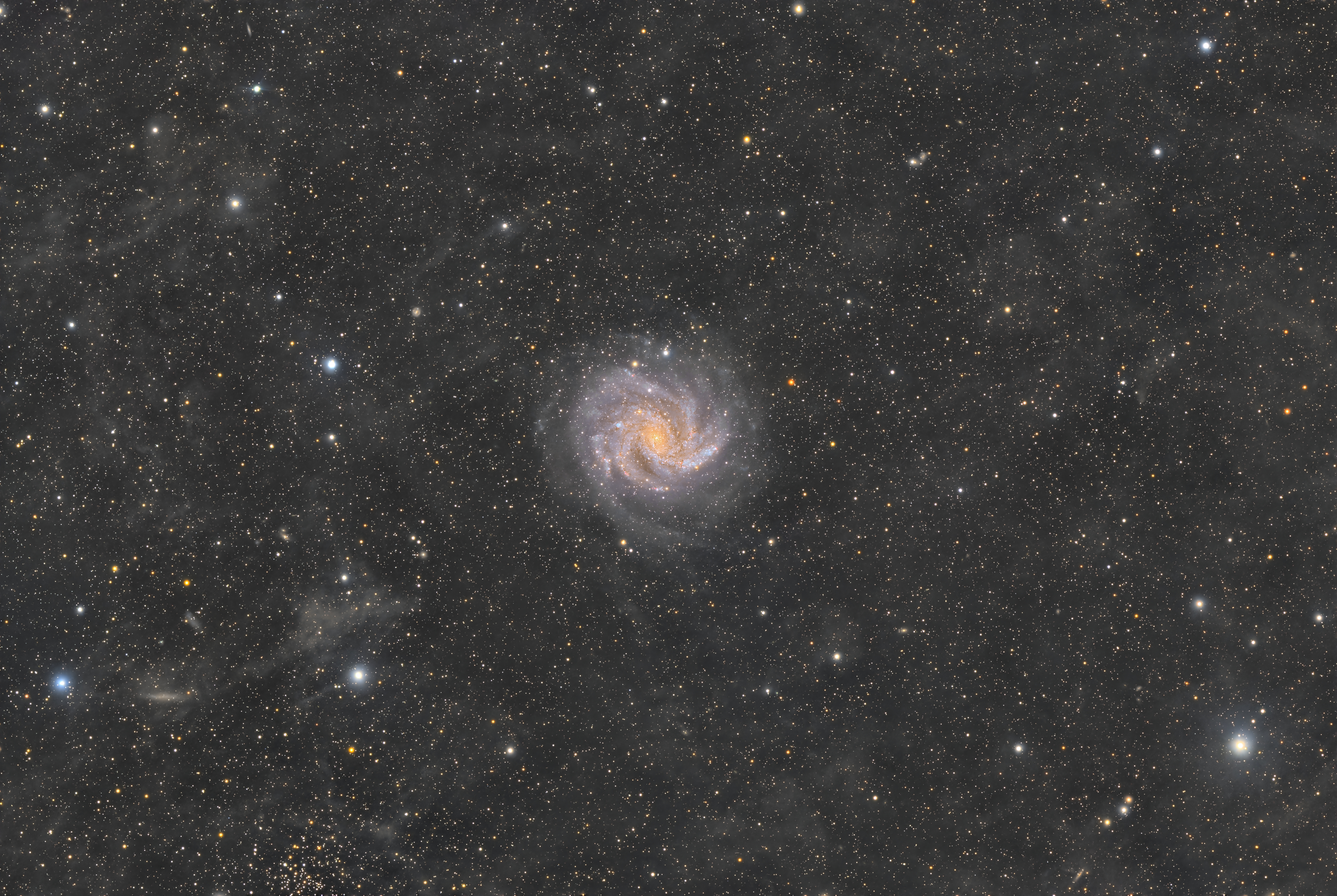

Here is a slightly different view of NGC 6946. Most versions seem to supress the background of gas and dust in our Milky Way in order to make the galaxy more visible.
I have chosen to leave the gas and dust clouds in the shot because the galaxy is partially obscured by them due to its location in Cygnus, and we have to look
through the Milky Way to see it. NGC 6946, referred to as the Fireworks Galaxy due to the large number of supernovae detected, is a grand design, face-on intermediate spiral galaxy with a small bright nucleus,
whose location in the sky straddles the boundary between the northern constellations of Cepheus and Cygnus. Its distance is about
25.2 million light-years from Earth. NGC6946 was once
considered to be part of the Local Group, but is now known to be among the dozen bright spiral galaxies near the Milky Way but beyond the
confines of the Local Group within the Virgo Supercluster.
The galaxy was discovered by William Herschel in 1798.
| RA: | 20:34:59 |
| Dec: | +60:09:55 |
| Date: | 21 August, 2025 |
| Exposure: | 4 hours and 50 minutes (29 X 10 minutes) |
| Conditions: | Bortle 4 to 5 skies, reasonable seeing |
| Gain: | 100 |
| Camera: | Zwo ASI2600MC-Pro |
| Optics: | Prime focus of a SkyWatcher Esprit 120 f/7 APO refractor with a focal length of 840 mm |
| Filter: | None |
| Location: | Marion Bridge, Nova Scotia |
Processed entirely in PixInsight using several plug-ins, Blur Exterminator for deconvolution, Noise Exterminator for noise reduction, GHS for stretching, Seti-Astro
suite for gradient removal and StarNet++ to produce a starless image.
1. Calibration and stacking done using the WBPS.
2. Deconvolution using Blur Exterminator.
3. Spectrophotometric Colour Calibration used to calibrate the colour of the image and remove the green cast.
4. Gradient removal using GraXpert.
5. Noise reduction using Noise Exterminator with three iterations.
6. StarNet++ was used to produce a starless and star only images.
7. GHS was used multiple times to stretch the starless image, with the first stretch using colour mode to enhance the colour in the galaxy.
8. Local Histogram Equalization was used with a mask to enhance the core contrast of the galaxy.
9. Unsharp mask used to sharpen the core detail using the same mask.
10. HistogramTransformation used to set the black point.
11. The image identifer set to g.
12. GHS used to stretch the star only image paying attention to the star profile. No attempt to retain colour. Image luminance extracted.
13. GHS used on a copy of the unstretched star only image in colour mode to stretch the image. Attention was paid to the star colour.
14. Convolution used in three iterations to slightly blur the colour star image to remove odd colour halos made by GHS using an inverted mask made from the star luminance image.
15. Saturation increased using GHS in saturation mode.
16. The LRGB tool was used to combine the star luminance image with the star colour image. This produces a better colour star image than GHS alone. Image ID set to s.
17. Pixel math used to recombine the star image with the galaxy image with s+g-s*g as the combination expression.
18. ICC profile set to sRGB.
19. Image stored then binned by two for web upload and stored as a jpeg.